The Virginia Supreme Court today came back with an opinion in Ramsey v. Commissioner of Highways, No, 140929 (Apr. 16, 2015), a eminent domain case in which we filed an amicus brief in support of the property owner. 

Under Virginia’s condemnation procedures, as a prerequisite to a court exercising jurisdiction over an eminent domain action, a state condemning agency must as an initial step present to the property owner a statement of “the amount which [the condemnor] believes to be just compensation,” and must include an appraisal if an appraisal is required:

The state agency concerned shall provide the owner of real property to be acquired with a written statement of, and summary of the basis for, the amount it established as just compensation, and, if an appraisal is required or obtained, such written statement and summary shall include a complete copy of all appraisals of the real property

Continue Reading Virginia: Jury Gets To Hear About Appraisal Bait-And-Switch
Alderwoods

Here’s the amici brief on behalf of Central Oregon Builders Association, Oregonians in Action, and Owners’ Counsel of America in a case being considered by the Oregon Supreme Court, State of Oregon v. Alderwoods (Oregon), Inc., No. S062766. 

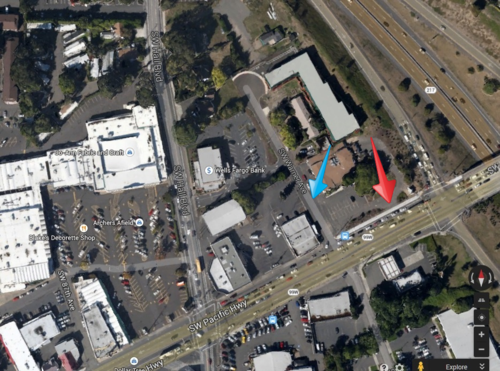
In an eminent domain action to improve Highway 99W in Tigard, Oregon, the DOT condemned Alderwoods’ two driveways, which had been in place since the 1930’s, which provided direct access to and from the property to the highway (approximate location red arrow). After it filed the action, however, the DOT purported to administratively eliminate the driveways because they were too close to the 99W/217 intersection to be safe. The trial court agreed with the DOT that the post-condemnation elimination meant that Alderwoods did not have a property interest in the two direct access driveways. The court prohibited Alderwoods from presenting evidence to the jury of the loss of value to its

Continue Reading Amici Brief: Property Owners Have Right Of Direct Access To Highways That Can’t Be Regulated Away

IMG_1534

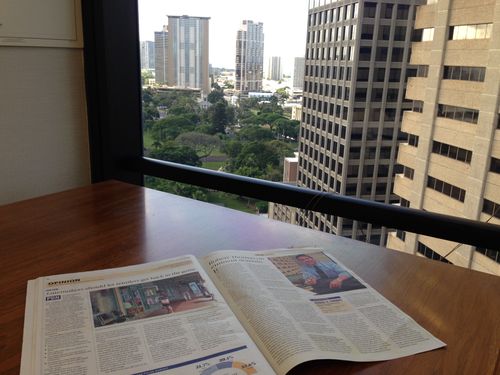
We can’t reproduce the entire interview, and the link to the online version is behind a partial paywall, but here are the highlights of a recent interview, where A. Kam Napier, the Editor-in- Chief of Pacific Business News, came by and chatted with us about eminent domain, property rights, and the Honolulu rail project.  

  • Robert H. Thomas thinks it’s no accident that the Fifth Amendment in the Bill of Rights protects not only the right to due process for people accused of a crime but also the same rights for people who own property the government would like to take. The right of the people to be secure in their private property was that essential to the Founders.
  • “’The Kelo decision was a direct result of the Midkiff decision, where essentially any public purpose that the government advances is going to be enough [to take the


Continue Reading Pacific Business News Report On Eminent Domain And The Honolulu Rail

In Coleman v. Mississippi Transportation Comm’n, No. 2013-CA-01161-SCT, the Mississippi Supreme Court addressed an issue we’ve been pondering lately, holding that evidence of the condemnor’s initial appraisal, its offer, and its deposit, were admissible when its appraiser presented a lower valuation at trial. The appraiser was also subject to cross-examination about why he lowered his valuation.

We’ve been pondering this issue lately, because the Virginia Supreme Court currently has under submission a case dealing with pretty much the same issue in which we filed an amicus brief, which argues for admissibility of this type of evidence. So naturally we think the Mississippi court came down on the right side of this question.

The court concluded that the property owner was entitled to introduce evidence of the condemnor’s initial offer and deposit of $380,300, and to cross-examine the Commission’s appraiser about why his trial testimony was that the property was

Continue Reading Condemnor’s Higher Initial Appraisal, Offer, And Deposit Admissible

A short one from the Florida District Court of Appeals, Florida Dep’t of Transportation v. Mallards Cove, LLP, No. 2D13-181 (Mar. 6, 2015), a regulatory takings case that followed on the heels of a straight condemnation.

The DOT condemned property belonging to Mallards Cove via Florida’s quick take procedure, by which certain agencies may obtain immediate possession and title, provided they deposit a good faith estimate of the land’s value with the clerk of the court. Under Florida law, the property owner’s right to just compensation is then vested, and two weeks later, the property owner withdrew the $2 million deposit. While the funds were on deposit, he clerk invested it, and under a Florida statute, 90% of the interest went to the DOT. The eminent domain case wrapped up, with the owner agreeing that the final judgment represented full compensation for the property taken.

But the owner wasn’t

Continue Reading Fla App: Quick Take Deposit Only Vests Owner’s Right To Compensation, Not To Specific Funds

Weird headline from KITV. No, owners whose property is taken for the rail aren’t “profiting” if they are able to get more for their land than what the condemning agency offered; “just compensation and damages” are required by the constitution, and if they are able to obtain more, in many cases that still leaves them undercompensated and simply means the condemnor’s offer was inadequate.

But besides the headline, KITV does a good report on last night’s community forum on property owners’ rights in eminent domain which we sponsored

Continue Reading Video: Report On Community Meeting On Property Rights And The Honolulu Rail

Have you ever read one of those opinions where each piece seems okay, but as a whole the result just doesn’t sit well? The Idaho Supreme Court’s opinion in State of Idaho, Dep’t of Transportation v. Grathol, No. 40168 (Feb. 11, 2015) is just one of those.

You’ve no doubt heard a lot about “eminent domain abuse” in the past few years, and that’s what seemed to fuel the opinion. Except here, it wasn’t abuse of the property owner by the condemnor, but rather the other way around: the overall vibe of the opinion was that the court wasn’t too pleased with the property owner’s approach. It determined the appeal was “extreme and unlikely” and assessed the property owner the attorneys’ fees and costs the government incurred on appeal.

It also concluded that the property owner may have interposed “extreme and unlikely” defenses in the trial court, even though

Continue Reading “Eminent Domain Abuse” Turnaround In Idaho: Property Owner Liable For Condemnor’s Attorneys Fees For “Extreme And Unlikely” Appeal And Defenses

This is the first of two posts today out of the Tar Heel State (here is the other one). 

North Carolina lawyers no doubt knew this, but we can’t say that we did: the North Carolina Constitution currently does not have a provision that mirrors the Fifth Amendment’s Takings Clause. 

According to these reports (“Eminent Domain bill passes committee” and “NC Lawmakers Look To Restrict Land Seizures With Constitutional Amendment“), the N.C. legislature is considering a measure to add the following text to the state constitution:

Sec. 19.1. Eminent domain.

Private property shall not be taken by eminent domain except for a public use. Just compensation shall be paid, and shall be determined by a jury at the request of any party.”

See the entire bill, and the related proposed amendment to state statutes (which takes out the words “use or benefit” from the

Continue Reading Who Knew? The North Carolina Constitution Doesn’t Have A “Takings” Clause

If you are a “public agency staff, an appraiser, or a right-of-way consultant” (or, we presume, a lawyer) in California, check this out: a free half-day seminar on eminent domain issues in Costa Mesa on Thursday, March 5, 2015, presented by the Nossaman law firm, the guys who produce the California Eminent Domain Report blog. 

Topics on the agenda: “Eminent Domain: Another Path to CEQA Challenges,” “Design-Build Project and Right of Way Acquisition,” “Public Projects and Business Losses: Who Gets What and When?,” and “Valuation, Cleanup Costs, and Other Scary Things: Acquiring Contaminated Property.”

Check it out and register here

Continue Reading Californians: Upcoming Eminent Domain Seminar, March 5, 2015 (And It’s Free!)

20150205_072910

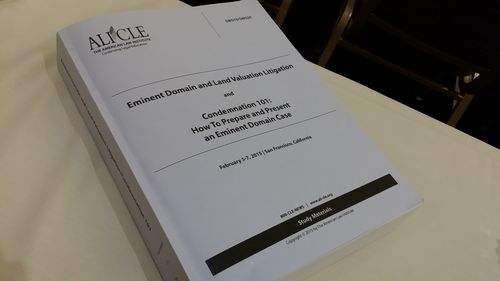
Here are the links from our opening sessions this morning:

It seems clear that the city and

Continue Reading Links From Day Two, ALI-CLE Eminent Domain Conference