20150204_161439 (1)

Here are the cases which I spoke about this morning at the 2015 ALI-CLE Eminent Domain and Land Valuation Litigation conference:

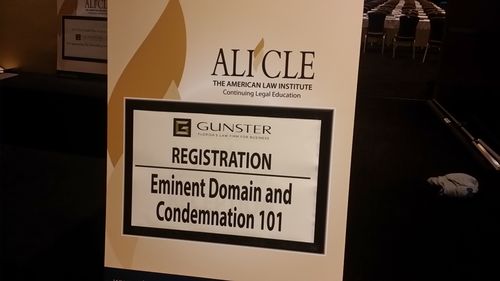
Here is our annual “proof of life” photo, the view from the dais. Proof

Continue Reading ALI-CLE 2015 Eminent Domain Conference: Links From Today’s Presentation
This is a longer post, but since we think this case may be going further and is worth watching, we’re going to hit it up in some detail.

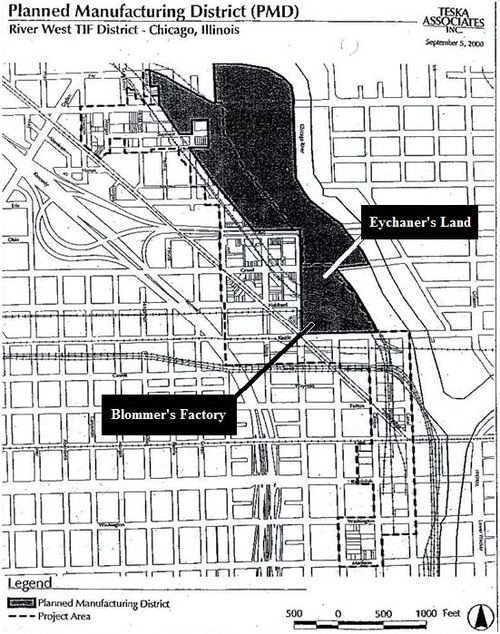
In City of Chicago v. Eychaner, No. 05L050792 (Jan. 21, 2015), the Illinois Appellate Court upheld the taking of private vacant land near the Chicago Loop (Eychaner’s Land on the map below) so that it could be transferred to the owners of a nearby chocolate factory (Blommer’s Factory).

The court viewed this “A-to-B” taking as merely a part of an area redevelopment and tax increment finance plan, which would keep the chocolate factory from moving out as the area gentrified.


1131833

The opinion contains a long recitation of the reasons for the taking, how the Planned Manufacturing District (PMD) was designed to “protect[] the 2,800 industrial jobs located in the area, [to] prevent[] residential encroachment on the existing manufacturing facilities, and

Continue Reading The Chicago Way: City Taking Non-Blighted Property For Economic Development Was Not Pretextual Because … Studies

AFTER

Here at invesecondemnation.com, we do our best to bring you timely decisons on cases of interest from around the nation and the world. But today we’ve outdone ourselves, because we have an opinion from the Connecticut Court of Appeals, issued … next week: Dep’t of Transportation v. Cheriha, LLC, No. 155AP144 (Jan. 27, 2015).

The case involved the condemnation of a parcel in New Britain at the intersection of Beaver and Washington Streets shown above in the “after” condition. The trial court did not allow the property owner to introduce the testimony of one Dr. Sheik Ahmed, who was prepared to testify that 17 months before the taking he had submitted a letter of intent to buy the parcel for a price even in excess of the property owner’s appraiser’s trial valuation. The court of appeals held that it was proper to exclude Dr. Ahmed’s testimony

Continue Reading Back To The Future With The Connecticut Court Of Appeals: Prospective Purchaser Cannot Testify As Expert About Valuation

20150117_084032

This could be your view, winging your way to San Francisco in a couple of weeks, to join us for the 2015 ALI-CLE Eminent Domain and Land Valuation Litigation Conference (and the concurrent Condemnation 101 program), at the Hotel Nikko, February 5-7, 2015. 

There’s still a few spaces left, and time to register. We’re the co-Planning Chair of the Eminent Domain and Land Valuation Litigation program along with Joe Waldo, and we’ve assembled an exciting agenda, presented by a faculty comprised of the nation’s best-of-the-best in our field of law.

Winter in San Francisco is the one time of the year when you are likely to not be fogged in, and in addition to the 2 and a half days of programming, there are networking and social events so you can get to know your colleagues and the faculty better.

Please come and join us, if you

Continue Reading Still Time To Join Us For The 2015 ALI-CLE Eminent Domain Programs In San Francisco

It’s been accepted for such a long time that it’s become one of those things that “everyone knows we’ve always done it that way,” but most probably don’t quite know why that is so: if you have to sue the United States for a regulatory taking or inverse condemnation, you go to the Court of Federal Claims.

In the CFC, just compensation determined isn’t determined by a jury, nor is your case presided over by an Article III judge. In other words, your case is wholly decided by a judge with a 10-year appointment who technically is an employee of the Executive branch, instead of your peers and a guy or gal with life tenure, who is independent and in the Judicial branch. 

Comes now a complaint, filed in the United States District Court for the Western District of Michigan earlier this week, that one would normally expect

Continue Reading Right To Compensation Self-Executing: Property Owners Entitled To Jury & Article III Judge In Federal Inverse Cases

On Maui today to argue an eminent domain case, so haven’t had a chance to post up a new opinion. But in our down time between hearings and flights, we were able to do some reading of our colleagues’ stimulating blog posts. Check ’em out:


Continue Reading Blog Posts We’re Reading Today: TransCanada, Admissibility Of Value Statements, HRAP Amendments Proposed

Here’s the property owners’ Reply Brief in Ramsey v. Commissioner of Highways, a case currently pending before the Virginia Supreme Court. 

This is the case about Virginia’s statutory requirements in eminent domain cases. As 

a prerequisite to a court exercising jurisdiction over a condemnation complaint, a state condemning agency must as an initial step present a statement of “the amount which [the condemnor] believes to be just compensation,” to the property owner, and must include an appraisal if an appraisal is required. 

The trial court viewed the required “statement” as a settlement offer, and prohibited the property owner from both telling the jury about the statement, and cross-examining the state’s appraiser about it. Even though the state’s initial statement of just compensation was $246,292, and later, its new appraiser at trial testified that just compensation was only $92,127. 

Disclosure: we filed an amicus brief in support of the property

Continue Reading Final Brief In Virginia Supreme Court Eminent Domain Case: DOT’s Precondemnation Statement Of Value Is Admissible

Despite its caption, the opinion of the Texas Supreme Court in Wheeler v. Enbridge Pipelines (East Texas), L.P., No. 13-0234 (Aug. 29, 2014) isn’t another one of those can-they-or-can’t-they pipeline cases.

But it’s a case that takings mavens might find intersting anyway, because the court sets out how a property owner is compensated for the destruction of trees.  

Enbridge wanted to construct its pipeline on Wheeler’s heavily wooded property, used by the family as a retreat. Wheeler agreed to a right of way, “but insisted that Enbridge install the pipeline by boring underground in order to preserve the trees on the property.” Slip op. at 2. Seems reasonable to us. Enbridge specially approved the condition. Despite these precautions, however, Enbridge damaged Wheeler’s trees: 

Soon after the parties executed the agreement, Enbridge hired a construction company to build the pipeline, but failed to inform the contractors about

Continue Reading How To Value Trees In Texas

Under Nebraska eminent domain law, the condemnor is required to make a “good faith” effort to negotiate with the property owner before it files an eminent domain action. See Neb. Rev. Stat. § 76-704.01(6).

In Camden v. Papio-Missouri River Natural Resources District, No. A-13-266 (Aug. 26, 2014), the court concluded that the condemnor had not made these efforts. Here’s what occurred:

  • The NRD contacted the property owners, and made an offer of $67k for the desired easements.
  • The owner said “from now on, talk to my lawyer.”
  • The NRD did so, and sent the owners’ lawyer a revised proposed purchase agreement.
  • The owners, through their lawyer, rejected the offer. They valued the loss at $750k.
  • The owners also proposed an alternative to only monetary compensation.
  • The NRD responded that the counteroffer was unresonable, and thus stafff would not recommend the NRD board accept it, but suggested the


Continue Reading Neb App: Condemnor Did Not Make Jurisdictional Good Faith Effort To Negotiate

Clark v. Titus County, No. 06-14-00035 (Sep. 19, 2014) is a somewhat civil procedure oriented opinion, specifically about Texas’ “no-evidence” motion for summary judgment. But it’s a condemnation case, and there’s some good background from the court about the eminent domain process in Texas courts and how appraisers calculate fair market value.

Under Texas civil procedure, a “no-evidence” motion is based on the utter lack of evidence to support an essential element of the other side’s claim. The county filed such a motion, arguing that the property owners did not submit a “scintilla of probative evidence” about the taken property’s fair market value, specifically the value of fencing. Thus, the county asserted, the court was bound to accept the county’s valuation in its appraiser’s testimony, which among other things, was based on his estimate of the cost of fencing.

The court of appeals reversed. Although the owners did not

Continue Reading Tex App: “No-Evidence” Summary Judgment Wrongly Granted Where Property Owner Undercut Appraiser’s Assumptions