Callies_book
by David Lee Callies

Coming soon (August), a new book from lawprof David Callies on what might be our favorite subject, regulatory takings.

We had a chance to review the proofs, and we highly recommend this one for your bookshelf. We’ll bring you more once published. But for now, you can reserve your copy here.

Here’s the description:

Regulatory Takings after Knick summarizes the Supreme Court’s recent decision in Knick v. Township of Scott which does away with the state action prong of the Court’s former ripeness test and what it means for the law of regulatory taking of property. It emphasizes total takings after Lucas v. South Carolina Coastal Commission and the exceptions which permit government to so strictly regulate property as to permit no economically beneficial use of it.

The Supreme Court’s recent decision in Knick v. Township of Scott has been aptly described by some commentators


Continue Reading New Book Coming In August: Regulatory Takings After Knick by David Callies

20160114_125445

Here’s the latest in a case we’ve been following for what seems like forever. This is also a fact situation that has resulted in litigation in a variety of different fora, and at times has seemed like the final exam question in a Federal Courts law school class. We wrote about this latest phase — the issues raised by the Ninth Circuit’s opinion — in this article, even.

We won’t go into the background of the case, but if you are interested, you can find out more at this post (“What Constitutes a Loss“). The property owner has also summarized the situation thusly:

The State of Hawaii zoned for agricultural use land that it knew was not viable or appropriate for such use. At the property owner’s request, it rezoned it for urban use but, after Plaintiff Bridge Aina Le‘a began developing it, the State

Continue Reading New (Mike Berger) Cert Petition: “This case is the proverbial ‘Exhibit A’ of much that is wrong [with takings law].”

KingStreet

Breaking! In H.C. Cornuelle, Inc. v. City and Cnty of Honolulu, No. 14068 (Haw. July 17, 1990), the Hawaii Supreme Court held that the City and County of Honolulu inversely condemned a strip of private property in downtown when it prohibited development and use of that land because the City intended to acquire it in the future for a road-widening project.

Wait, what? “Breaking,” you say? This memorandum opinion was issued nearly 30 years ago. What gives? Well, we remember this case from back in the day when we were just starting out, but had long forgotten about it. Plus, the same case resulted in one of the first post-Williamson County Ninth Circuit opinions, because the landowners originally sued for the taking in federal court, but were bounced out for ripeness. So they tried the takings case in a Hawaii state court. The Hawaii Supreme Court’s opinion

Continue Reading HAWSCT: City’s Prohibiting Use Of Property Pending City Acquisition Is Land Banking Taking

104481738_2170057539806372_2938554143515873721_nphoto: Patricia Salkin

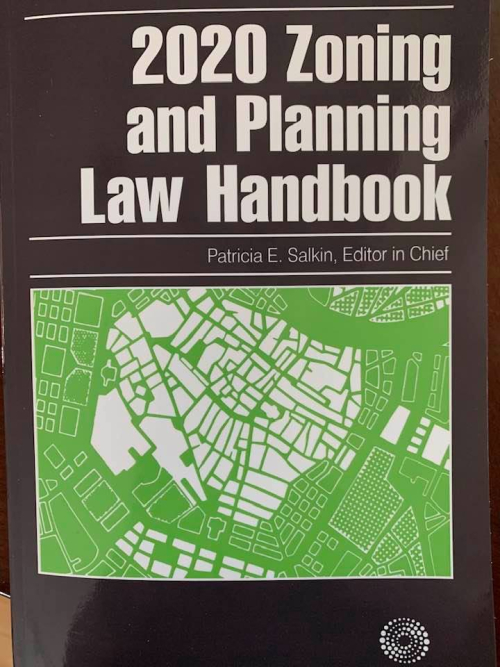
Just published: the 2020 Zoning and Planning Law Handbook (Green Book). The first section of the Summary of Contents is about Takings, and includes as the lead piece Professor Gideon Kanner and Michael Berger’s tour-de-force article, “The Nasty, Brutish, and Short Life of Agins v. City of Tiburon.” It also includes my articles on Murr, “Restatement (SCOTUS) of Property: What Happened to Use in Murr v. Wisconsin?”

Check it out. The Green Book is a one-stop shop for the best articles on land use in a given year, and this edition includes chapters on housing, agriculture, cell tower placement, RLUIPA, and (of course) zoning.

Our thanks to Dean Patty Salkin who edited the volume for including us.

Summary of Contents, 2020 Zoning and Planing Law Handbook (Green Book)

Continue Reading Available Now: 2020 Zoning and Planning Law Handbook (Green Book)

On one hand, the Colorado Supreme Court’s opinion in Forest View Co. v. Town of Monument, No.18SC793 (June 8, 2020), concluding that a restrictive covenant is not a property interest that the government needs to pay for conflicts with the decisions on similar facts from other jurisdictions (Kansas, for example). On the other, the ruling is nothing new under Colorado law, because the court didn’t announce a new rule, but simply refused to overrule a prior case holding the same thing, Smith v. Clifton Sanitation Dist., 300 P.2d 548 (Colo. 1956).

Town wants to build a water tower. Seems like a reasonable goal. It purchased property, another reasonable thing. The property it bought, however, was subject to a covenant, running in favor of the neighboring property owners, that the owner couldn’t use the property for anything other than single-family homes. Last time we checked, single-family homes

Continue Reading Negative Easements Such As Restrictive Covenants Still Are Not Property In Colorado. tl;dr: We Can’t Afford To Consider These Things Property

Here’s the latest complaint that alleges a taking arising out of the coronavirus situation. It joins a long list of similar lawsuits (See here, here, here, here, here, here, here, here, here, here and here, for example.

This one challenges the State of New York’s executive order that bars property owners from pursuing residential evictions for nonpayment of rent and requires the owners to apply security deposits towards rent.

Some interesting elements in the case:

  • The complaint was filed in federal court against the Governor.
  • It avoids the Eleventh Amendment issue by not seeking compensation, only declaratory and injunctive relief.
  • Does that raise the issue of whether such relief is available for a taking?

Stay tuned, this isn’t going to be the last of these things. We wrote up how we think these type of claims should be handled

Continue Reading Latest Coronavirus Complaint: NY State’s Order Suspending Evictions Is A Taking

Here’s the latest in a case we’ve been following (briefs here, and oral argument recording here).

Any eminent domain lawyer will tell you that loss of access cases can be difficult. In some jurisdictions, you have to lose all access before the court will consider you harmed. Or the courts see a difference between a loss of “direct” access versus “circuitous” access. All we know is that from an owner’s perspective, access to the property can be a key element of its value.

The big question in these cases is who gets to decide: the judge or the jury? And many courts for whatever reason (fear of jury compensation verdicts, perhaps?) cut off the inquiry with bright line no-compensation rules that seem designed more to reserve for judges the critical questions than to facilitate a searching inquiry to whether the property owner has truly suffered a loss

Continue Reading In Virginia, Where The Baffled Courts Now Compose “Major” vs. “Minor” Streets

WMdoor2

This fall, we’ll be back at the William and Mary Law School (hopefully in-person, depending on the circumstances and the yet-to-be-announced approach to be taken by the College of William and Mary), teaching two of our favorite subjects.

Not only will this be the third time leading Eminent Domain and Property Rights (Law 608), but we’ll also be undertaking another subject, Land Use Control (Law 425). This semester, we’re stepping into the (big, figuratively speaking) shoes of Professor Lynda Butler who recently retired after a stellar and trailblazing career. Thankfully, Lynda is continuing to lead the Brigham-Kanner Property Rights Project and is underway with planning October’s Brigham-Kanner Conference, honoring Harvard lawprof Henry Smith.

Land Use is, of course, related to Eminent Domain and Property Rights, but the law school understands that they are each worthy of separate study, and they should not be folded into a single course (or

Continue Reading Land Use Also On The Fall Semester Agenda At William And Mary Law

In City of Chicago v. Eychaner, No. 1-19-1053 (May 11, 2020), the Illinois court of appeals revisited a case that it ruled on once before. 

Five years ago, in City of Chicago v. Eychaner, 26 N.E.3d 501 (Ill. Ct. App. 2015), the same court held that a redevelopment taking of Eychaner’s property qualified as a public use. We won’t go into the details of facts or that opinion’s reasoning. Instead, we’ll refer you to our summary, analysis (and criticism) of the opinion here (“The Chicago Way: City Taking Non-Blighted Property For Economic Development Was Not Pretextual Because … Studies“). After approving the taking, the court remanded the case for a determination of the compensation owed.

Flash forward. On remand, the jury determined just compensation was $7.1 million. Also while the case was remanded, the City changed its redevelopment plans. You know, the basis for the court

Continue Reading Illinois App: We Haven’t Changed Our Mind – Chicago’s Sketchy Redevelopment Taking Is Still For Public Use