We’re going to end 2018 with the latest in what we think was the most important issue of the past year (and which, we predict, will be the most important case in takings law for at least a decade when it likely gets decided in 2019), Knick v. Township of Scott, No. 17-647.

That case, as you well know, asks whether a property owner who alleges that a local government action has taken property but hasn’t paid the required just compensation is entitled to bring a lawsuit seeking just compensation under the Fifth and Fourteenth Amendments in a federal court.

Thirty years ago, in Williamson County, the Supreme Court said no. Or at least not until the owner has first pursued compensation via a state’s available procedures to recover compensation, assuming such procedures exist. Add to the mix the rules of preclusion and full faith and credit —
Continue Reading Wrapping Up 2018, And Previewing 2019’s Most Important Case: Final Briefs In Knick v. Township Of Scott

Here’s the final brief for Ms. Knick, replying to the Township’s and the Solicitor General’s supplemental letter briefs.

It’s very short, so you should read it yourself. But here’s what we think is the highlight:

Williamson County is irreconcilable with the traditional view that a Takings Clause claim accrues (and is actionable in federal court) the moment government injures property without securing compensation. The Solicitor General ultimately concurs. SG Suppl. Brief at 6. Williamson County is also irreconcilable with the original understanding of Section 1983 as a law opening federal courts to unconstitutional takings suits, Monell v. Dep’t of Soc. Servs. of City of New York, 436 U.S. 658, 687, 687 n.47 (1978), and with exhaustion of remedies doctrine.

Br. at 4. 

Ms. Knick’s argument focuses — correctly, we think — on Kirby Forest Industries, Inc. v. United States, 467 U.S. 1 (1984), pointing out that “[s]ignificantly, a suit

Continue Reading Knick’s Supplemental Reply Brief: Injury To Property Triggers Right To Come To Federal Court

Earlier this week, we spoke to Howard Mansfield, author of the recently-published book “The Habit of Turning the World Upside Down – Our Belief in Property and the Cost of That Belief.”

His book is about property, property rights, and how these ideas are processed by the American psyche. But instead of the usual scholarly (and very often dry) treatment of these topics that we might expect – especially those of us in the legal and academic world – Mr. Mansfield takes a slightly different approach. He relates stories of how property fits in with the culture – the different and often competing narratives that are attached to the notion of property – and the often-contradictory way in which we in the United States view the idea of ownership and possession.

Listen to our interview above (Sound Cloud stream), or if that does not work for you

Continue Reading Audio: Our Interview With Author Howard Mansfield – “The Habit of Turning The World Upside Down – Our Belief in Property and the Cost of That Belief”

20181004_152311_HDR

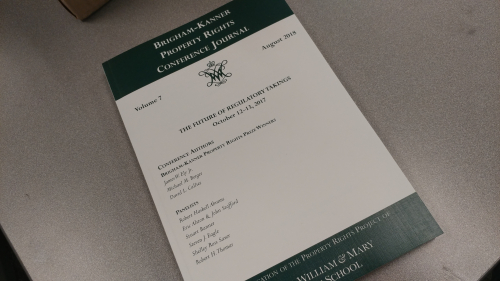
Every year, at the Brigham-Kanner Property Rights Conference, the conference publishes a law journal with the articles, essays, and remarks presented at last year’s conference. So it was this year, and Volume 7, with the theme of “The Future of Regulatory Takings,” is now available

We contributed an essay, “Back to the Future of Land Use Regulation,” which focuses on the rational basis test in land use law — where it came from and where it might be going — as well as some other current issues in property law such as the recent trend of raising general environmental concerns as property claims. Check it out if you are so inclined. 

Here’s the Introduction:

As always, I bring you greetings from the land of Midkiff, the land of Kaiser Aetna. The jurisdiction in which the legislature thought it was a good idea to try and

Continue Reading New Article: Back to the Future of Land Use Regulation – From Hadacheck To “New” Property

Would you pay, say $10 for an undeveloped Maui beachfront parcel that is zoned for hotel and residential purposes, but currently is not developable because the County in the past wanted to condemn the land and turn it into a public park (but then ran out of money)?

In furtherance of its acquisition plan, the County changed the parcel’s Community Plan (known as a “general plan” in most jurisdictions) designation to “park.” But it never amended the Hotel zoning, which allows lesser intensive uses such as single-family homes. But then the County didn’t have enough money — beachfront property, it turns out, was (and is) a lot more spendy than the government appraisers thought — so it never actually acquired the land. But having downplanned the parcel in order to take it, it never bothered uplanning it when it couldn’t: the County never reverted the CP designation to its former

Continue Reading New Amicus Brief In SCOTUS Hawaii Case: Takings Is About Denial Of *Use* Not Whether Property Has Value

Whatisthis

From Reno, Nevada colleague Steve Silva, comes this contribution to our growing collection of Knick/Williamson County-related memes.

Congratulations if you get this without having to do research. If so, you are a True Takings Nerd (and a nerd generally).

For those of you who are not quite getting it, here is the breakdown:


Continue Reading Friday Takings Fun: More Knick Memes

20181002_154246_HDR (1)

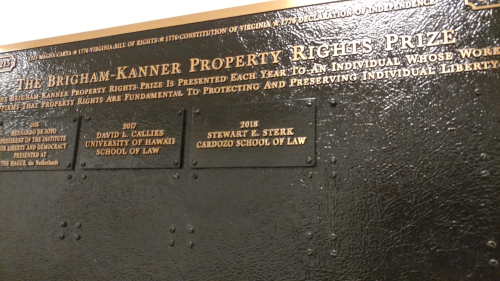
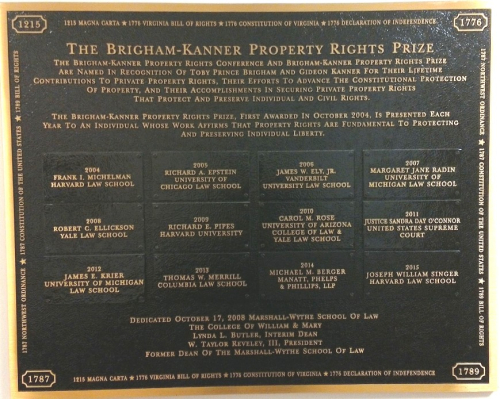
Last week, the 15th Annual Brigham-Kanner Property Rights Conference saw the gathering of legal scholars, judges, lawyers, and law students at the William and Mary Law School to award the B-K Property Rights Prize to Cardozo lawprof Stewart Sterk, followed by a day-long conference focusing on Professor Sterk’s work and the latest developments in property rights law.

Professor Sterk joins the pantheon of property law scholars (and a judge and a practitioner) who have been awarded the Prize. Pretty impressive:

WIN_20151002_13_15_51_Pro

As always, the program starts off with a candlelight dinner and award presentation in the historic Wren Building, definitely a highlight of the Conference. More about the Conference here

And there’s nothing like spending the following day addressing some of the most pressing issues in our area, along with the brightest minds in the business (below is the final panel of the day, with Professor John Echeverria

Continue Reading 2018 Brigham-Kanner Property Rights Conference Report: Emerging Issues

20181003_114518_HDR

Seeking A Cause of Action

It has been just under a century since the U.S. Supreme Court first recognized (in the modern era, that is) the regulatory takings doctrine. You might think that the intervening decades would be enough time to allow the Justices, collectively, to have figured out what a cause of action looks like. You know, just enough to get by a motion to dismiss for failure to state a claim under Rule 12(b)(6).

Unfortunately, yesterday’s oral arguments in Knick v. Township of Scott, No. 17-647 (transcript here, and below), would not confirm that belief.

Our major impression from the argument is that no more than three Justices clearly understand the major difference between an affirmative exercise of the eminent domain power to take private property, and an inverse condemnation action in which a property owner asserts that the exercise of a power other than

Continue Reading Oranges And Tangerines – The Difference Between Eminent Domain And Inverse Condemnation: Deconstructing The Knick Oral Arguments

20170918_192854

Just out of the Knick arguments. Full report to come later. But for now, these thoughts:

College of Surgeons – D.O.A. I think there’s a consensus to overrule the case to the extent it allows municipalities to remove takings cases to federal court. 

San Remo – On life support. I think also that there may be enough votes to overrule the Catch-22 aspects of that case and the preclusion/full faith and credit trap. 

Here’s the federal government’s position, in a nutshell:

2j7vra

Justice Kagan, like us, found that distinction hard to swallow. 

Justice Bryer quote of the day: “why not let sleeping dogs lie?” (Asking about stare decisis.)

As for the “big” issue of whether the Court will overrule Williamson County? Too close to call. We didn’t see an obvious majority forming around anything but overruling Chicago and San Remo. No Justice seemed to like Williamson County too much (except

Continue Reading Meanwhile Back At 1 First Street … Hot Take On The Knick Arguments

6a00d83451707369e20223c85004e4200c-800wi

I’m not going to do an in-depth preview of tomorrow’s Supreme Court oral arguments in Knick v. Township of Scott, No. 17-647 for several reasons.

First, a lot of others have summarized the issues already, far better than I can. See the list below.

Second, I filed an amicus brief in the case in support of Ms. Knick, and that brief pretty much sums up my thinking about the case. Williamson County ripeness is something I’ve railed on for a while, and there’s no need for me to say it once again.

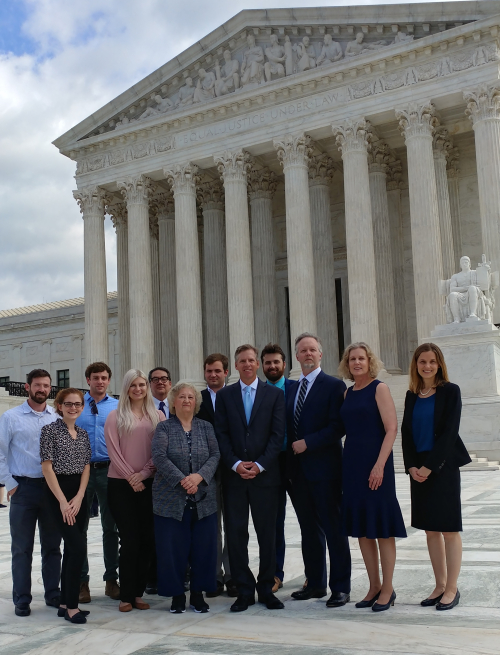
Finally, I’m attending the arguments tomorrow with my William and Mary Law class, (they get to see the sausage being made!) and am keeping my powder dry for a post-argument report from the scene. 

First, the previews, followed by some brief thoughts:

  • Read the merits and amici briefs (all 21 of them!) here 


Continue Reading Knick Preview: Reevaluating Williamson County Ripeness With An Eight-Justice Court – Just How Badly Can SCOTUS Screw Up Takings Law?