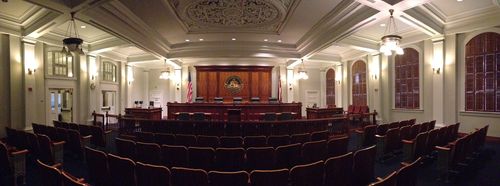
Our colleague and co-planning chair Joe Waldo was in town yesterday, so we walked through historic Williamsburg, Virginia (cradle of the Constitution and the Bill of Rights), to invite you to join us for the 36th Annual ALI-CLE Eminent Domain & Land Valuation Litigation Conference (January 24-26, 2019, in Palm Springs, California).

As we wrote in this post, the Conference will feature the nation’s best eminent domain faculty, presenting on the topics we love.

Register now here. Early registration and group discounts available. The 2018 Conference in Charleston sold out, so be sure to sign up now so you don’t miss out. Continue Reading Join Us For The 36th Annual ALI-CLE Eminent Domain & Land Valuation Litigation Conference In Palm Springs (Jan 24-26, 2019)
One more lesson on the speed of the interwebs: we were all set to take a deep dive into the California Court of Appeal’s opinion in an inverse condemnation case, Bottini v. City of San Diego, No. D071670 (Sep. 18, 2018), when our colleague Brad Kuhn analyzed the case at his California Eminent Domain Report blog. 

The title of Brad’s post, “Improper CEQA Determination Does Not Trigger Regulatory Taking,” tells you most of what you need to know. The short story is that the City asserted that Bottini’s planned demolition of a beach bungalow as part of a project to build a new house required assessment and analysis under California’s environmental reporting statute, CEQA (California Environmental Quality Act). Bottini disagreed, asserting the demolition was exempt from CEQA, and, by the way, the delay caused by the City’s wrongful assertion of CEQA authority was a temporary taking. 

Continue Reading Cal App: Landgate’s “Substantially Advance” Standard Isn’t The Takings Test (But The Property Owner Still Loses)

BK header

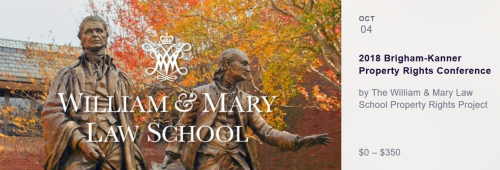
Come join us for one of the best conferences on property rights and property law at the 2018 Brigham-Kanner Property Rights Conference, October 4-5, 2018 at the William and Mary Law School in Williamsburg, Virginia.

Register here

We’ve attended and presented at the Conference in past years, including when it went international in Beijing and at the World Court in The Hague. This year it is back home, and will focus on the work of the 2018 B-K Prize winner, Professor Stewart Sterk of Cardozo Law School

The B-K Prize is awarded to a legal scholar, judge, or practicing lawyer who “has advanced the cause of property rights and has contributed to the overall awareness of the important role property rights occupy in the broader scheme of individual liberty.” The list of past prize winners is a pantheon of property law greats. 

We will be speaking

Continue Reading 2018 Brigham-Kanner Property Rights Conference: Williamsburg, Oct. 4-5, 2018

Ah, the speed of the interwebs: we were all set to write something up about the California Court of Appeal’s recent opinion in Black v. City of Rancho Palos Verdes, No. B285135 (Sep. 6, 2018), when our friend and colleague Bryan Wenter beat us to it.

His post, “Court Rejects Residents’ Takings Lawsuits for Failure to Exhaust Administrative Remedies” pretty much tells the story. This same court a decade earlier concluded the City’s earlier version of a development moratorium was a Lucas taking. As Bryan writes,

Based on their interpretation of Monks II [that 2008 decision noted above], none of the landowners even filed an application for an exclusion from the moratorium. Instead, the landowners argued that Monks II absolved them of the need to exhaust administrative remedies or, alternatively, that exhausting administrative remedies would be futile.

Because the City might allow development if the owners

Continue Reading Cal App: No Taking For Development Moratorium Because Owners Had Not Asked For Development Permits

20180126_111558_HDR

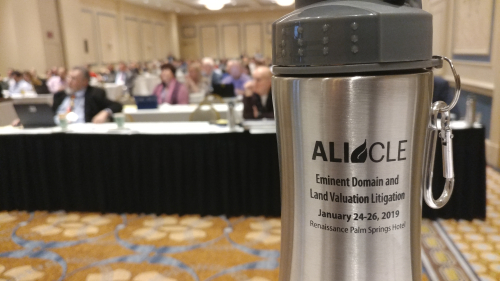
You’ve known for a while that Palm Springs, California, specifically the Renaissance Palm Springs Hotel (a resort facility, but right in town, so you will have many options for “off campus” activities like art museums, the aerial tram, golf, and whatever suits your fancy, and close-in to the Palm Springs Airport), is the venue for our 2019 ALI-CLE Eminent Domain and Land Valuation Litigation, January 24 through 26, 2019.

Of course, you also knew that the programming would be the usual spread of topical and cutting-edge topics, presented by some of the nation’s experts. But we didn’t give you the details. So here are some of the programs we’re having: 

  • Keynote Address: “Property Rights: Foundation for a Free Society” – Taylor Revley, most recently the past President of the College of William and Mary, and also former law school Dean (as well as a


Continue Reading ALI-CLE 2019 Eminent Domain And Land Valuation Litigation Conference, Palm Springs Agenda – Register Now!

Here’s a short but interesting one from the U.S. Court of Appeals for the Sixth Circuit. It isn’t exactly about the usual topics we cover, but is interesting enough that we thought we would post it. 

The case involves old deeds (dated between 1922 and 1957) in the Adams County, Ohio recorder’s office, which contain unenforceable racially restrictive covenants. (You remember back in law school where you learned that these things can’t be enforced because the Supreme Court in Shelley v. Kraemer, 334 U.S. 1 (1948) prohibited courts from doing so, even if the contracts were private.)

The plaintiffs in Mason v. Adams County Recorder, No. 17-3605 (Aug. 28, 2018) objected to the objectionable deed language remaining on public record in the recorder’s office:

Mason maintains that the practice of county recorders to permit documents with restrictive covenants in the chain of title to be recorded or

Continue Reading Damnatio Memoriae Be Damned: “Feeling Unwelcome” By Old Deeds With Racially Restrictive Covenants Isn’t Enough For Article III Standing

Back in April, we posted the Florida District Court of Appeal’s opinion in a case where landowners sued the state fish and wildlife commission because “deer dog hunters and their dogs” who had hunting licenses trespassed on the plaintiffs’ lands. The court, over a single judge dissent, affirmed the dismissal of the takings claims, because the physical invasions by the hunters and their dogs were not caused by the commission. 

The property owners sought rehearing, and although the majority revisited and revised the opinion, it didn’t change the outcome, which stayed the same. In Florida Fish and Wildlife Conservation Comm’n v. Daws, No. 1D16-4839 (Aug. 16, 2018), the court amended the majority opinion to clarify its takings analysis. 

We won’t go into a page-by-page redline (for a direct comparison of the two opinions, go here), but the opinion’s biggest change was a section in which the majority

Continue Reading Fla App: Takings Dog Still Doesn’t Hunt

Challenging an ordinance that the court characterizes as an “even-handed” zoning regulation, even if it outlaws an existing conditional use, is going to be a tough one for a plaintiff. In theory, it need not be, given the right conditions. But any zoning lawyer will tell you that it is tough to overcome most courts’ presumption that these things are ok. That’s just the way it is. 

The Minnesota Court of Appeals’ opinion in Minnesota Sands, LLC v. County of Winona, No. A18-0090 (July 30, 3018), confirms that vibe. There, the county adopted an ordinance that banned all “industrial-mineral mining, including silica-sand mining.” Slip op. at 1. If that sounds oddly specific, the backstory is that this is the stuff used in fracking. 

Mr. Frick (and here you might think we’d try to work in both “Frick” and “frack” into this post’s title) owned leases to mine silica-sand on

Continue Reading Ordinance Banning Industrial Mineral Mining Not A Regulatory Taking – But What About Palazzolo?

Photo

One of the problems with high-public-profile cases like the multiple challenges to the “Thirty Meter Telescope” up on the top of the Big Island’s Mauna Kea, is that when the court issues an opinion, the public focuses only on the result, mostly from a policy perspective. Who won? Did the court invalidate the TMT permits? Did it side with the “right” party? 

We get that. Big cases make big headlines, and most people don’t care much about what the decision might mean for the law and future cases. And it matters in these type of cases who won. 

But those of us down here in the trenches look at these cases somewhat differently. Yes, the Hawaii Supreme Court’s long-awaited opinion in the latest phase of the multiple litigations challenging the TMT has dropped, and as you might have figured from this post’s headline, the court sided with the telescope and

Continue Reading Hawaii Telescope – Been There, Done That: Cultural Property Ownership Gets You Only A Public Hearing If You Have Other Chances To Make Your Case

Doesnotsimply

We already knew from its amicus brief brief that the federal government supported the property owner in Knick v. Township of Scott, No. 17-647, the case in which the US. Supreme Court agreed to review the continuing validity of the “state procedures” rule of Williamson County Regional Planning Comm’n v. Hamilton Bank, 473 U.S. 172 (1985). The SG’s brief called for the Court to vacate and remand the dismissal of Knick’s case. We also filed an amicus brief in support of Ms. Knick

But recently, the feds have doubled down by filing a motion to participate in oral argument and to split time with the Petitioner, which notes:

The United States has filed a brief as amicus curiae supporting vacatur and remand. The brief argues that Williamson County correctly recognized that the Fifth Amendment does not “require that just compensation be paid in advance of, or

Continue Reading Federal Govt: Reject Williamson County! Property Owners Whose Property Is Taken By Local Governments Should Be Able To Enforce Fifth Amendment Rights In A Federal Forum