


BK 2022

There’s still space for you to join us — preferably in-person, but remotely if that is not possible for you — at the 19th Annual Brigham-Kanner Property Rights Conference, September 29-30, 2022, at the William and Mary Law School in Williamsburg.

The American Law Institute was kind enough to post a notice about the Conference and the ALI members who are on the speaking faculty here.

Registration for the Conference is ongoing, and you can sign up here. Here is the full agenda. (We’ll be speaking on Panel #2, “Reshaping the Framework Protecting Property Under the Roberts Court.”

In our opinion, the Conference is the best of its kind, and brings together legal scholars and the practicing bar to talk dirt law. So please come join us.Continue Reading Registration Underway – 19th Annual Brigham-Kanner Property Rights Conference (Sep 29-30, 2022)
You’ll definitely want to check out the U.S. Court of Appeals for the Third Circuit’s opinion in Makrilov v. City of Jersey City, No. 21-1786 (Aug. 16, 2022).

Not because it reaches any earth-shattering conclusions — the opinion unsurprisingly concluded that the city’s restricting (but not eliminating) short-term rentals (less than thirty days) was not a taking — but primarily because of the interesting concurring opinion.

So here’s the story. At one time, the city thought that renting residential property for less than thirty days was a good thing, believing that short-term renting “incentivize[d] investment and development in Jersey City.” Slip op. at 3. The city even adopted an ordinance affirmatively legalizing STRs as permitted accessory uses in residential zones. A property owner didn’t even need to obtain a permit, as long as the operation was small-scale (the owner did not have more than five units it rented).

But

Continue Reading Penn Central May Be A “Fuzzy” Test, But What Is A Court Doing Weighing The Factors?

Check out the U.S. Court of Appeals for the Second Circuit’s opinion in Village Green of Sayville, LLC v. Town of Islip, No. 19-3353 (Aug. 5, 2022), a case in which the court held the Town reached a final decision denying Village Green’s request to develop a 64-unit apartment complex on Long Island.

Final decision ripeness under the surviving part of Williamson County, you say? So this is a takings case, right? No, not quite. The claims asserted by the developer  included a takings claim (although it seems to have played a more minor role) and the claims were mostly about the Town allegedly discriminating against affordable housing and the people who build and live in affordable housing. See slip op. at 11.

But as you know, many courts — including the Second Circuit — apply Williamson County’s final decision ripeness requirements to anything vaguely land usey.

Continue Reading CA2: Land Use Challenge (Not Takings) Is Ripe – Govt Gave Its Final “No”

Today’s a busy day, so we can’t lay out the details of the Texas Court of Appeals’ opinion in City of Dallas v. Trinity East Energy, LLC, No. 05-20-00550-DV (Aug. 1, 2022). But we want to post up the decision and urge you to read it because it is a rare bird: not only did the property owner win a takings claim at trial – the verdict survived appellate review.

The takings claims (Lucas and Penn Central) were based on the city’s denial of a Special Use Permit. The city argued that its denial of the SUP for the desired drilling locations did not cut off completely the owner’s ability to access the minerals, since there were other ways to get at them. Here’s what happened at trial:

The trial court found that other than the drill sites proposed in Trinity’s three SUP requests, “Trinity did not

Continue Reading Tex App: Property Owner’s Penn Central Verdict For Drilling Permit Denial Is OK By Us

Is there a more appropriate place at which to study property rights and dirt law than William and Mary Law School? After all, it is a stone’s throw from Jamestown, the place where there’s a good argument the concept of property law and property rights first took hold in the New World. As noted by author David Price in “Love and Hate in Jamestown – John Smith, Pocahontas, and the Start of a New Nation” –

The introduction of private property for the common citizen had a salubrious effect on the owners’ sense of initiative, as John Rolfe would observe. By the end of 1619, he reported, the “ancient” (or longtime) colonists had chosen their allotments, “which giveth all great content, for now knowing their owne lande, they strive and are prepared to build houses and to cleare their grounds ready to plant, which giveth …

Continue Reading Ye Olde Law 608: Eminent Domain & Property Rights, S5E1 @ William & Mary Law

Here’s the latest in a case we’ve been following.

In City of Oberlin v. FERC, No. 20-1492 (July 8, 2022), the U.S. Court of Appeals for the D.C. Circuit held FERC adequately explained why, in granting a certificate of public convenience, it relied in part on evidence that some of the natural gas in the pipeline was slated to go to Canada. 

Earlier, the court held FERC had not explained why well enough (or at all), and sent the case back down to give FERC the chance to do so. The handwriting was on the wall in the remand order because the court pointedly did not vacate FERC’s order granting the certificate: “we remand without vacatur, because we find it plausible that the Commission will be able to supply the explanations required, and vacatur of the Commission’s orders would be quite disruptive, as the Nexus pipeline is

Continue Reading DC Circuit OK’s Pipeline That’s Already Built

Screenshot 2022-07-07 at 13-44-38 The Brigham-Kanner Property Rights Conference

By now, you know that the 19th Brigham-Kanner Property Rights Conference is set for September 29-30, 2022, at the William and Mary Law School in Williamsburg, Virginia (register here – space is limited – fee ranges from free to $195 – a bargain!). And you know that our colleague Jim Burling is this year’s B-K Prize winner.

But now you know who is speaking at the Conference, and the topics: here’s the full agenda. The list of speakers is too long to list here but check out these topics:

  • Panel 1: The Importance of Property Rights: A Tribute to James S. Burling
  • Panel 2: Reshaping the Framework Protecting Property Under the Roberts Court (that’s the panel we’re speaking on)
  • Roundtable: Emerging Issues in Takings and Property Rights Litigation
  • Panel 3: Choosing A Property Regime
  • Panel 4: Property Rights in Times of Scarcity and Crisis

Who can

Continue Reading Here’s The Full Speaker And Topic List For The Brigham-Kanner Property Rights Conference (Sep 29-30, 2022)

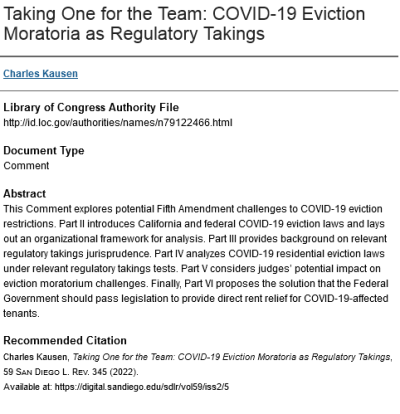
Screenshot 2022-07-02 at 09-16-05 Taking One for the Team COVID-19 Eviction Moratoria as Regulatory Takings

Check it out: a new article from the San Diego Law Review that’s worth reading. Here’s the Abstract:

This Comment explores potential Fifth Amendment challenges to COVID-19 eviction restrictions. Part II introduces California and federal COVID-19 eviction laws and lays out an organizational framework for analysis. Part III provides background on relevant regulatory takings jurisprudence. Part IV analyzes COVID-19 residential eviction laws under relevant regulatory takings tests. Part V considers judges’ potential impact on eviction moratorium challenges. Finally, Part VI proposes the solution that the Federal Government should pass legislation to provide direct rent relief for COVID-19-affected tenants.

Get the pdf here: “Taking One for the Team: COVID-19 Eviction Moratoria as Regulatory Takings,” 59 San Diego L. Rev. 345 (2022).

Our take on Co-19 takings (not just eviction moratoria) here. And our thoughts on emergency response laws, generally.Continue Reading New Article: “Taking One for the Team: COVID-19 Eviction Moratoria as Regulatory Takings”

The owners of the Hollymead Town Center (Route 29, LLC) located, perhaps not surprisingly along U.S. Route 29 in Albemarle County outside of Charlottesville, needed the County to rezone a portion of the property.

Part of the rezone was something called a “conditional proffer” that required a cash donation of $50,000 “[w]ithin thirty days after demand by the County after public transportation service is provided to the Project,” and then additional donations of fifth large each year for 9 years for a total of a half-million.

There was some discussion among the public and County officials about whether this condition would ever be actually realized because public transportation service might not be provided in the future, but in the end the County approved the “Commuter Route” that is projected to run “from northern Albemarle County to downtown Charlottesville.” But the owner objected to the cash payment, throwing up the Nollan

Continue Reading Virginia: Property Owner Can Object To Permit Condition As Unconstitutional, Even After Accepting The Permit

A long-ish opinion from the Alabama Supreme Court in Douglas v. Roper, No. 1200503 (June 24, 2022). But a short post because the good stuff is relatively brief.

Bottom line: property owners have a vested interest in excess money generated from a tax sale of their property, and the Alabama legislature cannot prohibit the owners from claiming that excess equity.

Quick background: the legislature enacted a statute that required property owners who had their properties sold to satisfy tax debts first have redeemed the property before they could claim the excess funds, if any, from the sale. This had the effect of permitting the government in many cases to keep that excess (i.e., the property’s equity), as a little something extra — what our New Orleans friends might call lagniappe. Property owners objected, arguing that retroactively applying the statute would be a taking.

There’s a lot to

Continue Reading Alabama: Government Can’t Keep The Change After A Tax Sale