Its deja vu all over again: like it did just a short while back, in Lafave v. City of New Orleans, No. 21-30358 (June 1, 2022), the U.S. Court of Appeals for the Fifth Circuit once again has rejected a takings claims “based on the city’s failure to honor a judgment of the Louisiana state courts.” Slip op. at 1.

Unlike the previous case, here the judgment being dishonored was not for just compensation, but a state court order that “call[ed] for the return of personal property acquired by the government unlawfully.” Id.

Here’s the story. New Orleans likes traffic cameras, and “used mail to collect fines for traffic violations captured by street cameras.” A class action lawsuit challenged the scheme, and eventually a Louisiana court determined the city lacked the authority to designate the Department of Public Works (and not the police department) as the enforcement authority.
Continue Reading The Keepings Clause: CA5 (Again) Throws Up Its Hands When Local Gov Refuses To Pay Back Money It Owes

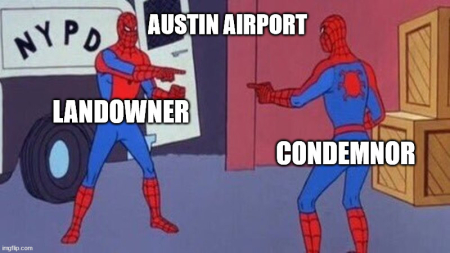
Austinairport

Here’s what we’re reading today:

Continue Reading Tuesday Round-Up: Austin Airport Taking Its Own Land?, The Right To Exclude, And More

The U.S. Court of Appeals for the Seventh Circuit’s decision in Nowlin v. Pritzker, No. 21-1279 (May 20, 2022), adds to a long line of rulings denying takings claims for coronavirus-related business shutdowns. 

This one challenged the Illinois governor’s executive orders which required “non-essential” businesses to shut down or reduce operations, and limited the size of gatherings. The plaintiffs brought the usual host of constitutional claims (a total of six), which included (naturally) a takings claim. The district court, after granting leave to allow the filing of an amended complaint, dismissed all six claims, concluding either that the plaintiffs had not alleged particularized injuries (and thus lacked standing, and thus the court lacked jurisdiction), or that the complaint failed to state claims.

The Seventh Circuit affirmed that all claims, with the exception of the takings claims, lacked jurisdiction because the plaintiffs had not alleged specific injuries. The court subject

Continue Reading CA7: Co-19 Shutdown Complaint Does Not Meet “Demanding test for alleging a regulatory taking”

Here’s a pretty rare one: a trial court entering summary judgment on liability in favor of the property owner in a takings case. Yes, you read that right.

And to top it off, this ruling comes in a case in which the taking alleged was a police invasion and destruction of a home for the valid public purpose of apprehending a holed-up criminal, a brand of claim that has not met with a whole lot of success. See, for example, this case from the Tenth Circuit, and this case from the Supreme Court of South Carolina.

In this order, the U.S. District Court for the Eastern District of Texas held the City of McKinney liable for a physical taking. The entire order is worth reading, but here are some of the highlights.


Continue Reading District Court: City Liable For Physical Taking For Destroying Home While Apprehending A Criminal

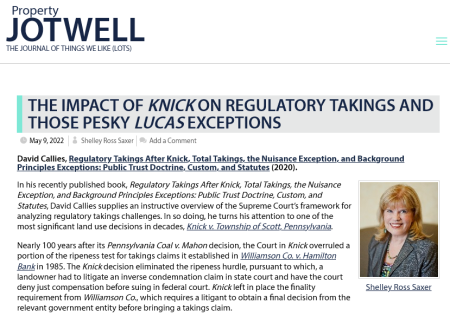
Screenshot 2022-05-13 at 14-45-41 The Impact of Knick on Regulatory Takings and Those Pesky Lucas Exceptions - Property

Check this out: Pepperdine lawprof Shelley Saxer has a piece in Jotwell, “The Impact of Knick on Regulatory Takings and Those Pesky Lucas Exceptions,” a review of U. Hawaii lawprof David Callies’ book, “Regulatory Takings After Knick.”

The review is short and to the point, so we suggest you read it. But here’s a teaser:

This small but mighty book offers a concise history and understanding of takings jurisprudence as it stood before and after the Knick decision. It brings clarity to a convoluted chronicle of takings litigation and presents specific situations where litigants have asserted a total taking claim and the defense has relied on the various exceptions to Lucas.

Don’t miss it.Continue Reading Lawprof Saxer On Jotwell: “The Impact of Knick on Regulatory Takings and Those Pesky Lucas Exceptions”

Anyone who reads this blog regularly knows Tiburon, California, even if you’ve never stepped foot there. Yes, that Tiburon. Well, the beat goes on: the Agins litigation wasn’t the only time that the town and its residents combined forces to try and draw up the drawbridge and prevent the building of more homes in this very exclusive and chichi Marin County waterfront and hilltop community with commanding multi-million dollar views of San Francisco and the Bay. 

For the latest example, read the California Court of Appeal’s opinion in Tiburon Open Space Committee v. County of Marin, No. A159860 (May 12, 2022). It’s 110 pages, but don’t let that discourage you (it’s not necessary to dig into the details, unless you are a true California Environmental Quality Act nerd). The facts alone are hair-raising. But on the other hand, the story may be an old story to

Continue Reading “Something is very wrong with this picture.” Cal Ct App Calls Out CEQA (“fearsome weapon”), Tiburon’s “official hostility,” And “combined animus of two levels of local government”

Screenshot 2022-05-02 at 11-51-57 Display event - 2022 Hawaii Land Use Law Conference (LIVE)

It’s back! After a hiatus on the in-person program, the bi-annual Hawaii Land Use Conference is back in-person (see here for a sample of one of our prior presentations at this conference).

May 25 and 26, 2022, downtown Honolulu.

The full agenda and speaker list has not yet been published, but here’s a summary of the program:

Sponsored by the Hawaii State Bar Association and the Real Property and Financial Services Section. Coordinated by David Callies and Benjamin Kudo, his 2-day conference is a must attend for any attorney or professional whose practice involves land use and development. Distinguished land-use practitioners, scholars, planners, and regulators from Hawaii and the Mainland will discuss timely and relevant issues, including:

• Takings 

• Transit Oriented Development (TOD) 

• Seawalls and Shoreline Access 

• Climate Change 

• Affordable/Workforce Housing 

• Ethical Considerations for Real Property Practitioners and Other Professionals

We’ll be speaking during

Continue Reading Hawaii Land Use Law Conference, May 25-26, 2022, Honolulu – Join Us!

Bergerpage

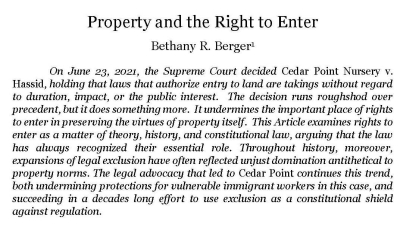
A new article by lawprof Bethany Berger, “Property and the Right to Enter,” criticizing the Supreme Court’s ruling in Cedar Point Nursery. The article builds on the amicus brief in the case, also authored by Prof Berger.

Here’s the Abstract:

On June 23, 2021, the Supreme Court decided Cedar Point Nursery v. Hassid, holding that laws that authorize entry to land are takings without regard to duration, impact, or the public interest. The decision runs roughshod over precedent, but it does something more. It undermines the important place of rights to enter in preserving the virtues of property itself. This Article examines rights to enter as a matter of theory, history, and constitutional law, arguing that the law has always recognized their essential role. Throughout history, moreover, expansions of legal exclusion have often reflected unjust domination antithetical to property norms. The legal advocacy that led to Cedar Point continues this trend, both undermining protections for vulnerable immigrant workers in this case, and succeeding in a decades long effort to use exclusion as a constitutional shield against regulation.

Definitely worth reading.
Continue Reading New Article (Bethany Berger): “Property and the Right to Enter”

FedCtsTakingsArticlepage1

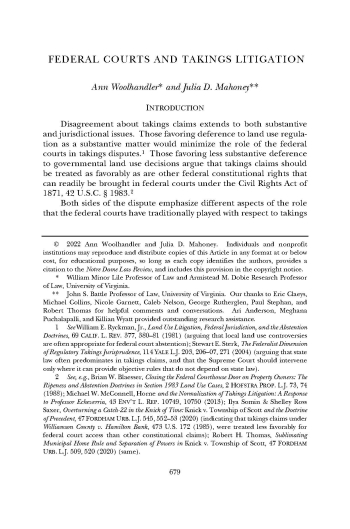
A new article on takings from U. Virginia Law School profs Ann Woolhandler and Julia Mahoney in the Notre Dame Law Review, “Federal Courts and Takings Litigation.” Get the pdf here.

Rather than try and summarize the piece, we’re just going to cut-and-paste the highlights from the article’s Introduction:

While Knick clearly expands the lower federal court role in takings claims, many questions remain. We do not know how federal courts will respond to the increase in claims—whether they will embrace a robust federal role in land use cases, or use various abstention doctrines to rein them in. While pro-regulatory and pro-property rights scholars have predictably taken sharply contrasting positions as to the appropriate federal court role post-Knick, this Article will recommend a middle-of-the-road approach, based partly on history and partly on an assessment of where the lower federal courts may most usefully contribute to the

Continue Reading New Article: Woolhandler & Mahoney, Federal Courts and Takings Litigation, 97 Notre Dame L. Rev. 679 (2022)

Not too long ago, we posted the Fifth Circuit’s panel opinion in a case where the court held that there’s nothing a federal court can do if a local government does not pay a state-court just compensation judgment. We filed an amicus brief in that case arguing “[t]he Takings Clause does not permit the Sewerage Board to take property and hand the owner an IOU the Board might pay sometime in the future if and when it feels like it. Instead, it requires the Sewerage Board to pay the court ordered just compensation without ‘unreasonable delay.'”

Well, in the interim we’ve traded in our amicus hat for a co-counsel hat, and last week asked the Fifth Circuit to rehear the case en banc, via this en banc petition.

Since we’re now co-counsel in the case, we won’t go into further detail, but will leave it there for you to

Continue Reading Are The Federal Courts Powerless When A Condemnor Doesn’t Pay Just Compensation?