If you are lacking good things to read, fear not: thanks to amici curiae, you now have boocoo merits-stage friend-of-the-court briefs (16!) on your plate.

This is the case in which the U.S. Supreme Court is considering the nature of physical invasion takings, and how permanent a permanent intrusion must be in order to qualify for Loretto and Kaiser Aetna-ish per se treatment. In Cedar Point Nursery v. Shiroma, 923 F.3d 524 (May 8, 2019), a 2-1 panel of the Ninth Circuit affirmed the dismissal of a complaint for failure to plausibly state a takings claim under Twombly/Iqbal. At issue was a regulation adopted by California’s Agricultural Labor Relations Board which requires agricultural employees to open their land to labor union organizers. The regulation is framed as protecting the rights of ag employees to “access by union organizers to the premises of an agricultural

Continue Reading No Shortage Of Amicus Briefs In SCOTUS Physical Invasion Takings Case
1o 11 ALI-CLE

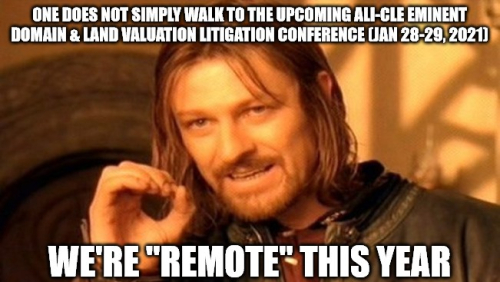
Are you a law student interested in takings, eminent domain, land use, environmental, and other dirt-lawyering related topics? If so, good news: thanks to the generosity of ALI-CLE, you can register gratis (free!) for the upcoming 38th Annual Eminent Domain & Land Valuation Litigation Conference, to be held remotely on Thursday and Friday, January 28-29, 2021.

This is the “big one” where the nation’s best practitioners, scholars, jurists, and other industry professionals gather to talk shop about the subjects we know and love. We’re having programs with intriguing subjects such as “Planning to Win: Practical Strategies for a Successful Inverse Condemnation Case,” “How Do I Keep My Firm’s Doors Open When the Courthouse Doors Are Closed? Making Your Practice More Efficient When You Can’t Try Cases,” “Where Is the Supreme Court Headed on Takings Cases? Regulatory Takings Update and Cedar Point Preview,” “No Show and All Tell:

Continue Reading Law Students: Register Free For The 38th Annual ALI-CLE Eminent Domain & Land Valuation Litigation Conference (Jan 28-29, 2021)

Our thanks to Clint Schumacher for having us on his program to talk about the upcoming Conference. We’re “remote” this year, but that means a different approach to our presentations (and a very modest tuition!).

We’re having programs with intriguing subjects such as “Planning to Win: Practical Strategies for a Successful Inverse Condemnation Case,” “How Do I Keep My Firm’s Doors Open When the Courthouse Doors Are Closed? Making Your Practice More Efficient When You Can’t Try Cases,” “Where Is the Supreme Court Headed on Takings Cases? Regulatory Takings Update and Cedar Point Preview,” “No Show and All Tell: Breaking News in Property Rights and Takings,” “More Than the Fifth Amendment: Other Tools for Upholding Property Rights,” “Evaluating Lockdown, Moratorium, and Emergency Claims,” and more (including Ethics for those of you in MCLE jurisdictions). We’ll have a post with more details. 

Register now!Continue Reading Eminent Domain Podcast’s Preview Of The Upcoming ALI-CLE Eminent Domain & Land Valuation Litigation Conference

Here’s the property owners’ Brief on the Merits in the case in which the U.S. Supreme Court is considering the nature of physical invasion takings, and how permanent a permanent intrusion must be in order to qualify for Loretto and Kaiser Aetna-ish per se treatment.

In Cedar Point Nursery v. Shiroma, 923 F.3d 524 (May 8, 2019), a 2-1 panel of the Ninth Circuit affirmed the dismissal of a complaint for failure to plausibly state a takings claim under Twombly/Iqbal. At issue was a regulation adopted by California’s Agricultural Labor Relations Board which requires agricultural employees to open their land to labor union organizers. The regulation is framed as protecting the rights of ag employees to “access by union organizers to the premises of an agricultural employer for the purpose of meeting and talking with employees and soliciting their support.”

The Ninth Circuit panel majority

Continue Reading Prunes And Raisins And The Cedar Point Merits Brief: “Regular And Predictable” Invasions Of Property Are Per Se Takings, Even If Not 24/7

We would not have guessed back in March when we posted the “first” coronavirus shut down takings complaint that we’d still be at it at the end of 2020, but here we are.

The latest is this complaint filed last week in the U.S. District Court for the District of Oregon against Oregon’s governor (in her official capacity), the City of Portland, and Multnomah County, asserting that “several provisions of law, including state statutes, executive orders, and municipal ordinances that, taken together, significantly impair Plaintiffs’ rental contracts and amount to per se takings and unreasonable seizures of Plaintiffs’ property for a public purpose without just compensation.” Complaint at 2.

The laws referred to are a series of state and municipal statutes and ordinances that establish and enforce a moratorium on termination of tenancies. Rather than go into details, we recommend you read the complaint (it’s not one of those massive

Continue Reading New Complaint: Oregon’s Eviction Moratorium Extension Is A Taking

Diehard

If you are like us, today’s kind of a slow day work-wise. Relax, watch a holiday movie, take it easy.

Us, we’re reading. Not totally frivolous, mind you. A couple of scholarly pieces we’ve been meaning to take a look at for a while. We recommend you do so also. Maybe not today (we understand if you want to take it really easy), but soon.

  • First, for you takings mavens: Molly Brady’s “The Domino Effect in State Takings Law: A Response to 51 Imperfect Solutions,” which suggests that “takings law has often been marked by uniformity, rather than state-level variation and innovation—uniformity driven, in part, by the force of other states’ rules. This domino effect is the consequence of both specific features of takings doctrine and organic borrowing.” Professor Brady then offers “some tentative thoughts on why property and takings law have tended to yield homogeneity and eliminate


Continue Reading Light Holiday Reading: State Takings Law, And Home Rule

The Town of Fort Myers Beach, Florida, barred the sale of alcohol on beaches in 1995. Turns out that a beachfront business was already (legally) selling alcohol on its property at the time of the ban. And we know what that usually means: a grandfathered nonconforming use.

Today’s case from the Florida District Court of Appeal (Second District), Persaud Properties FL Investments, LLC v. Town of Fort Meyers Beach, No. 2D19-1282 (Dec. 11, 2020), is at the intersection of two of our favorite subjects, land use and inverse condemnation.

No one questioned whether Persaud possessed a nonconforming use. The issue was whether it had it abandoned it when it closed the establishment “to begin extensive renovations.”

The Town was well aware of the renovations as various construction permits had to be issued and inspections had to occur; additionally, during the renovation period, multiple stop-work orders were issued by

Continue Reading Florida: You Can’t Unintentionally Abandon A Nonconforming Use

Photo

Here’s a big development in a case we’ve been following for a while (and in which we filed an amicus brief in support of the prevailing property owner).

In DW Aina Lea Dev., LLC v. State of Hawaii Land Use Comm’n, No. SCCQ-19-156 (Dec. 17, 2020), the unanimous Hawaii Supreme Court held that the statute of limitations governing a regulatory takings claim under the Hawaii Constitution’s “takings or damagings” clause is six years.

The case started out in a Hawaii state court, and was removed to the U.S. District Court by the State Land Use Commission. The district court dismissed the state takings claim for missing the limitations cut-off. Hawaii has not adopted a statute of limitations expressly for takings or inverse condemnation claims. Thus, the question is what is the closest analogue claim. If there isn’t one, Hawaii has a “catch all” statute (six years) for civil claims.

Continue Reading Hawaii: State Takings Are “Self-Executing” Constitutional Violations (Not Torts Or Breaches Of Contract), Subject To A Six-Year Statute Of Limitations

Often, the dispositive question in many takings cases tuns on whether the plaintiff owns “property,” and if so, what rights does that recognize. If you define the property in such a way that ipse dixit excludes the “stick” the owner claims was taken, then the answer is always going to be no property, no taking. To us, this is largely a question of definitions and policy: is this interest, in a judge’s view, worthy of constitutional protection?

And that’s the wrong approach, because this analysis often seems more like a semantic exercise, undertaken by the wrong party. Instead of concluding, for example, that the property in a case is a lease (a recognized property interest) and then going on to ask whether there’s been a sufficient interference with an owner’s distinct investment-backed expectations, the question shifts from what we think is the proper focus (a fact question of the impact

Continue Reading Surf And Turf (Our Beef With The Virginia Oyster Takings Case): Although Leases Are “Property,” They Don’t Confer A Right To Exclude Government Sewage