Here’s the Reply in Support of what we think is a very worthy cert petition, and which responds to the recently-filed BIO.

For the background of the case, check out this post (“What Constitutes a Loss“). The property owner has also summarized the situation thusly in its petition:

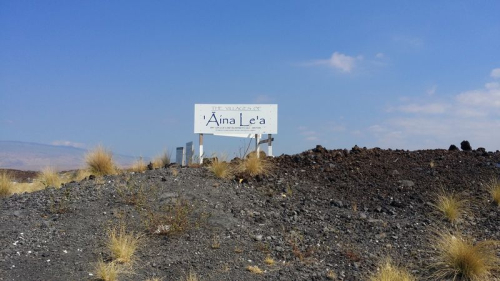
The State of Hawaii zoned for agricultural use land that it knew was not viable or appropriate for such use. At the property owner’s request, it rezoned it for urban use but, after Plaintiff Bridge Aina Le‘a began developing it, the State illegally (as the Hawaii Supreme Court later held) “reverted” the land to agricultural use. A jury found this to be a 5th Amendment taking under this Court’s standards in both Lucas v. South Carolina Coastal Council, 505 U.S. 1003 (1992) and Penn Central Transp. Co. v. City of New York, 438 U.S. 104 (1978).

Continue Reading Reply In Penn Central And Lucas Takings Case

PXL_20201118_163528916 (1)

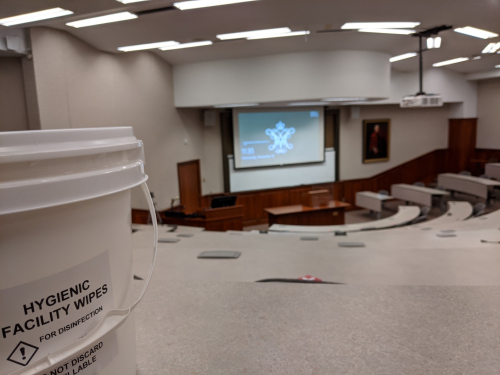
We have now wrapped up the coursework portion of the Fall semester at William and Mary Law School, so here’s an after-action report from the two full courses which I taught in a “hybrid” style (some students live, in the classroom; others attending via Zoom live; and still others with the option to attend via the Zoom recording). The two courses: (1) Land UseEminent Domain & Property Rights

Overall, it went much better than I think nearly everyone else expected. When I say “everyone else,” that is because when I posted photos of the “distanced” classroom that the law school set up in the adjacent indoor Tennis Center, the reactions were mostly dubious, or even scornful. I had much less doubt about teaching and learning in a non-typical environment. The in-person option, I believed, was essential, and anything less would likely be … less.

So off

Continue Reading Wrapping Up A Semester In A “Hybrid” Law Classroom (Never Go “Full Remote”)

Ainalea

Here’s the State of Hawaii’s Brief in Opposition in a case we’ve been following for what seems like forever.

Check it out. The State waived response, but after a whole bunch of amici filed briefs in support of a cert grant (ours included), at least one of the Justices wanted to hear its arguments in opposition. 

Instead of the State’s “Solicitor General” filing the brief, it hired a SCOTUS player to argue that this case isn’t worth the Court’s time. The need to hire the D.C. big guns with name-recognition instead of relying on the in-house lawyers who are the State’s appellate experts somewhat belies any assertion that the State isn’t concerned about this case. 

Here are the Questions Presented as (re)framed by the BIO:

1. Whether the Ninth Circuit correctly held that Petitioner did not suffer a taking where the State rezoned Petitioner’s property because

Continue Reading BIO In Penn Central And Lucas Takings Case

Check this out, the Complaint we filed a couple of weeks ago in the U.S. District Court for the Western District of Virginia, in Grano v. Rappahannock Elec. Coop., No. 3:20-cv-00065-NKM (W.D. Va. Oct. 28, 2020).

It’s not a true “takings” case because the claims for relief are limited to due process and Contract Clause and the plaintiffs are not seeking just compensation, but there’s a takings flavor, because the due process problem alleged is failure to condemn and also provide for compensation.

We’re not going to comment in depth because it’s our case, and we’d rather just let the complaint speak for itself at this point. But the short story is that recently, the Virginia General Assembly adopted a statute directing that all existing easements in which the servient estate owner granted a right to use property for electrical distribution now include the right of the dominant estate

Continue Reading Is Virginia’s Legislative Rewriting Of Existing Electric Easements To Permit Fiber Optic Use Unconstitutional?

DSCF3357

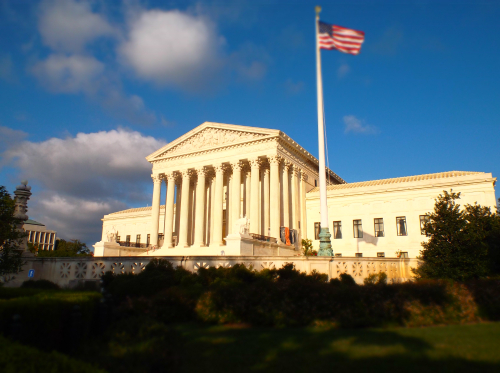
Today, Friday, November 13, 2020, is the day that the Supreme Court is scheduled to decide whether to decide a case we’ve been following for a long time (and one in which we filed an amicus brief urging the Court to take up the case).

In Cedar Point Nursery v. Shiroma, 923 F.3d 524 (May 8, 2019), a 2-1 panel of the Ninth Circuit affirmed the dismissal of a complaint for failure to plausibly state a takings claim under Twombly/Iqbal. At issue was a regulation adopted by California’s Agricultural Labor Relations Board which requires agricultural employees to open their land to labor union organizers. The regulation is framed as protecting the rights of ag employees to “access by union organizers to the premises of an agricultural employer for the purpose of meeting and talking with employees and soliciting their support.”

The Ninth Circuit panel

Continue Reading It’s Conference Day For Case Asking How “Permanent” A Loretto Permanent Physical Invasion Taking Must Be

We listened live last week, but the court has now made the recording available in Johnson v. City of Suffolk.

This is what we call the “oyster takings” case in which Nansemond River oystermen claim that their property was taken when the City of Suffolk and the Sanitation District dumped sewage into the river and declared a “condemnation zone” (i.e., no oyster harvesting).

This is a case at the intersection of property and takings law, and environmental protection. And the public trust concept of jus publicum. The oystermen own a lease from the State of Virginia for the riverbed, which among other things, allows them to harvest some of the oysters that Virginia is so well known for. But they were forced to bring an inverse condemnation claim in state court, asserting that the City’s dumping of wastewater in the river — and prohibiting the

Continue Reading Recording Now Available In Virginia Supreme Court Oral Arguments In Takings, Property, And Public Trust Case

Screenshot_2020-11-05 Legal challenges regarding COVID-19 emergency orders

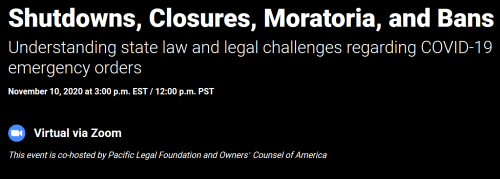
Join us next Tuesday, November 10, 2020 at 3pm ET (12 noon Pacific) for the free webinar “Shutdowns, Closures, Moratoria, and Bans,” produced by Pacific Legal Foundation and Owners’ Counsel of America.

Along with my colleagues Leslie Fields (Executive Director, OCA), and Jim Burling (PLF), I’ll be talking about the legal foundations for objections, some of the cases that have made their way to decision, and what the future might look like. To register (did I mention it was free?) go here.

Here’s the program description:

Governors and state legislatures across the country have implemented an array of policies in an attempt to contain the virus and its socioeconomic impacts. Many of these policies broadened the scope of government power while placing a heavy burden on property owners and businesses already struggling with the pandemic.

Join representatives from Pacific Legal Foundation and Owners’ Counsel of America as

Continue Reading Join Us: Tuesday, Nov. 10, 2020 (3pm ET, 12n PT) For Free (!) Webinar: “Shutdowns, Closures, Moratoria, and Bans”

Here’s the latest in a case we’ve been following even before its inception (last semester, our William and Mary class visited the site and witnessed the oyster operation affected – see video above), Johnson v. City of Suffolk.

This morning, the Virginia Supreme Court heard oral arguments in the case, and we livestreamed it during our class. (We can’t post the audio recording just yet; those are released on Fridays, so hold on just a bit longer if you missed the live event.)

This is what we call the “oyster takings” case in which Nansemond River oystermen claim that their property was taken when the City of Suffolk and the Sanitation District dumped sewage into the river and declared a “condemnation zone” (i.e., no oyster harvesting).

This is a case at the intersection of property and takings law, and environmental protection. And the public trust concept of

Continue Reading Virginia Supreme Court Oral Arguments In Takings, Property, And Public Trust Case