This semester, we’re teaching two courses at the William and Mary Law School: the usual Eminent Domain & Property Rights (our regularly-scheduled fall semester course), and Land Use. If we were to try and create a hypothetical for the final exam in either class, we couldn’t do better than the actual fact pattern and arguments presented to the Texas Court of Appeals in City of Dickinson v. Stefan, No. 14-18-00778-CV (Oct. 27, 2020). That case involved a use of property alleged to have been started before the city adopted a zoning code, and claims of vested rights, “grandfathering,” and related.

We won’t recount the entire fact pattern here (we suggest reviewing the entire opinion yourself; it is a decent read), and only note that it covers a range of land use and takings topics, including the aforementioned nonconforming use arguments, exhaustion of admin remedies, and the like. In all
Continue Reading Your Land Use/Takings Exam Hypo: Tex App Considers Nonconforming Uses, Vested Rights, Zoning, Admin Appeals, And Takings

Bk_2020_02_475

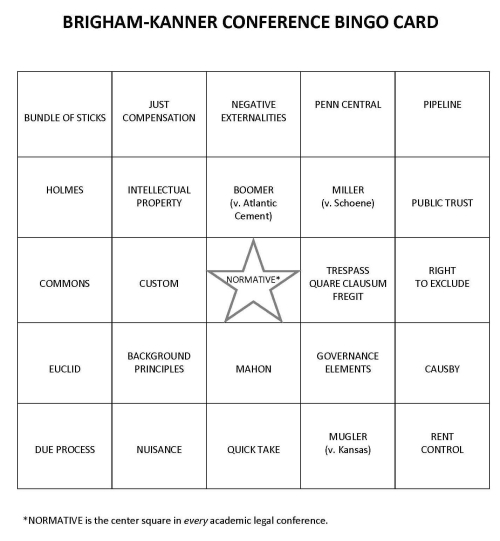
In case you missed any part of it: the recordings of the recent 2020 Brigham-Kanner Property Rights Conference are now available.

Go here for the descriptions of the panels, speakers, and links to the recorded sessions.

This year’s conference, held on October 1-2, opened with the Brigham-Kanner Property Rights Prize being awarded to Professor Henry E. Smith of Harvard Law School. The prize is named in honor of the lifetime contributions of Toby Prince Brigham, founding partner of Brigham Moore, LLP, and Gideon Kanner, professor of law emeritus at Loyola Law School in Los Angeles, and is presented annually to a scholar, practitioner or jurist whose work affirms the fundamental importance of property rights.

Topics covered: “Where Theory Meets Practice: A Tribute to Henry E. Smith,” “The Housing Crisis,” “Emerging Issues in Takings and Eminent Domain Law,” “The Reach of Government’s Confiscatory Powers over Exigencies and Emergencies,” and “The

Continue Reading Brigham-Kanner Property Rights Conference Videos Now Available

Callies Book Launch Invitation Announcement_Page_1

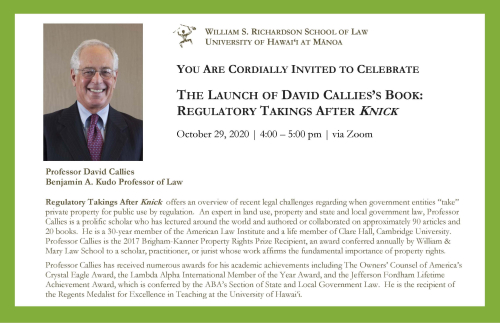
Come join us for the book party for Professor David Callies’ recently published (by the ABA State and Local Government Law Section) book, “Regulatory Takings After Knick.”

We’re online (of course), so you don’t have to come to Honolulu – we’re on Zoom:

Date: Thursday, October 29, 2020

Time: 4-5pm Hawaii Time

RSVP: No need to RSVP, just follow the Zoom link on the flyer below.

Is joining at 4pm Hawaii Time too late in the day in your time zone? We will be scheduling a “pre-event” on Zoom where you can record your video congratulations for Professor Callies. Details to be posted here shortly, or email us.

And yes, buy this book. As the back cover blurb notes:

The problem with so much regulatory takings scholarship — like the Supreme Court’s takings doctrine itself — is that it is muddled and murky, and casts shadow

Continue Reading You’re Invited: Book Launch For “Regulatory Takings After Knick” (David Callies), Oct. 29, 2020

When an opinion starts off with “[t]his case offers a feast of legal issues – ranging from procedural to constitutional – but its main course is a cautionary tale to government entities: they must follow the exact statutory requirements for bringing a condemnation action[,]” you just know that you have to read the entire thing.

That’s exactly what we recommend with the Utah Court of Appeals’ opinion in Salt Lake City Corp. v. Kunz, No. 20190010-CA (Oct. 16, 2020). The court concluded that when a statute requires that a condemnor provide the property owner with at least 10 days written notice and an opportunity to be heard before the condemnor takes a final vote to approve exercising eminent domain, “substantial compliance” isn’t sufficient. We make this recommendation that although this sort of statutory requirement is quite common — as are examples of condemning agencies not strictly adhering to

Continue Reading Utah App: “All bets are off for any actions other than exactness.” Close Enough Isn’t Good Enough In Condemnation – When The Statute Requires Notice To Property Owners Within 10 Days, It Means 10 Days

We all know that despite the heightened Twombly/Iqbal federal pleadings standard, that it doesn’t mean a whole lot if a complaint survives a 12(b)(6) motion to dismiss. All this means that the court thinks it is plausible that the complaint states a claim. And that the plaintiff gets to keep going. That’s it.

But when takings claims are involved, we also know that courts can be dismissive, and a property owner surviving a motion to dismiss can be kind of a big deal.

In Hunters Capital LLC v. City of Seattle, No. C20-983 (Oct. 16, 2020), the U.S. District Court for the Western District of Washington dismissed the plaintiffs’ equal protection claims, but held that the procedural and substantive due process, and takings claims survived. This is the case on which we posted earlier, in which property owners in the part of Seattle known as CHOP (or

Continue Reading Federal Court: If It’s True That Seattle Provided Material Support To CHOP/CHAZ, That Could Be A Taking

Here’s the latest in a case we’ve been following. In this Order, the Ninth Circuit denied rehearing and rehearing en banc of the 2-1 panel decision in Pakdel v. City & County of San Francisco, No. 17-17504 (9th Cir. Mar. 17, 2020).

Earlier, the panel concluded that a regulatory takings case was not ripe under Williamson County‘s requirement. Recall that in Knick, the U.S. Supreme Court overruled the first Williamson County ripeness hurdle — the requirement that a property owner first pursue and be denied just compensation via “state procedures” — but the Court didn’t consider or disturb the “final decision” requirement.

The Pakdels sued San Francisco for a regulatory taking because of the city’s requirement that as a condition of converting a tenancy-in-common to a condominium, the owners must first offer any tenant a lifetime lease. The Pakdel’s twice requested exemptions from the lifetime

Continue Reading Certworthiness Alert: 2-1 CA9 En Banc Denial (And 9 Judge Dissental) – Is A Takings Claim Forever Unripe Because The Owner In The Past Didn’t Jump Through All Administrative Hoops?

EjqLrfkWAAAB5QF

In between talking about eminent domain-y songs, the goofy cult film “Snakes on a Plane” (yes, we really do have a cast-signed poster of that film in our office), and other fun stuff, we returned to the Pendulum Land Podcast for part II of our guest spot, where we also discussed Virginia Uranium, Inc. v. Commonwealth, No. CL15-623 (July 30, 2020), a recent decision from a Virginia trial court about regulatory takings and “damagings.” 

[Stream the podcast above, or better yet, subscribe and become a regular listener. The podcast is both entertaining and informative.]

The Virginia Uranium case involves a long-standing — but “temporary” — moratorium on uranium mining, and the court’s order analyzes Palazollo, the Salt-peter case (Lord Coke alert!), Penn Central, and Lucas.

The court concluded that the inability to mine uranium was a damaging under the Virginia Constitution because it “directly

Continue Reading In Which We Return To The Pendulum Land Podcast To Talk “Snakes on a Plane,” Eminent Domain Songs, And What Might Be Virginia’s First True Regulatory Takings Case

You know those times you go to the store and try to get a refund on something you’ve purchased, and instead of cash back, you get a gift card, only useable at the same store? Or when, instead of refunding your plane ticket, the airline gives you some limited-time credit for a future flight? Anyone like those?

Well, a fascinating case from the New Mexico Court of Appeals, Premier Trust of Nevada, Inc. v. City of Albuquerque, No. A-1-CA-34784 (Oct. 1, 2020) reminds us of the risks associated with these things.

Albuquerque has an impact fee ordinance which developers must pay to offset the costs of needed infrastructure such as roads, drainage, parks, and public safety facilities. To satisfy the exaction requirement, the property owner could either pay money, build the improvements, or give the city property. If the value of these exactions was more than the impact

Continue Reading NM App: No Property In Impact Fee Gift Card

This just in in a case we’ve been following. In In re Certified Questions, No. 161492 (Oct. 2, 2020), the Michigan Supreme Court responded to the federal court’s certified question about whether, under Michigan’s statutes, the governor has the authority to effectively extend a declared state of emergency by terminating an expiring declaration and issuing a new declaration “again declaring a ‘state of emergency’ and
‘state of disaster’ under the EMA for the identical reasons as the declarations that had just been terminated — the public-health crisis created by COVID-19.” Slip op. at 8.

The court held no, the statute does not allow the governor to do that, in the absence of the Legislature’s approval of an extension:

The Governor argues that because MCL 30.403(3) and (4) provide that ‘[t]he governor shall, by executive order or proclamation, declare a state of [disaster/emergency] if he or she finds [a

Continue Reading Michigan SCT: Without Legislature’s Assent, Governor’s Emergency Powers Terminate At 28 Days