


This one doesn’t involve a takings claim, but since we’re tracking the cases involving coronavirus-related shut down orders and restrictions, we thought we would post this here too.

In Harvest Rock Church, Inc. v. Newsom, No. 20-55907 (Oct. 1, 2020), a panel of the Ninth Circuit rejected a church’s request for an injunction pending appeal of the District Court’s denial of a preliminary injunction. The church is challenging the California governor’s order that have the effect of restricting religious services even though the orders apparently do not expressly target religious services:

The evidence that was before the district court does not support Harvest Rock’s arguments that the Orders accord comparable secular activity more favorable treatment than religious activity. The Orders apply the same restrictions to worship services as they do to other indoor congregate events, such as lectures and movie theaters. Some congregate activities are completely prohibited in

Continue Reading Ninth Circuit, Over Dissent, Denies Injunction For Church COVID Restrictions
Here’s the latest in a case we’ve been following.

In Berry v. City of Chicago, No. 124999 (Sep. 24, 2020), the Illinois Supreme Court avoided the analysis that split the court of appeals, and upheld the dismissal of a very “torty” inverse condemnation claim. The plaintiffs alleged that the City of Chicago’s program to replace old water meters, water mains, and lead pipes had taken their property because it made the service lines “more dangerous” by using copper and galvanized iron, which leads the lead pipes to corrode (the lede is that copper leads lead pipes to corrode). In addition to tort damages, the plaintiffs sought compensation for the taking. 

No deal, held the court, and its ruling is pretty straightforward. The court didn’t really see the arguments the same way as the court of appeals, which split on the question of how the “public” is defined for

Continue Reading Burying The Lead: No Taking When City’s Water Pipe Replacement Program Alleged To Result In More Danger To Owners’ Properties

We were honored to be a guest on an episode of the Pendulum Land Podcast. Here’s the description from the show notes:

Hawaii inverse condemnation lawyer and William and Mary Law School adjunct professor Rob Thomas joins your hosts to discuss recording his classic single “Smooth” with Carlos Santana, whether the COVID moratoriums on evictions constitute a taking, and his favorite flavor of SPAM! (Don’t act like you don’t love SPAM.) This is the first of two episodes with the publisher of the popular eminent domain blog inversecondemnation.com.

We had to bring our “A game” because the hosts were full of rapid-fire questions, wit, and nerd trivia. It was hard to keep up at times. But we did our best (and yes, we did talk about our favorite flavors of SPAM). We also chatted about the coronavirus related takings claims, and an interesting takings case working its way up

Continue Reading In Which We Go Over To The Dark Side: Our Guest Appearance On The Pendulum Land Podcast (SPAM, Takings, Star Trek/Wars, and More!)

Here’s the latest development in a case out of Maryland that we’ve been following for a while.

This is the one where Maryland Reclamation Association bought land back in 1990 to operate a rubble landfill. But after the purchase, the County changed its regs to prohibit (guess what) … rubble landfills. Mesne litigation ensued in various tribunals over the years. Eventually, MRA filed a regulatory takings claim under the Maryland Constitution’s takings clause in 2013, and the jury awarded a whopping $45 million in just compensation and interest. Hartford County asserted that MRA should have exhausted its administrative remedies by seeking a variance, and the claim was barred by the three-year statute of limitations because the takings claim accrued in 2007 when the Board of Appeals administratively denied MRA’s variance request.

The Maryland Court of Special Appeals concluded that the “final decision” for purposes of both ripeness and statutes

Continue Reading Cert Petition: Can A State Agency Decide Whether There’s Been A Taking?

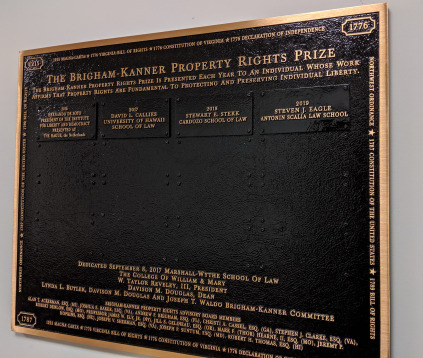
IMG_20190925_175845

Although it is set to launch this Friday, October 2, 2020, there’s still more than enough time to register (and room at the inn) for you to join us for the 17th Annual Brigham-Kanner Property Rights Conference at the William and Mary Law School.

Like everything else this season, the Conference is online (register here), and although we would have preferred to gather in-person of course, the online format has some advantages: the number of attendees isn’t limited by the classroom size (this year’s registrations are at record levels), you don’t need to travel to Williamsburg, and the Conference is free if you don’t want Virginia CLE credit for attending. What a deal.

In our opinion, this is the best legal academy/practicing bar conference on property law. This year, the Conference honors the Brigham-Kanner Prizewinner, Harvard Law School Professor Henry Smith.

Here are the panel topics

Continue Reading There’s Still Room: Join Us For The 17th Annual Brigham-Kanner Property Rights Conference (Online, Free!)

Well, that didn’t take long: as we surmised back when the CDC first issued its order halting residential evictions until the end of the year due to COVID (see “How Can? U.S. DHS: National Eviction Moratorium (Roscoe Filburn Could Not Be Reached For Comment),” the order has resulted in a complaint in the U.S. District Court for the Northern District of Georgia that alleges the order is unconstitutional.

No takings claim (not the right court to raise a just comp claim), but there’s a lot “there,” so to speak: admin law (CDC exceeded its authority), violation of the right of court access, Supremacy Clause, Tenth Amendment, anti-commandeering, this is an invalid exercise of legislative power under Article I.

No takings claim, but read the complaint anyway.  

Complaint, Brown v. Azar, No. 1:20-cv-03702 (N.D. Ga. Sep. 8, 2020)

Continue Reading Complaint (N.D. Ga.): CDC Eviction Moratorium Is Unconstitutional (No Takings Claim, However)

We’ve been meaning to write up the U.S. Court of Appeals’ decision in a case we’ve been followingProtect Our Parks, Inc v. Chicago Park District, No. 19-2308 (Aug. 231, 2020), but our Illinois colleague Mike Ryan was quicker on the draw.

Rather than summarize Mike’s write up, we simply suggest you go to his firm’s blog and read “7th Circuit Rules Construction of the Obama Presidential Center Is Not A Taking Under The Fifth Amendment.”

Short story: the citizen’s group plaintiff doesn’t have a property interest in Grant Park, notwithstanding its argument that the public’s status as the beneficiary of the public trust (the real public trust, not, you know, the other things that get labeled “public trust” but really aren’t the thing you think about when you think “public trust”), is enough of a property interest to come under the Fifth Amendment’s protections (or

Continue Reading Friends Without Benefits: CA7 Rejects Takings Claim For Obama Center Because Citizen’s Group Lacks Property Interest In Public Park

As if to respond to a sibling federal court’s recent order upholding a covid-reaction shut down orders, the U.S. District Court for the Western District of Pennsylvania’s opinion in County of Butler v. Wolf, No.2:20-cv-00677 (Sep. 14, 2020) reaches an entirely different conclusion:

The fact is that the lockdowns imposed across the United States in early 2020 in response to the COVID-19 pandemic are unprecedented in the history of our Commonwealth and our Country. They have never been used in response to any other disease in our history. They were< not recommendations made by the CDC. They were unheard of by the people this nation until just this year. It appears as though the imposition of lockdowns in Wuhan and other areas of China-a nation unconstrained by concern for civil liberties and constitutional norms-started a domino effect where one country, and state, after another imposed draconian and hitherto untried

Continue Reading Fed Ct: “[T]he stay-at-home and business closure components of Defendants’ [COVID] orders violate the Due Process Clause” (Applying Rational Basis Review!)

The District Court’s bottom line in Lukes Catering Service, LLC v. Cuomo, No. 20-CV-1086 (Sep. 10, 2020)? The New York governor’s emergency orders aimed at coronavirus “imposing quarantines, mandating workforce reductions, closing schools, requiring face-coverings, and restricting activities of all types,” are not takings of the businesses of event, banquet, and catering services that have been shut down as a result. The specific emergency measure challenged was the order limiting gatherings to no more than 50 people.

The controlling authority? You guessed it, Jacobson v. Massachusetts, 197 U.S. 11 (1905). That’s the case in which the Court defined “real liberty,” and which has been most prominently applied in emergency order cases to reject due process challenges. But if you want the court’s takings analysis, jump to page 24. The court rejected the categorical (Lucas) claim:

Plaintiffs allege a categorical regulatory taking in their complaint. (Complaint, ¶¶

Continue Reading NY Fed Ct: “When faced with a society-threatening epidemic, state officials are empowered to … infringe federal constitutional rights. They may generally do so at their sole discretion and for so long as is necessary.”

If you are available at 9:30 a.m. Eastern Time today (Wednesday, September 9, 2020), tune in to the Michigan Supreme Court’s YouTube channel and watch and listen live as the court hears arguments in a case challenging the governor’s exercise of emergency powers to respond to the covid epidemic.

The case started in U.S. District Court, but that court certified what it thought were dispositive questions of state law to the Michigan Supreme Court, which accepted the certification. Here are the questions to be answered:

1. Whether, under the Emergency Powers of the Governor Act, MCL § 10.31, et seq., or the Emergency Management Act, MCL § 30.401, et seq., Governor Whitmer has the authority after April 30, 2020 to issue or renew any executive orders related to the COVID-19 pandemic.

2. Whether the Emergency Powers of the Governor Act and/or the Emergency Management Act violates the Separation

Continue Reading This Morning: Michigan Supreme Court Hearing Arguments: Governor’s Covid Emergency Powers Expired (And A Long-Term Pandemic Isn’t An “Emergency”)