Euclid_front98 years old, and still going (for better or worse)

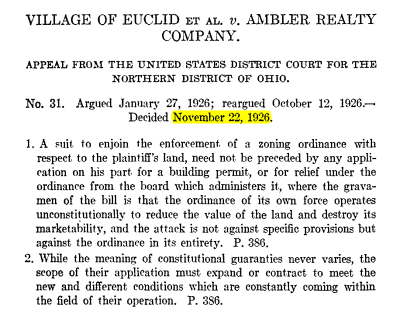
On this day in 1926, the United States Supreme Court issued its landmark opinion in Village of Euclid v. Ambler Realty Co., 272 U.S. 365 (Nov. 22, 1926).

You know this one (and can you call yourself a dirt lawyer if you don’t?). It’s the one in which the Supreme Court first upheld — against a facial due process challenge — the validity of this thing we call “zoning.” While in the intervening century, zoning has become a catch-all term for all sorts of regulatory restrictions on the uses of real property, land users know that “zoning” — ackshually — refers only to the regulation and separation of uses, and restrictions on density, and height regulation. At least that’s how it began.

While “Euclid” and “Euclidean zoning” have become part of the land use
Continue Reading (Un?)Happy Euclid Day!

Screenshot 2024-11-20 at 09-16-50 Lake Worth Lagoon - Google Maps
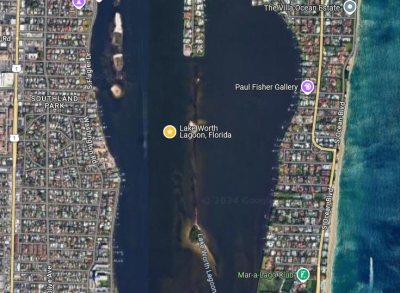
Lake Worth: the “lago” in Mar-a-Lago

You know his name. He’s taken on the City of Riviera Beach twice at the U.S. Supreme Court. And won both times. The houseboat that isn’t a boat. The government can’t shut you out from speaking your mind simply because you irritate them.

That’s right, it’s Fane Lozman. A “Florida Man” that you can like and admire. And he’s back for Round 3.

He owns property that’s mostly in (in, not near) Lake Worth. Two-tenths of an acre is uplands, and the rest (7.75 acres) is submerged. As the Eleventh Circuit noted, “[o]nly a sliver of Lozman’s property is above water.” 

The city, in accordance with the usual approach to land use regulation has a comprehensive plan. That plan designates submerged lands as “Special Preservation Future Land Use,” a label which should set off your Lucas

Continue Reading CA11: Takings Claim Not Ready Despite Govt’s Enforcement Actions

Here are the cases and other materials we discussed in today’s Section of State & Local Government Law Land Use group meeting on takings:


Continue Reading Links From Today’s ABA Land Use Session

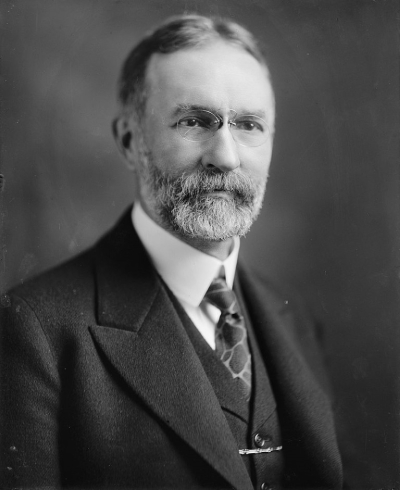
Sutherland_5
Justice Sutherland asks:
whadda mean, you don’t like apartments?

Check out this uncharacteristically-lengthy opinion from New York’s Appellate Division (and entire 6 pages!).

In Bennett v. Troy City Council, No. CV023-0709 (Oct. 24, 2024), the court invalidated a municipal upzoning (from single-family residential to Planned Development — which would permit apartments) because the city’s conclusion that the zone change would have no significant environmental impact under New York’s study-and-disclose statute.

Not content with apartments coming to the neighborhood, an adjoining owner, the “coufounder of The Friends of the Mahicantuck,” sued to challenge the negative environmental declaration. Under New York’s environmental study-and-disclose statute, the “environment” may include such things like historic or archaeological resources, and similar. 

Zoning and rezoning is generally subject to deferential judicial review under Euclid, with the courts applying rational basis review and generally taking a hands-off approach. But this was not a Euclid-like challenge

Continue Reading The Old “Neighborhood Character” Trope Dressed In Environmental Clothing

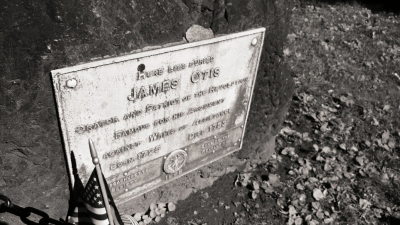
20180719_101400_Film8
Mr. Otis would be a P’Nut fan.

Our Pacific Legal Foundation colleague and search-and-seizure expert Daniel Woislaw quickly responded to the cultural zeitgeist and looked into l‘affaire P’nut le Squirrel with his keen legal eye.

That’s the case in which an internet narc dropped dime on the owner of a pet squirrel, resulting in New York state game officials obtaining a warrant, searching his home, confiscating said squirrel and his little buddy Fred the Raccoon, and then through a series of unfortunate events, putting both P’Nut and Fred down. Sad!

Here’s Daniel’s thoughts.

+++++++++++++++++++++++++++++++++++++++++++++++

Government kills pet squirrel P’Nut in Fourth Amendment horror story

Daniel Woislaw

In a small corner of New York State, a family’s quiet, peaceful home was shattered by an unthinkable intrusion. Environmental police stormed in, seized a rescued orphan squirrel named P’Nut, took him away, and put him down. All because his owner allegedly

Continue Reading Guest Post: P’Nut, The Fourth Amendment, And Property Rights

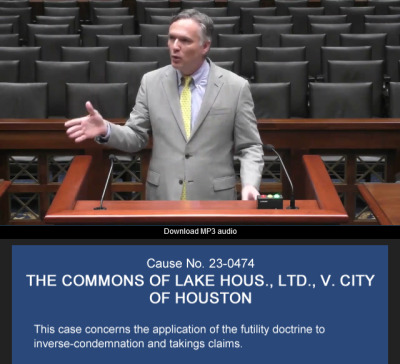
Screenshot 2024-11-04 at 12-34-18 Texas Supreme Court
Charles McFarland, arguing.

Here’s the latest in a case we’ve been following closely (and disclosure: our firm filed an amicus brief in the Texas Supreme Court).

In The Commons of Lake Houston, Ltd. v. City of Houston, the Texas Court of Appeals held that the city could not be liable for a taking for an ordinance that limited development and use within the city’s 100-and-500-year floodplains because the ordinance was a valid exercise of police power and otherwise survived the rational basis test.

As we wrote here, that seems like utter nonsense to say that a valid police power reason categorically insulates a government action from a takings challenge. After all, the entire regulatory takings doctrine is built on the notion that an otherwise-valid exercise of government power (here, the police power, delegated from the State to the city) can so impact an owner’s property rights that

Continue Reading Oral Arguments In Texas Takings Case: If The Govt Limits Use For Healthsafetywelfaremorals, Is It Exempt From Takings?

Here’s the latest in a case we’ve been following, which has now results in a cert petition from Michael Berger. This one involves some very intriguing questions about what limits the Constitution places on the government acquiring property for a public use (in this case, an “airport purpose”) but then later deciding it would rather do something else with the property.

Check out the Questions Presented:

The City and County of Denver condemned 8,360 acres of land from Petitioner Monaghan Farms as part of its land acquisition for the creation of the Denver International Airport, including a large area surrounding the facility to serve as an environmental buffer and safety zone. Thirty-four years later, Denver decided to use approximately half that land (which had not been used for airport purposes) for commercial nonaeronautical developments. But the power of eminent domain may only be used to take property for

Continue Reading New Cert Petition: Does A Taking For Public Use Become A Problem If The Govt Later Abandons That Use?

Screenshot 2024-10-25 at 13-19-32 Housing and Exactions The Next Frontiers After Sheetz Pacific Legal Foundation

Our outfit (Pacific Legal Foundation) has put out a call for papers. on the topic of land use exactions and housing law. Honorarium included for accepted papers, and there will be a workshop to follow.

Here’s the description:

This workshop seeks to build on the result of Sheetz v. County of El Dorado and chart the course of the next steps in exactions/unconstitutional-conditions law. From Nollan v. California Coastal Commission, through Dolan v. City of Tigard and Koontz v. St. John’s River Water Management District, and now including Sheetz, the Supreme Court has looked to the doctrine of exactions and unconstitutional conditions to ensure property rights are protected. In doing so, it has created a constitutional bulwark protecting the right to build housing on private property, an important stick in the property rights bundle.

The Supreme Court’s unanimous decision in Sheetz held that legislatively-imposed development-fee schedules are

Continue Reading Call For Papers: “Housing and Exactions: The Next Frontiers After Sheetz“

Screenshot 2024-10-24 at 12-28-24 Vacancy Taxes A Possible Taking The University of Chicago Law Review

A new student-authored journal article worth reading, Christine Dong, “Vacancy Taxes: A Possible Taking?,” 91 U. Chi. L. Rev. 1725 (2024).

Here’s the Abstract:

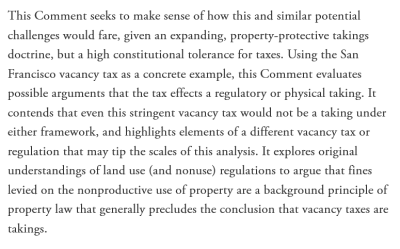
Vacancy taxes are an increasingly popular solution to the paradoxical problem of high housing demand coupled with high vacancy. Cities across the country facing housing shortages have either implemented or are considering adopting vacancy taxes to encourage property owners to rent or sell their property. Soon after San Francisco adopted a vacancy tax with one of the broadest definitions of vacancy, property owners lobbed a constitutional challenge under the Takings Clause, taking advantage of a moment of doctrinal instability.

This Comment seeks to make sense of how this and similar potential challenges would fare, given an expanding, property-protective takings doctrine, but a high constitutional tolerance for taxes. Using the San Francisco vacancy tax as a concrete example, this Comment evaluates possible arguments that the

Continue Reading New Article (Comment): “Vacancy Taxes: A Possible Taking?” (U. Chi. L. Rev.)

Brinkmann

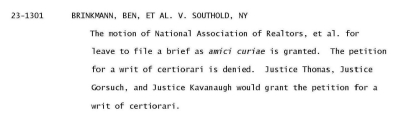
So close: if just one more Justice had agreed, the U.S. Supreme Court would have taken up a public use case we’ve been following, Brinkmann v. Town of Southhold. After all, this one had a lot of the usual markers: a divided court below, an allegation of a lower court split, beaucoup amicus support, and a long-festering issue that has remained open for almost 20 years.

But alas, in this Order, the Court denied the cert petition. Perhaps not surprising given the small number of cases the Supreme Court takes up these days (those of us who have been around for a while remember the days when the Court’s docket was up to 140 argued cases each Term). But nonetheless a disappointment.

One hint for future similar cases: three Justices (Thomas, Gorsuch, and Kavanaugh) “would grant the petition.” We wonder why one more Justice among at least

Continue Reading By The Thinnest Of Margins, SCOTUS Declines Public Use Pretext “Spite Taking” Case