Unlike a sibling federal court in a similar case (see that court’s TRO order below), a Florida court has declined an emergency motion challenging government officials’ coronavirus-related shut-down and stay away orders.

This is the case we’ve been following in which property owners challenge the local government’s order that they stay off beaches. The difference between this and other cases ordering people to keep away from beaches and parks is that in this case, the beaches are alleged to be private. The complaint is posted here

Although we do not yet have a written order denying the TRO, the court’s minute order notes, “the Court orally denies the Emergency Motion.” See alsoJudge rules against Walton beach property owners who sought exemption from closure order” from the local newspaper, which reported on the hearing:

During the hearing Vinson delved, at times, into the overriding issues that Walton

Continue Reading No TRO In Private Beach Taking-By-Shutdown Case
This morning, the Supreme Court of Virginia heard oral arguments (by telephone) in a case we’ve been following.

This is an inverse case that asks whether less than a total loss of access to a parcel could be taking — did the owner plead enough to put the issue to a jury — and is the government’s mere invocation of a “police power” rationale to cut off access is enough to insulate it from the payment of compensation.

When Hooked proposed to develop its property, the City of Chesapeake closed Callison Drive, the street adjacent to Hooked’s property after the neighbors complained. This cut off Hooked’s direct access to Callison Drive, even though it still had access from and to its property from a second street.

The trial court dismissed (demurred) Hooked’s inverse condemnation claim, concluding that the City was exercising its police power when it closed the street

Continue Reading Supreme Court Of Virginia Oral Arguments In Important Inverse Case: Must An Owner Allege Loss Of All Access To Plead A Taking?

Here’s the latest in a case we’ve been following since it was filed just a couple of weeks ago.

This is the one where “Friends of Danny Devito” (no, not that Danny Devito) sued the Pennsylvania governor challenging shut down orders under a variety of theories. Including a takings claim, of course.

Well, the Pennsylvania Supreme Court acted quickly, and just a couple of days ago issued an opinion that came out pretty much the way we expected, especially on the takings claim. We recommend you read it (not only for your virtual cocktail parties, since nonlawyers will ask about this stuff even if it isn’t your bag), but because we think the court make a good point when it rejected the state’s argument that the shut down orders are an exercise of the Commonwealth’s “police powers” and not its eminent domain power. Therefore, the Commonwealth argued

Continue Reading Pa Supreme Court Rejects Takings Challenge To Shut-Down Order

Lech

Today, along with our colleague Bill DeVinney, we filed this amicus brief in support of the property owners’ cert petition in a case we’ve been following for a while. 

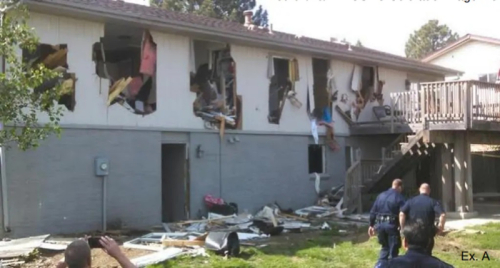
Yes, this is the case where the Village police pretty much destroyed a family home in the course of their efforts to dislodge a shoplifter who had taken refuge there while fleeing. Homeowner sought compensation for a taking. The Tenth Circuit, however, concluded “no taking” because the police were exercising the police power. And you can’t have a taking where the government is exercising the police power.

Instead of summarizing our brief, how about we just post the Summary of Argument:

This Court should review the Tenth Circuit’s holding that action taken by the government under its police power—as opposed to an exercise of eminent domain—can never trigger a taking under the Fifth Amendment’s Just Compensation Clause. This brief makes two main

Continue Reading Amicus Brief: Invocation Of “Police Power” Is Not Dispositive In Takings

Title

To all who joined from Hawaii and across the nation, thank you for doing so. As I mentioned during the webinar, here is the video and links to the cases and other materials I spoke about: 

  • “Emergency does not create power. Emergency does not increase granted power or remove or diminish the restrictions imposed upon the power granted or reserved.”  Home Building & Loan Assoc. v. Blaisdell, 290 U.S. 398 (1934).  
  • The King v. Tong Lee: Hawaii Supreme Court upholds restrictions on commercial laundries in Honolulu’s Chinatown deferring to the government’s assertion that doing so was necessary to preserve the public health. 
  • United States v. Pac. R.R., 120 U.S. 227 (1887): during the Civil War, the Union Army blew up railroad bridges “to prevent the advance of the enemy.” No compensation because the destruction of the bridges was a “military necessity.” “The destruction or injury of


Continue Reading Video, Materials And Links From Today’s Webinar, “Safety vs. Freedom: Are There Limits to Lockdowns?”

Join us next Tuesday, April 14, 2020, at 12 noon Hawaii Time (3pm PDT, 6pm EDT) for a free webinar sponsored by the Grassroot Institute of Hawaii, “Safety vs. Freedom: Are There Limits to Lockdowns?” Register here

Here’s the description of the program:

Governments at every level in Hawaii have responded to the coronavirus pandemic by implementing lockdown measures never before seen in the United States during peacetime. We have been forced to give up many of our freedoms, but by what authority can our governor and mayors shutter our businesses, declare vast swaths of our communities “non-essential” and make us stay home? Are there any legal limits to these shutdowns?

Joining us for a free webinar at noon, Tuesday, April 14, to help answer these questions will be Grassroot Scholar Robert Thomas, a widely published attorney who is a director with the law firm

Continue Reading Safety Dance: Are There Limits To Lockdowns? Free Webinar April 14

Here’s another complaint (here’s the first) challenging a state’s business shut-down order as a taking. This time it is Colorado, and the complaint seeks an injunction and compensation.

Here are the highlights:

  • “As a result of the [shutdown] Orders listed above that restrict the gathering of more than ten people at a time, the plaintiff’s parish has ceased conducting weekly Mass, has ceased offering the Eucharist, and has ceased hearing confessions. The defendants’ conduct has impaired the plaintiff’s ability to freely exercise his religious faith, in violation of the Fifth Amendment.” 
  • “The plaintiff is a cook at a local restaurant.” The restaurant is now closed. “Because the defendants’ Orders have limited the use of the plaintiff’s place of work for the owner of the premises, such a limitation constitutes an exercise of eminent domain over those premises.” 
  • “An increase of less than 1% in our death rate is


Continue Reading Another Complaint Challenging Emergency Shut-Down Orders As Takings

20160114_125445

Here’s an article, just published in the American Planning Association’s monthly magazine, Planning (read the entire April issue here), summarizing the Ninth Circuit’s latest foray into regulatory takings, Bridge Aina Lea, LLC v. State of Hawaii Land Use Comm’n, No. 18-15738 (9th Cir. Feb. 19, 2020).

In Legal Lessons – What Constitutes Loss? we write about the decision and the court’s conclusion that losses short of 100% do not qualify for a per se Lucas taking, and are not enough to tip the scales for a Penn Central taking either. The opinion also adds to the growing confusion about whether the regulatory takings doctrine deals with use or value.  

Our thanks to the APA for asking us to contribute, for making the editing process so easy, and for allowing reprinting of the piece here. Check it out. 

Legal Lessons – What Constitutes a Loss? Planning Magazine (Apr. Continue Reading New Article: Ninth Circuit’s Latest Foray Into Lucas And Penn Central Takings

Here’s the latest in a case we’ve been following. We even visited the site with our class last year. 

Today, the Virginia Supreme Court heard argument on the petition for appeal (streaming above from the webstream, or download the mp3 here) in what we call the oyster case because it involves the property rights of Nansemond River oystermen, whose oyster beds were polluted by sewage from the City of Suffolk.

Bottom line from today’s argument: no decision yet. These arguments are short (10 minutes), only the petitioner is allowed to argue, and today’s argument did not elicit any questions from the three-Justice panel. So we wait. 

Some background, since this is a case at the intersection of property and takings law, and environmental protection. The oystermen own a lease from the state for the riverbed, which among other things, allows them to harvest some of the oysters that Virginia

Continue Reading SCOVA Oral Argument: Does A City Have The Right To Pollute Chesapeake Bay?

Real_liberty

Here’s what we’re reading today, spurred by the headlines swirling around all of us. Mostly cases about the role of the courts when government curtails liberty or property rights under its police or emergency powers. We’ve now seen the first lawsuit claiming that an order to shut down businesses is a due process violation and is a regulatory taking requiring compensation, and we’re hearing about official quarantines, citations for people violating stay-home orders, and the like. 

We started with the vaccination cases. These got us to thinking that if the government can for the most part force people who don’t want vaccinations to get vaccinations (violating their bodily integrity), then how will a court treat seemingly less-invasive intrusions into liberty or property in the name of public health? 

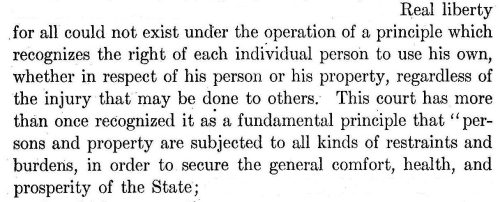
In Jacobson v. Massachusetts, 197 U.S. 11 (1905), the Court distinguished “an absolute right in each person to be, at all

Continue Reading More Readings: “Real Liberty,” Vaccination, Plague, Police Power, And Takings