Here’s the video of the OA held this morning (March 10, 2020) in a case we’ve been following, about the statute of limitations governing inverse claims. Maryland Reclamation Association filed an regulatory takings claim in 2013, and eventually the jury awarded a whopping $45 million in just compensation and interest. Hartford County asserted the claim was barred by the three-year statute of limitations, and the claim accrued in 2007 when the Board of Appeals administratively denied MRA’s variance request. 

The Maryland Court of Special Appeals concluded that “An inverse condemnation claim ‘accrues when the affected party knew or should have known of the unlawful action and its probable effect.'” Okay, the County responded, MRA discovered the County’s conduct in 2007 when the Board denied the variances. In response, MRA asserted that the taking must become “permanent or stabilized,” and that didn’t occur until the court of appeals affirmed the

Continue Reading Maryland Court Of Appeals Considers Statutes Of Limitations In Inverse Condemnation: Do Appeals Toll Time?

ALICLE-tagline-250x90

At the recent ALI-CLE Eminent Domain and Land Valuation Litigation Conference in Nashville, our colleagues, New York’s Jon Houghton and Hawaii’s Dave Day presented a very informative program on litigating regulatory takings cases. Jon is a property owner-side lawyer, while Dave is a Deputy Attorney General who represents the State of Hawaii in such cases. So it was a practical and balanced presentation.

Well, Jon and Dave are taking (pun intended) it to the next level. On Friday, April 24, 2020 at 2-3pm Eastern Time, they will be presenting “Strategies for Litigating Regulatory Taking Cases” in a webinar produced by ALI-CLE. This isn’t simply a repeat of their Nashville program, but they will be exploring in more detail the practicalities of building and defending these difficult cases. 

Here’s the description of the program:

The U.S. Constitution provides that private property may not be taken for public use


Continue Reading Mark Your Calendars (Friday, Apr 24, 2020): ALI-CLE Webinar – Strategies for Litigating Regulatory Taking Cases

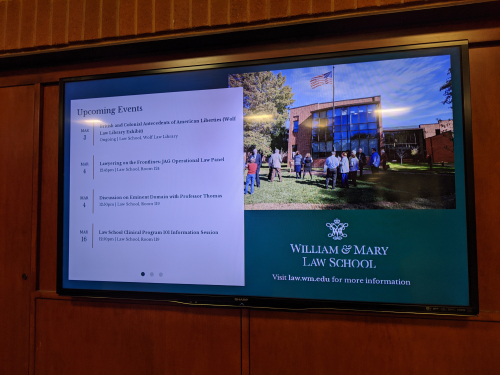
IMG_20200303_191820

We just completed a fun hour-long talk with the students in the William and Mary Law School’s American Constitution Society, the Native American Law Society, and the Society on Environmental and Animal Law about the various pipeline cases that are ongoing nationwide. (If our tech worked, we shall post the audio recording in a future post.)

The theme of our talk was that these cases are an excellent illustration of the need for lawyers to think outside their usual lanes when it comes to addressing and solving their clients’ problems, because they present a smorgasbord of legal issues that range from property and eminent domain law, to administrative law, constitutional law, state and local government law, environmental law, federal courts, and civil procedure. 

The lawyers who are litigating these cases have done a good job of not being bound by convention and thinking creatively. They are thankfully analyzing the cases

Continue Reading Cases And Materials From Today’s WM Law ACS Talk: “Pipelines at the Intersection of Environmental, Administrative, and Property Law: How Divergent Interests Joined Forces To Challenge Big Energy”

The local government does stuff that local governments do. Things like improve nearby roads. In doing so, they often interfere with the ingress and egress that nearby landowners enjoy. 

In Clark v. City of Pembroke Pines, No. 4D18-3549 (Feb. 26, 2020), the city had many reasons for erecting concrete barriers (among them the closure of nearby roads). But the end result was that access to Clark’s parcel (which happened to be over the city line, in an adjacent town) was partially (but not totally) cut off:

Before the City’s road construction, Clark had unrestricted access to SW 54th Place in front of his home. Afterwards, he said the barriers significantly impeded his travel because with them in place, Old SW 54th Place effectively became a “one-way, ten-foot-wide road” with no room for vehicles to turn around. Additionally, Clark’s only direct means of east and southbound travel—via SW 199th Ave—was

Continue Reading Substantial Loss Of Access — Even If Not Total — Is A Taking

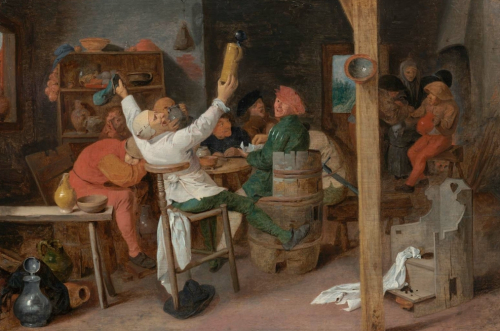
Peasants carousing

The last two cert-stage briefs have been filed in a case we’ve been following for a while (since it was decided by the Colorado Court of Appeals). 

In Carousel Farms Metro. Dist. v. Woodcrest Homes, Inc., 444 P.3d 802 (Colo. App. 2017), the appeals court invalidated an attempt to exercise eminent domain to take property which the owner had refused to sell to developer Carousel Farms. Although the Carousel Farms Metropolitan District couldn’t point to a present public use or benefit from the taking, it asserted that in the future the public would benefit from the condemnation because if Carousel Farms were allowed to develop its property in accordance with its agreement with the town, the public would receive new infrastructure such as roads and sewers. The trial court upheld the taking, but the court of appeals reversed. The real purpose of the taking was to facilitate the developer’s

Continue Reading Carousing at Carousel Farms: Final SCOTUS Cert-Stage Briefs In Colorado Eminent Domain Abuse Case

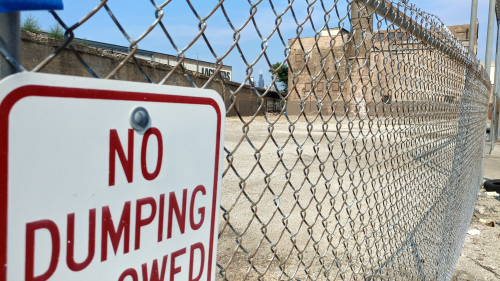
20180805_155740_HDR
Where is this? The clues are all in the picture. 

You’ve seen the citation so many times, your eyes probably gloss over it. After all, Westlaw lists it with 4,507 “Citing References.” That’s a heckuva lot of citations to a single case. 

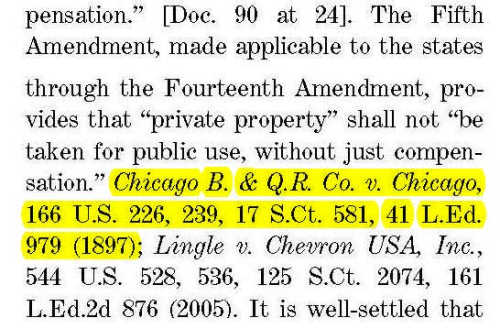
Like this one, pulled from a recent random federal district court opinion: 

Chcago cite

And we admit that we’ve done it: cited (but didn’t read) Chicago B. & Q.R. Co. v. Chicago, 166 U.S. 226 (1897) for the proposition that the rights in the Bill of Rights (in that case, the Fifth Amendment right to Just Compensation) have been selectively incorporated against states and local governments under the Due Process Clause of the Fourteenth Amendment. You’ve done it. We’ve all done it. 

To cure that shortcoming, we read and analyzed the case in our William and Mary class. And before we included it in the syllabus, we had

Continue Reading Just Compensation Site Visit: The First Right “Incorporated” Against States, And Local Govts

Here’s the latest in a long-running, multi-forum takings case about the development of affordable housing on the Big Island of Hawaii. 

Last we saw, the District Court awarded nominal compensation ($1), after the jury concluded that the State of Hawaii took Aina Lea’s property. The parties cross-appealed: the State argues the district court should have granted the State’s JMOL on liability, while the property owner appealed the $1 judgment. 

Today, the Ninth Circuit reversed the District Court’s ‘s opinion, holding that the district court should have ruled in the State’s favor on liability. The court remanded the case for entry of judgment in the State’s favor (meaning even the $1 just compensation judgment is gone). Bridge Aina Lea, LLC v. State of Hawaii Land Use Comm’n, No. 18-15738 (Feb. 19, 2020).

We’re tied up doing lawyer stuff today, so can’t read or analyze the decision in detail. But once

Continue Reading CA9: Remember That $1 The Court Awarded You For The Jury’s Finding Of A Regulatory Taking? We’re Taking That Away, Too

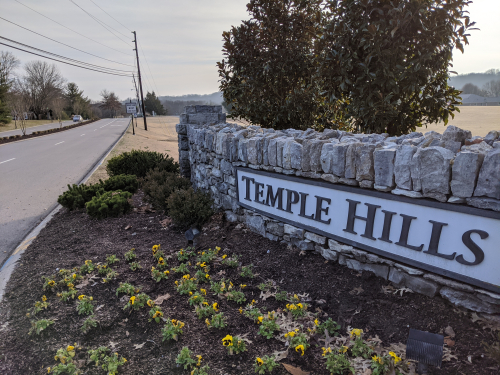
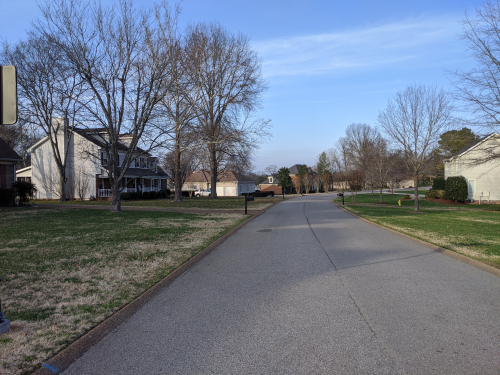
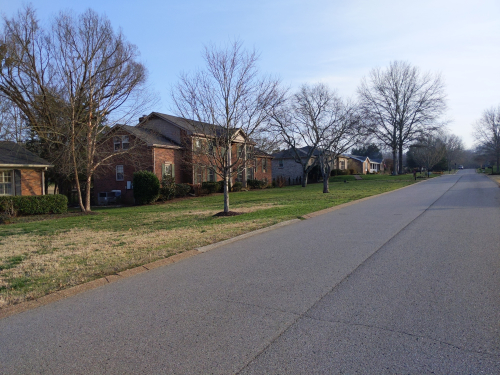
As we briefly noted in this post, before we departed the ALI-CLE Eminent Domain and Land Valuation Litigation Conference in Nashville, we just had to stop by the subdivision that was at issue in the Williamson County litigation. 

Frankly, there’s nothing especially special or noteworthy about this place, and only takings nerds will truly appreciate these pics. But given our propensity to make “takings pilgrimages” to the sites of famous property cases (see here (Claude Monet), here (Loretto), here (Chicago, B & Q RR), here (Dolan), here (Seneca Village), here (High Line), here (Hadacheck), and here (Nollan), for example), we just could not resist. 

So dig it, takings mavens. 

IMG_20200128_155300

There’s a golf course, of course. (There’s always a golf course.)

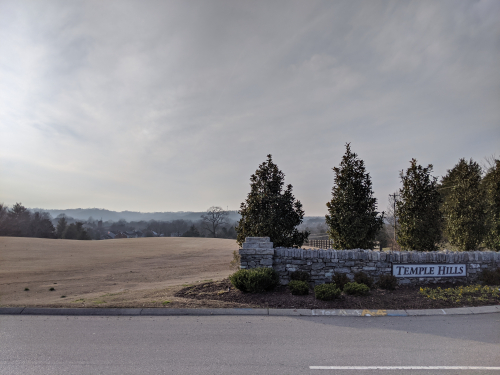
IMG_20200128_155147_1

“Temple Hills” beats “Glengarry Glen Ross”

PANO_20200128_154217.vr

A panorama of the main drag

IMG_20200128_154406

Up the street 

IMG_20200128_154302

Down the Continue Reading Williamson County, In Pictures

Profcorner.jpf

Please mark your calendars and join us next Tuesday, February 11, 2020 at 12:30pm ET for the free (for members of the ABA’s Real Property, Trust and Estate Section) webinar, the monthly “Professors’ Corner.”

This one will be on the aftermath of Knick v. Township of Scott, 139 S. Ct. 2162 (2019), in which the Supreme Court formally overruled the “state procedures” ripeness requirement in federal regulatory takings cases. 

We shall be speaking about the case and what’s next along with Professors Stewart Sterk and Michael Pollack (moderated by Professor Shelby D. Green). Here’s the summary of the webinar from the ABA website:

Last term, in Knick v. Township of Scott, the Supreme Court overruled the long-standing requirement that state takings claims first be litigated in state courts. The Court held that a property owner has an actionable takings claim when the government takes property without paying for

Continue Reading Tuesday Feb 11, 2020: Professors’ Corner – The Supreme Shift in Takings Litigation – Knick v. Township of Scott

IMG_20200128_154634_1 STOP

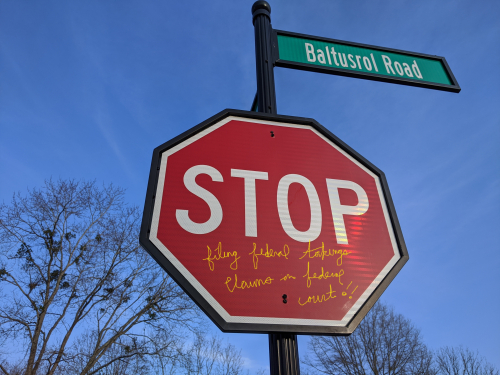
Having just wrapped the 2020 ALI-CLE Eminent Domain and Land Valuation Litigation Conference in Nashville (very successfully, but more on that later), we could not depart the area without paying a visit to the site of the late-and-not-so-great Williamson County case, in a nearby suburb (we’ll also have more on that later, once we’re back in the office). 

Driving into the infamous — at least in takings circles — Temple Hills subdivision, we came across this STOP sign at a key intersection, with some curious graffiti. Continue Reading Saw This Sign In Williamson County, Tennessee