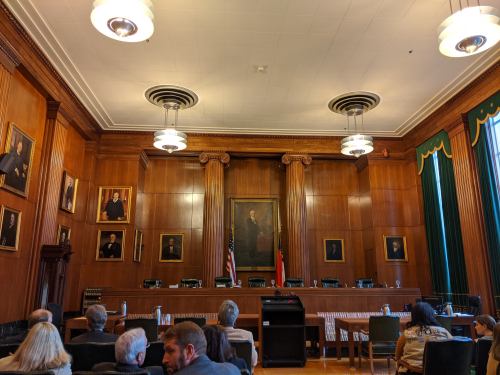
IMG_20200123_070935

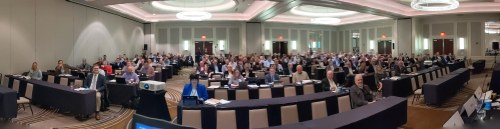
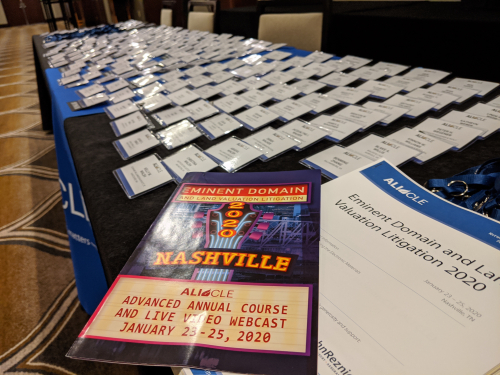
We’re in Nashville for the next three days, where we have record attendance (see above for the name-tag matrix), with nearly 300 attendees spread out over three rooms. 
IMG_20200123_070704

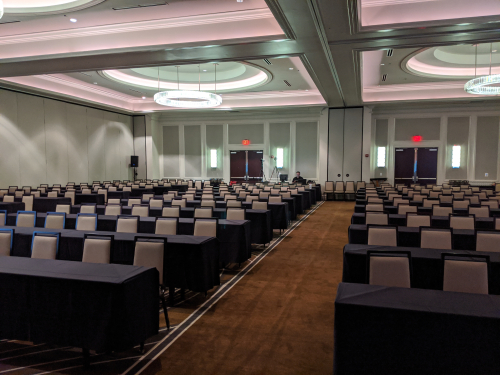
The Big Room, before. 

PANO_20200123_090701.vr

The Big Room, during. Like we said, record attendance. 
IMG_20200123_070830

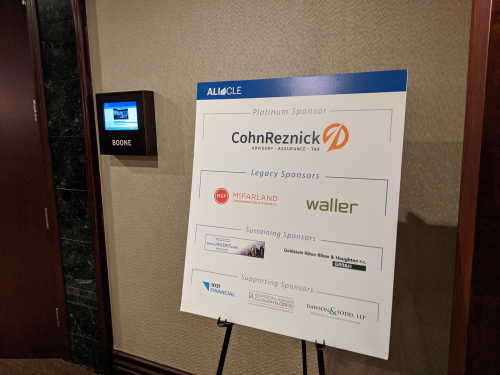
Thanks to the generosity of our sponsors, we have very good social events. Like the lunch, below.

IMG_20200123_122053

IMG_20200123_125822

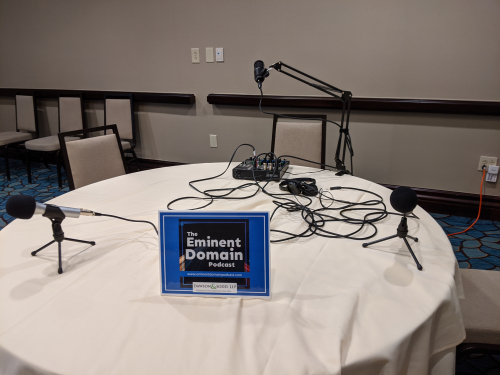
Clint Schumacher brought his Eminent Domain Podcast studio to Nashville to record future episodes.Continue Reading Greetings From The 37th Annual ALI-CLE Eminent Domain & Land Valuation Litigation Conference, Nashville
EOGnEv8W4AAoKnI

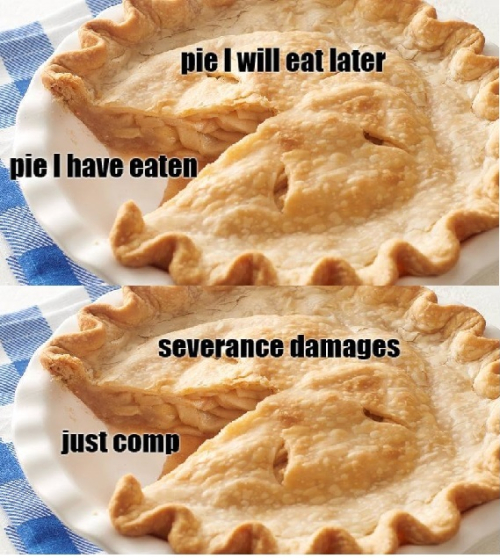
Picture 1: how normal people see pie.

Picture 2: how you see pie if you’re coming to the
ALI-CLE Eminent Domain Conference. 

If you get the above, you probably are already set to join us next week for the 37th Annual ALI-CLE Eminent Domain and Land Valuation Litigation Conference in Nashville. (If not, shame on you!).

And having just reviewed the latest registration list, I can report that we have an all-time record attendance.  But there’s still room for those of you still not committed. Register here. Don’t miss out. There will be pie. Continue Reading Record Attendance (But There’s Still Time For You Last-Minute Filers) At Nashville ALI-CLE Eminent Domain Conference

ELHy3bhUYAAdM4B

If there’s one downside to the law school experience from the teacher’s side of the lectern, it’s grading. Especially at a law school like William and Mary that has a pretty strict mandatory curve.

In an upper-division course like “Eminent Domain and Property Rights Law,” where we’re dealing with some very high-level stuff and the quality of the students is uniformly excellent, that makes for some hard choices at this time of year. But we’ve wrapped up grading, and have submitted the official scores.

Although I cannot share with you all the papers themselves, I don’t think my students would mind if I give you a sampling of the topics and titles, just so you can see how the next generation of lawyers is thinking about this area of law: 

  • One Man’s Castle is Another Man’s Parking Lot: A Homeowner’s Theory of Eminent Domain
  • Native Title: Concept and


Continue Reading The Circle Is Now Complete: A Sampling Of Final Paper Topics From William and Mary Law’s Eminent Domain & Property Rights Course

A very short opinion we’ve been meaning to post for a while.

In Hickman v. Ringgold County, No. 19-0123 (Nov. 6, 2019), the Iowa Court of Appeals considered property owners’ claim that the taking of their land to create a access road for the neighboring concrete plant was not a valid public use. Seemed like a pretty good claim. After all, Iowa prohibits economic development takings:

“public use” or “public purpose” or “public improvement” does not mean economic development activities resulting in increased tax revenues, increased employment opportunities, privately owned or privately funded housing and residential development, privately owned or privately funded commercial or industrial development, or the lease of publicly owned property to a private party.

Iowa Code § 6A.22(2)(b).

And, in the type of testimony that would make every municipal lawyer cringe, a county supervisor admitted the taking was “to further develop the economics of the county”

Continue Reading “That said…” A Prohibited Economic Development Taking Is OK If It Is For A Road

One does not simply walk to nashville

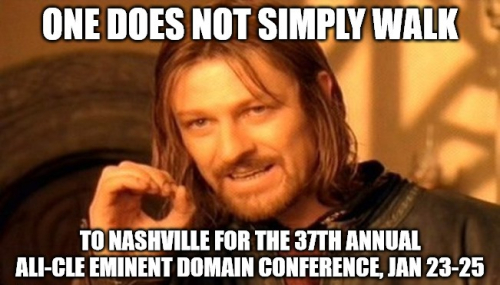
You can also fly, drive, or bike to the upcoming 37th Annual ALI-CLE Eminent Domain & Land Valuation Litigation Conference. in Nashville. Limited space still available, so don’t delay further and register now. We’re on track to record attendance, so you don’t want to miss the best nationally-focused three-day program on our area of law.

Takings, Knick, compensation, appraisals … and a bit of fun thrown in. We have many new attendees, and many new speakers, too.  Continue Reading (Nearly) Last Chance To Join Us In Nashville For ALI-CLE’s Eminent Domain Conference

20170918_171029_Richtone(HDR)

We’re seeing a lot of “end of year” and “end of decade” wrap-ups, so figured we’d better chime in.

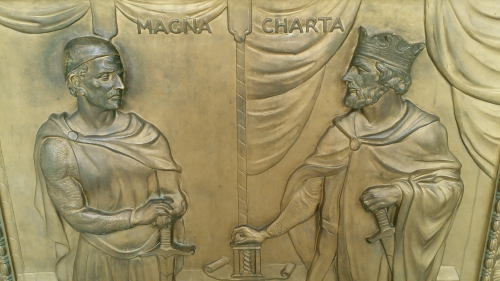
As the above graphic hints (this is detail of the doors of the U.S. Supreme Court), our biggest case of 2019 (and probably of the twenty-aughts) is Knick v. Township of Scott, 139 S. Ct. 2162 (2019). The federal courthouse doors are open again to federal takings claims. 

Yes, the U.S. Supreme Court doors were technically already open (via cert petitions from state supreme court takings cases), and Knick simply re-set the clock back to 1985, but if the two-thousand double-ohs were the decade of Kelo (a loss), will not the 2010’s be defined by Knick (a big win) even if the ruling came at the tail end of the decade?  

Compare where we are today with where in 2016 we thought we were heading

Continue Reading Biggest Case Of The Year…Or Maybe The Decade?

IMG_20191209_091814

This time last week, we were sitting in the North Carolina Supreme Court’s (very beautiful) courtroom, above, having just observed oral arguments in a case we’ve been following for quite a while, Chappell v. NCDOT, No. 51PA19 (docket here). 

This case is the follow up (after remand) of the N.C. Supreme Court’s landmark decision in Kirby v. North Carolina Dep’t of Transportation, No 56PA14-2 (June 10, 2016), in which the court held that the “Map Act,” a statute by which DOT designated vast swaths of property for future highway acquisition, was a taking because the Act prohibited development and use of designated properties in the interim. The court concluded “[t]hese restraints, coupled with their indefinite nature, constitute a taking of plaintiffs’ elemental property rights by eminent domain.” The court remanded the case for a parcel-by-parcel determination of just compensation. On remand, the trial court concluded

Continue Reading NC Supreme Court Considers Just Compensation For Formerly Indefinite–But Now Temporary–“Map Act” Takings

Check out Marianist Province of the United States v. City of Kirkwood, No. 18-3076 (Dec. 13, 2019), for the U.S. Court of Appeals’ handling of RLUIPA and (state law) takings claims stemming from the city not allowing a religious school to light up its baseball field. 

Today’s a busy day, so we won’t delve in detail into the opinion. But nicely, the Eighth Circuit’s website has a summary:

In school’s challenge to city’s zoning regulations in connection with the school’s lighting of its outdoor baseball diamond, the district court did not err in determining that the regulations concerning lighting and sound systems did not substantially burden the school’s religious exercise in violation of RLUIPA; the school’s inability to use its baseball field at night is a mere inconvenience and not a substantial burden because there are alternative times and locations available to it; school’s “as-applied” claim that the school

Continue Reading If You Build It, It Might Be A Zoning Violation: No Taking, No RLUIPA Violation When Zoning Limited Lights On Religious School’s Baseball Field

Here’s the latest opinion about land use from the Hawaii Supreme Court. Unite Here! Local 5 v. Dep’t of Planning & Permitting, No. SCAP-17-823 (Haw. Dec. 13, 2019).  Because our Damon Key partner Greg Kugle was the prevailing lawyer in the case, we won’t go into detail about the opinion, but leave it to you to delve into it.

It is about procedural due process and the opportunity to object in the administrative appeals process, permit conditions, and the like. Land users, check it out. 

Unite Here! Local 5 v. Dep’t of Planning & Permitting, No. SCAP-17-0000823 (Haw. Dec. 13, 2019) 

Continue Reading HAWSCT: When Agency Includes Conditions In Phase 1 Land Use Permit, But Later Removes The Conditions In Phase 2 Permit, Party Who Asked For Conditions Is Entitled To Notification