


Here’s the latest on the judicial takings/rent control case which we’ve been following

This is the case where New York property owners assert that the N.Y. Court of Appeals’ decision which concluded that the luxury apartments (which were never formerly subject to rent control) are now governed by the Rent Stabilization Law. This, the petition argues, allows tenants (who hardly need the protections of rent control) to renew less-than-market rent in perpetuity. 

Some heavy hitters have weighed in on the side of the Petitioner, including takings maven Richard Epstein, who filed this amicus brief:

But another way of thinking about this case is to focus less on Petitioner’s property right in the physical building and more on its interest in the public benefits conferred under the RPTL and RSL—namely, Section 421-g benefits and luxury decontrol. New York law recognizes a “vested” property right in a public benefit
Continue Reading Takings Maven Prof Epstein Weighs In On Latest SCOTUS Judicial Takings Case: Owners Had A “Legitimate Claim Of Entitlement” To Rent Decontrol

Here’s the amicus brief we filed yesterday in a public use case we’ve been following that asks whether pretext and private benefit are irrelevant as long as the condemnor invokes a “classic” public use. In this case, the Colorado Supreme Court overturned the court of appeals’ conclusion that even though the purported purpose of the taking was to provide future possible public infrastructure, the overwhelming private benefit today meant the taking was not for public use. 

Here’s the cert petition

Southeastern Legal Foundation, Cato Institute, Owners’ Counsel, and NFIB Small Business Legal Center joined in the brief, which argues that the unusual circumstances (an obviously self-interested condemnor) lead to a reasonable suspicion that “a private purpose is afoot” (as Kelo put it), and thus the usual presumption of conceivable basis review is not warranted, and indeed, the courts should look at these type of takings with a particularly skeptical

Continue Reading New SCOTUS Amici Brief: Invoking A “Classic” Public Use Isn’t Enough When The Circumstances Reveal “A Private Purpose May Be Afoot”

Here’s decision we’ve been anticipating in a case and issue we’ve been following for a while, the question of whether private utilities can be held liable under an inverse condemnation theory for much of the damages caused by the recent California wildfires. 

Short story from the Northern District of California Bankruptcy Court: yes, private utilities can be liable in inverse condemnation:

What Debtors advocate here is to set aside a well-seasoned principle of strict liability. Failing that, they are seeking a solution, fire cost reimbursement, in search of a problem, CPUC’s refusal or unwillingness to allow recovery by a blameless (prudent) investor-owned utility. As noted, they cite no instance when the CPUC denied inverse condemnation cost reimbursement to a prudent operator. And it is the role of the legislative branch, not the judicial branch, to fix problems in advance. As recently as this past July, the California legislature refused

Continue Reading California’s “Well-Seasoned” Inverse Condemnation Strict Liability Principle Not Set Aside By PG&E’s Bankruptcy Court

Following up on the petition, filed last Friday, asking the Virginia Supreme Court to review a trial court’s demurrer which failed to recognize that the owners of a state lease to harvest oysters in the Nansemond River have a property interest . The court concluded that the city and santitation district possess a superior right to pollute the river with sewage.

The case arose when the city and sanitation district declared the oysterbeds “condemned” during certain times of the year because they put sewage into the river. They denied compensation, and the trial court held that Darling v. City of Newport News, 249 U.S. 540 (1919) subjected the lease owners to the city’s superior right to pollute.

We paid a visit to the site a couple of weeks ago to see the pollution source, and how the oysters are harvested in the river. The above video is from that

Continue Reading Videos: Oyster Takings On The Nansemond River

MVIMG_20191108_125325

Just filed: this Petition for Appeal in a case which our William and Mary Law class has a special interest in.

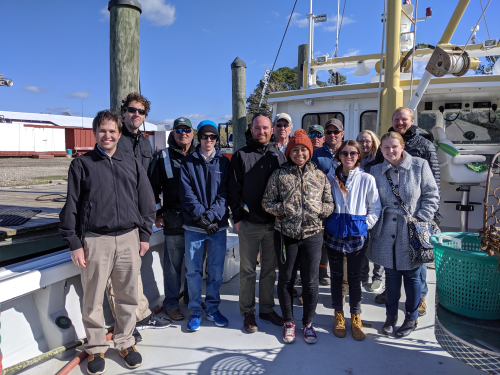
The above photo was taken a couple of weeks ago, when we paid a visit to the property owner/plaintiffs, the owners of a long-standing oyster business operating out of the City of Suffolk, Virginia. The oystermen own a lease from the state for the riverbed, which among other things, allows them to harvest some of the oysters that Virginia is so well known for. But they were forced to bring an inverse condemnation claim in state court, asserting that the City’s dumping of wastewater in the river — and prohibiting the harvesting of oysters during those times — was a taking under both the U.S. Constitution, and Virginia’s taking or damaging clause.

The trial court sustained the City’s demurrer, accepting the City’s argument that it has the right

Continue Reading City: We Have The Right To Pollute – Virginia Oystermen’s Petition Asserting A Taking

We were not as creative as our colleague Paul Henry (see below), but our Planning Co-Chair Joe Waldo and I wanted to personally invite you to join the “big guns” in our area of law at the 37th Annual ALI-CLE Eminent Domain and Land Valuation Litigation Conference, January 23-25, 2020, in Nashville, Tennessee.

We’ve assembled an excellent faculty, and an agenda that covers the hot topics of the day. Go here to view the complete faculty list and agenda. Water rights, Knick, appraisal, ethics, civil rights, and a whole lot more in three days of the longest (and we think best) conference in our area of law. Also, for those new to the field, Andy Brigham and Jack Sperber are again leading their “Eminent Domain 101” program. A great way to learn the topic, or for experienced lawyers to get a quick refresher on the basics. Your registration

Continue Reading Don’t Miss Out: Join The “Big Guns” And Secure Your Space At ALI-CLE’s Upcoming Eminent Domain & Land Valuation Litigation Conference (Jan 23-25, 2020, Nashville)

20170918_185734_Richtone(HDR)

Here’s the latest in a case we’ve been following for a while, Smyth v. Conservation Comm’n of Falmouth, No. 19-223 (cert. petition filed Aug. 16, 2019). 

The petition seeks review of a Massachusetts decision which held that a judge, not a jury, determines Penn Central takings questions, and also that the owner lost anyhow because, you know, Penn Central. The petition asks the Supreme Court to review these Questions Presented:

  1. Whether the loss of all developmental use of property and a 91.5% decline in its value is a sufficient “economic impact” to support a regulatory takings claim under Penn Central.
  2. Whether a person who acquires land in a developed area, prior to regulation, has a legitimate “expectation” of building and, if so, whether that interest can be defeated by a lack of investment in construction?
  3. Whether the Court should excise the “character” factor from Penn Central regulatory


Continue Reading Latest In SCOTUS Penn Central Cert Petition

Check this out: the Complaint, filed a couple of days ago in federal court against the State of New York (and others), that alleges the state’s recently-adopted rent control regulations is a taking (among other claims). 

It’s a long complaint so we shall leave it to you to delve into the details yourselves. Most interesting to us is that the complaint’s first named defendant is the State of New York as the State of New York.

What about Eleventh Amendment immunity, you ask? 

Read on. 

Compliant, 74 Pinehurst LLC v. State of New York, No. 1:19-cv-06447 (E.D.N.Y. Nov. 14, 2019) 

Continue Reading New Federal Court Complaint: State’s Rent Control Is A Taking

All seemed to be going well for the property owners in a Florida takings case. They obtained a satisfactory compensation judgment for the taking of their healthy citrus trees (yes, this is that case). And because Florida’s Constitution requires “full” compensation, they were also entitled to attorneys’ fees and costs. $13 million in compensation, nearly $1 million in fees. Took a while, but so far, so good.

That’s when the Florida Department of Agriculture really dug its heels in. It acknowledged it was obligated to pay compensation, but it simply refused to do so. It didn’t make a request to the legislature to appropriate money to satisfy the judgment, and claimed it has no obligation to do so. The legal equivalent of a middle finger at both the courts and Florida citizens:

Here, as discussed previously, the Department takes the position that it will make no payment of the

Continue Reading Florida Dep’t of Ag’s Middle Finger To The Courts And Property Owners: We Were Ordered To Pay Full Compensation…But We’re Not Going To