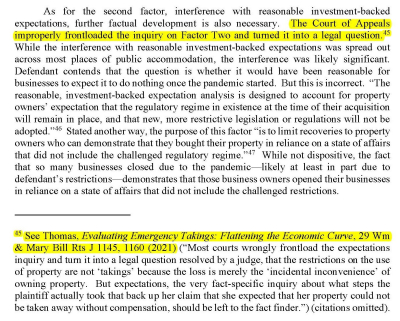
Here’s the latest in a case we’ve been following, which asks whether a local ordinance which allowed non-paying tenants to remain in the lessor’s property is a physical taking, or merely the regulation of the lessor/lessee relationship under the Yee theory, which posits that once an owner voluntarily rents property to a tenant, the government then allowing that tenant to remain rent free isn’t facilitating an unauthorized physical occupation, but rather is merely a regulation of the existing lessor/lessee relationship. In short, you let ’em in property owner, so suck it up.

The property owner has now filed this cert petition challenging that rationale.

As we’ve noted previously, some courts’ reliance on Yee in this and similar situations is a misreading of that decision. Besides that, these courts essentially upend the longstanding common law of property governing the owner/tenant relationship, and the contractual nature of that relationship

Continue Reading New Cert Petition: Eviction Moratorium Transferred Possession Easement To Nonpaying Tenants

This one from the Tenth Circuit didn’t even merit a published opinion, but is still worth reading, just because the situation seems so absurd.

In this Order and Judgment, the court affirmed the dismissal of property owners’ claim that the County wouldn’t issue a septic permit until after the owners actually constructed the septic system. Colorado law, they argued, requires them to get a permit before building a septic system. That’s nice, replied the County: here, we do it different; first you build, and only then do we decide whether you get a permit.

The owners alleged that without a septic permit, they could not obtain a construction permit. Which means that they couldn’t build their home as planned. Next stop, federal lawsuit alleging due process violations (both kinds) and a taking. 

The district court dismissed and the Tenth Circuit summarily affirmed:

  • Procedural due process: yes, the conflict between


Continue Reading CA10: A Municipality Is Forcing Owners To Violate State Law … No Problem!

Screenshot 2024-10-11 at 08-06-50 RPFSS

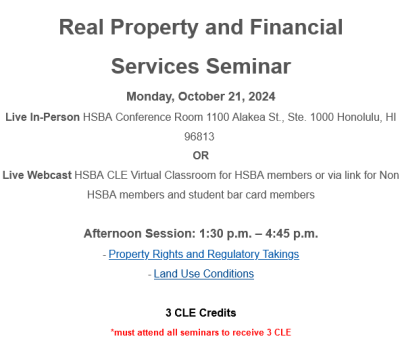
Hawaii lawyers (and those barred in the 808), take note: On October 21, 2024, the Hawaii State Bar Association will hold its annual Convention, and as always there’s a full lineup of CLE programs so you can meet your MCLE requirements.

Thanks to the Real Property & Financial Services Section, there’s a significant dirt law component. First, there’s “Property Rights and Regulatory Takings” the program on which we are presenting along with Dwight Merriam and lawprof Shelley Saxer. Here’s the official description:

This course will provide a survey of property rights and regulatory takings with an emphasis on recent decisions from the United States Supreme Court. Panelists include distinguished faculty and practitioners that will address impact fees, development rights, taking claims, rent controls, and other current issues.

Following us will be a program on “Land Use Conditions” with Cal Chipchase, Brad Saito, and a lawyer

Continue Reading Hawaii Dirt Lawyers: Don’t Miss “Property Rights & Regulatory Takings” CLE At The HSBA Convention (In-Person & Webcast)

CRE prize

Congratulations to our Pacific Legal Foundation colleague Brian Hodges for his article “Build-to-Rent Homes: A Promising Solution to Chronic Housing Shortages” being awarded the 2024 Jared Shales Prize by the Counselors of Real Estate (CRE).

From the Introduction:

When homeownership is increasingly out of reach for many, build-to-rent (BTR) housing offers a desirable alternative to traditional homeownership. First, BTRs provide flexibility that traditional homeownership cannot match. By renting rather than owning, tenants are free to move around the city or the country as their jobs, family situations or lifestyle decisions dictate. They can enjoy the benefits of urban or suburban living without being tied down to a particular location or property. Second, BTRs are often built to higher standards than traditional rental properties, with modern amenities and communal spaces that foster a community and belonging. These properties are often professionally managed, meaning that tenants can enjoy the

Continue Reading “Build-to-Rent Homes: A Promising Solution to Chronic Housing Shortages” – CRE 2024 Jared Shales Prize

If there’s a silver lining in the U.S. Court of Appeals for the Sixth Circuit’s opinion in Slaybaugh v. Rutherford County, No. 23-5765 (Sep. 3, 2024), a case about what we call “SWAT takings” (police destroy someone’s property in order to dislodge a criminal suspect), it’s that the court did not adopt the usual “this was a really, really good exercise of the municipality’s police power so there’s no taking” approach.

But even though it applied a different analysis, the result was the same: no taking. Instead of the “police power” rationale, the court dug into the substance a bit more and determined that the police were “privileged” to physically invade and destroy the Slaybaugh property.

The court first acknowledged that owners generally have the right to exclude:

In arguing their prima facie takings claim, the Slaybaughs contend that police infringed on their property rights by invading

Continue Reading No SWAT Takings In CA6: Police’s Power To Arrest Includes Privilege To Damage Property

In Turner v. Jordan, No. 22-13159 (Sep. 17, 2024), the U.S. Court of Appeals for the Eleventh Circuit held that even though the federal courts have jurisdiction over Turner’s takings claim, the court nonetheless has the discretion to choose to wash its hands of the case in order to protect a state’s administrative procedures.

This is one of those home equity takings cases, with the twist here being that Turner claims that because Florida officials failed to account for his homestead exemption, his property sold for half of what it should have at a property tax foreclosure sale. He alleged that with the exemption, the sale would have netted him some equity to which he was entitled. The district court dismissed for comity reasons, and the Eleventh Circuit affirmed.

Of course, the opinion pays lip service to the more-often-in-the-breach-than-in-the-observance principle that “federal courts have a ‘virtually unflagging obligation …

Continue Reading Comity Of Errors: CA11 Chooses Nondisruption Of State’s Administrative Process Over Constitutional Right To Compensation

The gunfight at the OK Corral is about all we know
about bearing arms in public places.

There’s a lot going on in the U.S. Court of Appeals for the Ninth Circuit’s opinion in Wolford v. Lopez, No. 23-4356 (Sep. 6, 2024), and none of it is about takings, at least directly. And the case involves a Second Amendment challenge to Hawaii and California’s restrictions on where a bearer of arms can bear those arms, a topic that is beyond our full understanding as mere mortals.

So why are we covering it? Well, glad you asked. This one is peripherally about property rights and because of the posture of the case avoids what we think is the biggest issue from a property rights viewpoint. The bulk of the case analyzes the state’s ability to restrict carrying weapons in public places like beaches, parks, and other public venues. But one

Continue Reading Guns N’ Encloses: While Figuring Out Gun “Sensitive Places,” CA9 Backhandedly Upholds The Right To Exclude

A frequent vibe in cases where a member of the public asks a court to compel a local government to do something about an undesired land use (i.e., “the city should stop my neighbor from illegally renting their property,” or “the police should remove the pop-up unlicensed food stand on the sidewalk in front of my restaurant”) is that zoning enforcement is often viewed by courts as a discretionary municipal function or a question about allocation of enforcement resources — and therefore the judiciary takes a hands-off approach.

That vibe, however, did not carry the day when the Arizona Court of Appeals tackled Brown v. City of Phoenix, No. CV23-0273 (Aug. 27, 2024). In that case, the court upheld a trial court’s preliminary injunction ordering Phoenix to do something about the notorious “zone” that the trial court determined was a public nuisance “created or maintained” by the

Continue Reading Court To Phoenix: Clean Up Your Act!

Excerpt

In this Order, the Michigan Supreme Court declined to consider a case which challenges the Michigan governor’s Co-19 shutdown executive orders, which, in the words of the dissenting Justices, reached “nearly every aspect of life in our state.”

There have been a lot of cases asserting that Co-19 shutdowns are takings, with most (but not all) of them crashing and burning, including this one. Here, the plaintiffs — a class of owners whose businesses suffered devastating losses as a result of the shutdown orders — sought just compensation for the regulatory taking. They alleged both types of takings, categorical and ad hoc (Penn Central). They also asserted claims under the Michigan Constitution (a trend we approve!).

We recommend you take a dive into the Statement of the two Justices who dissented. They would have taken up the case because “the majority leaves unresolved

Continue Reading Michigan, Over Dissent, Declines To Hear Co-19 Shutdown Takings Case

This would not be authorized.

Here’s the latest in an issue that found new vitality after the U.S. Supreme Court’s decision in Cedar Point affirming that government-authorized physical entry to private property is presumptively a taking.

This is the “precondemnation entry” issue in eminent domain which several courts have addressed:

This is where a condemnor contemplates taking property and wants to get on site to check it out. Do things like surveys, examinations, tests, and sample-taking. Often, the owner of the property doesn’t mind: pay me a bit for my trouble, indemnify me in the event someone gets injured, and you can have limited access to do your business and then go on your way, condemner. But sometimes, an owner says no.

In Betty Jean Strom Trust v. SCS Carbon Transport, No. 30317 (Aug. 21, 2024), SCS is planning a CO2 pipeline though South

Continue Reading S Dakota: Only Way To Read Precondemnation Entry Statute Constitutionally Is Allowing “minimally invasive superficial inspections” and “minor soil disturbances”