IMG_20170726_181554

You may recall that last October, we attended the first round of Supreme Court oral arguments in the Knick case with our William and Mary law class (Law 608: Eminent Domain and Property Rights).  

And even though there’s not a takings case on the Court’s current docket, we figured that the Maui Clean Water Act case was close enough. So we road-tripped it from Williamsburg to DC last Wednesday. And to make sure the six-plus hour round trip was not filled with awkward silence, like last year we asked each attendee to supply at least two songs for our playlist: one song a good “driving” song; the other a song that could be somehow connected to either our class topic (property rights, eminent domain, land use, and similar), or the day’s Clean Water Act and environmental issues. Well done, class, for being creative. 

Here’s what we came up with:

Continue Reading Law 608’s [Continuing] Playlist: More Takings And Related Road Trip Music
Check this out. The Complaint that we’ve been meaning to post for a while, filed last month in a Los Angeles U.S. District Court, alleging that California’s new rent control laws are a taking, among other things.

Are rent control laws takings? Yes, pretty sure about that. But will courts conclude that they are takings? If past experience is any guide, courts look for (and find) ways to conclude they are not takings, because, you know, this is one government regulatory scheme that people — here, tenants, can rely on (compared to others, where if you claim a property right in government regulation you are, in Chief Justice Roberts’ words, a “chump”).

Chump on, rent control challengers.

Complaint, Better Housing for Long Beach v. City of Long Beach, No. 2:19-CV-08861 (C.D. Cal. Oct. 15, 2019)… 

Continue Reading New Fed Ct Complaint: City’s And California’s New Rent Control Laws Are Takings

Here’s the OA video (courtesy of the Michigan Supreme Court) from last week’s arguments in what we’re calling the “keep the change” case. 

That’s the one where the government is arguing that after a property owner was late paying $8.00 in property taxes, the government is not only entitled to foreclose on the property, but to keep the difference between the sales price and the taxes and penalties owed. As our Louisiana friends might say, that’s a bit more than lagniappe

Eight bucks is more like a rounding error than a significant underpayment, but we get that you do owe every cent. And that when you don’t pay on time, they can hit you up for the taxes owed, the interest, and penalties. But as Gilbert & Sullivan wrote in their famous treatise on Remedies, “let the punishment fit the crime.” They can’t just pocket the difference

Continue Reading Oral Argument In Michigan “Keep The Change” Takings Case

IMG_20191106_112246

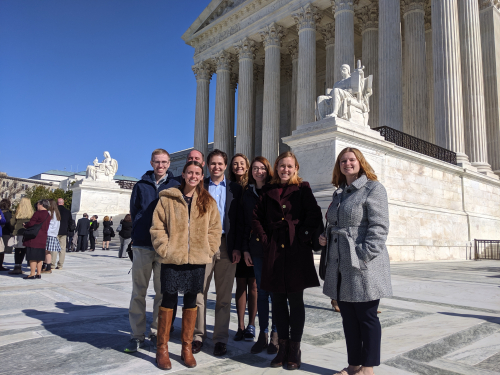
Protip for the public line for SCOTUS arguments: you have to get there really early. As in really early. Before 5 am early. Because that’s the time that we, along with some of our William and Mary Law students (pictured above, after the arguments), arrived at 1 First Street NE to take up our place in line yesterday for the arguments in the Maui Clean Water Act case. And we were — literally — the very last allowed in for the full arguments. We roadtripped it from Williamsburg (more on that in a future post), meaning that we awoke long before 5am, leaving the law school at an ungodly hour. It would have been a shame to have taken all that effort, only to not get in. So heads-up line standers: get there early.

Why all this effort, you may ask? After all, you can read the transcript the same

Continue Reading Hot Take On The Maui Clean Water Act Arguments (Protip: ARRIVE EARLY)

We’re on the road early tomorrow for another visit to SCOTUS with our William and Mary Law School class. We hope to get in for the arguments in the Maui Clean Water Act case. Last year, we attended the first Knick arguments in October, and we wanted to repeat the experience for this year’s students.

Yeah, we know that technically, the CWA case does not involve property or takings. But come on, it’s all we’ve got on the docket right now, and the case is very important to property owners who — if Earthjustice’s arguments are accepted by the Court — will only know if they are liable under the Clean Water Act for not getting a permit after they don’t get a permit. As we see it, the linkage test the respondent has advanced means that if a connection between a no-permit point source of pollution and waters

Continue Reading Road Trip SCOTUS: Maui Clean Water Act Oral Arguments (11/6/2019)

Registration underway, so come join us! Agenda full of hot topics in takings and appraisal law! The best national faculty! Renew friendships, and make new colleagues! And Nashville! 

Download the brochure and make your plans for January. (Don’t wait, we’ve sold out the past three years.)Continue Reading Register Now! ALI-CLE Eminent Domain And Land Valuation Litigation Conference (Nashville, Jan 23-25, 2020)

Here’s the other shoe that we’ve been waiting to drop.

Recall that in our last post on the pending Clean Water Act case (SCOTUS oral arguments scheduled for November 6, 2019 – yeah, as in one week from tomorrow), we suspected that a declaratory judgment action would be filed in a Hawaii state court to resolve the internal dispute between the various branches of the Maui County government about which branch(es)’s approval is needed to settle the case. On one side, the Mayor claims that the settlement of the CWA case needs his approval (which he isn’t giving). The Corporation Counsel’s analysis backs his argument up. On the other side, the County Council — which, by a one-member margin voted to settle the case because the CWA plaintiff’s lawyers are terrified of what the Supreme Court might do with the case — who assert that they alone have

Continue Reading Citizens Sue Maui Mayor (Finally) To Force Him To Settle SCOTUS Clean Water Act Case – But Is It Too Late To Scuttle The Arguments?

00100lPORTRAIT_00100_BURST20191023131755040_COVER

These days, parts of California often looks more like a developing country than the world’s fifth most powerful economy. Urban encampments — complete with medieval diseases — have become legendary. The streets of its glittering cities of tech are paved not with gold, but with human waste (but there’s an app for that!).

No longer the Golden State, it is more The Land Of No (no market rent, no plastic straws, no natural gas heating or cooking, no foie gras, no plastic bags, no fur, no teeny bottles of hotel shampoo, (no cheap gasoline, either), no early morning school, no state-funded travel to retrograde locales, no “lunch shaming,” no smoking outside. No this, no that. You name it, California will probably eventually ban it. (Except weed; weed anywhere is just fine.)

Most recently, no

Continue Reading Lights Out In The Land Of No: The Practical Effects Of California’s Wildfire Inverse Condemnation Doctrine

Update 10/25/2019: an astute and seasoned correspondent writes that the issue of whether a property owner must raise constitutional issues in the administrative proceedings was settled in a published opinion that involved the same agency, the California Coastal Commission. See Healing v. Cal. Coastal Comm’n (1994) 22 Cal. App. 4th 1158 (we put in in California citation style just because) (“These [the takings questions] are questions for a court of law to decide at an evidentiary trial, not by mandamus review of an administrative record of proceedings where the parties’ right to present evidence was limited by the very nature of the administrative process.”).

Why the Coastal Commission doesn’t know its own law, escapes us.  

++++++

Hat tip to Benjamin Rubin at the California Eminent Domain Report for writing up a recent opinion issued by the California Court of Appeal, Greene v. California Coastal Comm’n, No. B293301 (Oct. 9

Continue Reading Cal App: Agency Has Power To Adjudicate Whether The Agency Itself Is Taking Property (Really)

Emoji_u1f4a9.svg

There’s nothing terribly novel in the Texas Court of Appeals’ opinion in City of Houston v. The Commons at Lake Houston, Ltd., No. 14-18-00664-CV (Oct. 15, 2019), but we highlight it here for a couple of reasons. 

First, the court’s holding that a regulatory takings claim was not ripe because the property owner had not sought a permit — and as a consequence, the city had not yet reached a “final decision” whether the regulations in question (which require that buildings in an area be built at least two feet above certain floodplains) — reminds us that the first prong of Williamson County ripeness is alive and well (even though this was a case purely under Texas law, so Williamson County did not govern). The court noted that the owner “had not any permit of plat applications, or requests for variances, denied as a result of the amended

Continue Reading City Engineer’s Email Was Not “Official Action” Triggering Vested Rights Even If You Responded With A Smiley Emoji