Do we really need to tell you how a rent control regulatory takings claim fared in the Ninth Circuit? We didn’t think so.

In Colony Cove Properties, LLC v. City of Carson, No. 16-562655 (Apr. 23, 2018), a three-judge panel reversed a district court jury verdict which concluded that the City was liable for a Penn Central regulatory taking for the mobilehome Rent Board’s setting of a rent increase artificially low. The total award to the park owner, including damages for lost rental income, attorneys’ fees, and interest, was over $9 million. 

As we wrote in this post, the city and its amici predictably went ballistic and argued that the upholding the verdict threatened the very existence of mobilehome rent control. The court concluded that as a matter of law, the owner failed each of the three Penn Central factors.

First, the owner did not prove that the
Continue Reading 9th Cir: City Rent Board Determining Owner “Made Enough” Profit Isn’t A Penn Central Taking

20180419_150416_HDR

We’re in Detroit the rest of the week at the Mercy Law School for the venerable Land Use Institute, now in its 32nd iteration.

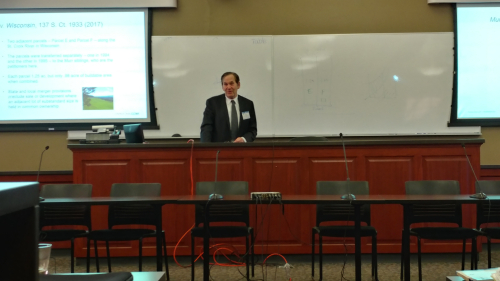
Planning Chair Frank Schnidman has assembled a great faculty including out Detroit colleague Alan Ackerman (above, talking about takings liability for flooding), and we’ll be spending the time talking inverse condemnation, public trust, planning law, homelessness, autonomous vehicles, affordable housing, RULIPA, and similar topics. We’ll be presenting on “Eminent Domain, Vested Rights, and Regulatory Takings,” “Client Representation: Developer, Government, and Citizens Groups,” and “Federal Laws Affecting Local Land Use Decision Making.” 

If you are here with us in Detroit, stop by and say hello. If you aren’t here, shame on you! This is one of the best and most affordable tuition deals in CLE.

But all kidding aside, if you are not in Detroit now, be sure to calendar these

Continue Reading Land Use Institute – Detroit

When the city condemned a portion of CED’s property back in 2012 for a highway project (replacing an intersection with a roundabout), the city’s appraiser testified that the taking did not confer any “special benefits” to CED’s remainder parcel. Eventually, CED and the city settled the case and the city paid agreed-upon compensation and severance damages. 

Flash forward a few years, and to help fund the roundabout project, the city adopted a special assessment and tagged CED and other nearby landowners. Based on its street frontage, the city charged CED a total of $40k, asserting that CED’s parcel had specially benefited from the improvement project by, among other things, “a substantial increase in accessibility, which includes safer, lower cost, and short travel time for customer, deliveries and employees. These special benefits are different in kind that those enjoyed by the public for through traffic.” The city acknowledged there were also

Continue Reading Wisconsin: “Special Benefits” In Eminent Domain Means “Uncommon Advantage,” But Only Regarding Market Value

Space is filling up, but there’s still time to join us later this month in Detroit for the 32nd Annual Land Use Institute (April-19-20). 

We’ll let program Planning Chair Frank Schnidman explain all the reasons why, and we’ll add only these points: (1) it’s a very good program that won’t take much of your time (fly in for the Thursday afternoon program, stay a night, fly home on Friday evening); (2) Detroit is the place to be these days; and (3) it’s one of the best deals in CLE credits, with tuition as low as $400.

2018 Land Use Institute Brochure Detroit 5 2018

Continue Reading There’s Still Time To Join Us In Detroit: 32d Annual Land Use Institute

We don’t usually post up trial court rulings, preferring to wait until the issue percolates up through the food chain. But this one is an exception, because, well, it’s darned interesting, and we wanted to get you all on board on the ground floor.

Here’s the trial court’s order granting the plaintiffs/property owners summary judgment in the case challenging the City of Seattle’s “first in time” ordinance, under which the city established the criteria for screening tenants, and required property owners to accept the first qualified applicant as a tenant.  The city acknowledged that the ordinance “affects a landlord’s ability to exercise discretion when deciding between potential tenants that may be based on factors unrelated to whether a potential tenant is a member of a protected class.” Slip op. at 2-3. The goal was to “eliminat[e] the role of implicit bias.”

In short, because a property owner might have an

Continue Reading Seattle’s “First in Time” Tenant Rule Is A Taking

Emotionheader

Here’s the printable brochure with the details on the 32nd Annual Land Use Institute in Detroit, April 19-20, 2018. We’ve plugged the program before so we won’t do so again, except to say that you really should attend because (1) it’s a very good program that won’t take much of your time (fly in for the Thursday afternoon program, stay a night, fly home on Friday evening); (2) Detroit is the place to be these days; and (3) it’s one of the best deals in CLE credits, with tuition as low as $400.

2018 Land Use Institute Brochure Detroit 5 2018

Continue Reading April 19-20, 2018: Land Use Institute, Detroit (Printable Brochure)

For those of you who have not recently attended the ALI-CLE Eminent Domain and Land Valuation Litigation Conference (just wrapped in Charleston, planning Palm Springs 2019), here’s a small sampling of the kind of thing we do.

It’s U. Virginia lawprof Molly Brady talking about the U.S. Supreme Court’s regulatory takings decision in Murr v. Wisconsin, in the session she shared with John Groen (the Murrs’ Supreme Court counsel). A really informative session, and these clips only give a small taste. More here, from ALI-CLE, including links to the on-demand video sessions we recorded in Charleston.  

And it’s not too early to mark your calendars for Palm Springs, January 24-26, 2019. Stay tuned here for further details as they become available. 

Continue Reading Professor Molly Brady On Murr – Video Clips From The ALI-CLE Eminent Domain Conference

If the headline of this post throws you off a bit, not to worry: it was designed to. Because the situation in the North Carolina Supreme Court’s recent opinion in Wilkie v. City of Boiling Spring Lakes, No. 44PA17 (Mar. 2, 2018), turned the usual arguments on their heads.

In condemnation cases, if the owner objects on the grounds that is being accomplished for a private — and not public — use or benefit, the remedy they seek is to stop the taking or unwind it. We can’t recall a case in which an owner sought compensation for what was claimed to be private taking. The question in the Wilkie case was whether that same approach applies in inverse condemnation cases — those in which the owner alleges that some government act other than an affirmative exercise of the eminent domain power has taken private property.

In that case

Continue Reading When Is A Taking For Private Benefit Compensable? When It’s A Statutory Inverse Condemnation In North Carolina

The last time the U.S. Supreme Court faced Williamson County in a merits case, the property owners made the mistake of not challenging that case’s “state procedures” requirement directly. An exchange with Justice O’Connor went like this; from the transcript:

Justice O’Connor: And you haven’t asked us to revisit that Williamson County case, have you?

Mr. Utrecht: We have not asked that this Court reconsider the decision in Williamson County.

Justice O’Connor: Maybe you should have.

Ouch.

But fool me once, shame on you; fool me twice…we won’t get fooled again!

This time, therefore, no mistake: the owners raised a challenge to Williamson County squarely, and as a result, there may now be a light at the end of the very bizarre ripeness tunnel that has mostly kept federal courts from reviewing claims that the U.S. Constitution has been violated.

This morning, the Court agreed to hear a case

Continue Reading New Cert Grant: Overrule Williamson County’s Exhaustion Of State Procedures Requirement?