Weird headline from KITV. No, owners whose property is taken for the rail aren’t “profiting” if they are able to get more for their land than what the condemning agency offered; “just compensation and damages” are required by the constitution, and if they are able to obtain more, in many cases that still leaves them undercompensated and simply means the condemnor’s offer was inadequate.

But besides the headline, KITV does a good report on last night’s community forum on property owners’ rights in eminent domain which we sponsored

Continue Reading Video: Report On Community Meeting On Property Rights And The Honolulu Rail

Railiscoming

[To reserve your space, please email your RSVP to me or Mark, or call either of us at (808) 531-8031.]

On Thursday, March 5, 2015, from 6:00 – 7:15 p.m. at the Farrington High School Cafeteria (1564 North King Street, Honolulu, Hawaii), we’re inviting property owners, businesses, and residents whose rights may be impacted by the Honolulu rail project to join us for an informational meeting about the rights of property owners when their property is targeted for acquisition for public transit projects, and how to protect those rights. 

Here’s the invite which we sent out:

Hawaii’s Constitution requires “just compensation” and monetary damages be paid if private property is taken for a public use such as the Honolulu rail project. The Honolulu Authority for Rapid Transit has already begun acquiring privately-owned property it needs for the rail corridor from the airport to Ala Moana, as

Continue Reading Property Owners Invited: Honolulu Rail Project Public Informational Meeting, Thursday, March 5, 2015, Farrington High School

Worth reading: “Legislative Exactions after Koontz v. St. Johns River Management District,” an article by colleagues Luke Wake and Jarod Bona, recently posted to SSRN. Here’s the abstract:

Decided in June, 2013, Koontz v. St. Johns River Management District settled a long-running debate among scholars as to whether the nexus test — first pronounced in Nollan v. California Coastal Commission — applies in review of monetary exactions. In the preceding years, the lower courts had largely resolved this question in the government’s favor — limiting Nollan to its facts, and holding the nexus test inapplicable if a challenged permit requires the applicant to pay or expend money as a condition of permit approval. Further, the trend among the lower courts held the nexus test inapplicable in review of legislatively imposed exactions, regardless of whether the contested condition requires a dedication of real property or money.

Without question

Continue Reading New Article: “Legislative Exactions after Koontz v. St. Johns River Management District”

Here’s the trial court’s opinion in one of the Jersey Shore “dune replenishment” cases we’ve been following.

These are the cases in which owners of beachfront property (or in one case, a municipality itself) objected to the state and local governments summarily taking easements on private property to be used to armor the shoreline against future hurricane damage. In response to Sandy, the federal government threw $3.461 billion at the shoreline in New Jersey and other states damaged by the hurricane, and as part of the package, the state and local governments were tasked with being “responsible for the rapid acquisition of property” needed.

As we posted earlier, the main issue in the cases is whether the government can take easements on private property by simply declaring that it has done so, without first condemning the easements under New Jersey’s eminent domain statutes. This was an “emergency”

Continue Reading NJ Court: There’s No Substitute For The Eminent Domain Process, Even On The Shore, Even In An “Emergency”

Yesterday, we were able to attend the Ninth Circuit oral arguments in a case which we posted on last month, Rancho de Calistoga v. City of Calistoga, No. 12-17749.

In that case, the U.S. District Court for the Northern District of California dismissed the complaint filed by the owner of a wine country mobile home park subject to a municipal rent control ordinance which alleged that the city’s hearing officer did not allow a fair return. The court concluded that the complaint did not adequately plead the claims for relief under a regulatory takings, private takings, due process, or equal protection theory.  

We filed an amicus brief in the case on behalf of the Western Manufactured Housing Communities Association

Much of the panel’s time was spent questioning the park owner’s counsel about whether the case was even ripe under Williamson County. Counsel responded that it

Continue Reading 9th Circuit Oral Arguments: Reg Takings, Private Takings, Due Process … And Williamson County

Owners of taxi medallions in Boston thought that they had some kind of special relationship with the city, perhaps understandably so. After all, taxi medallions are tough to get, are expensive, require the owner to comply with stringent regulations, and are the only commercial vehicles which can pick up passengers on the street (in other words, be “hailed”). 

But apparently, this relationship wasn’t special enough to cover the so-called “sharing economy,” because the city, according to the Boston Taxi Owners Association, wasn’t doing much of anything to crack down on ridesharing services like Uber, Lyft, and Sidecar. While their models differ somewhat, at their core these services allow owners of private vehicles to give rides to passengers that might otherwise be using taxis. And this means trouble for the owners of taxi medallions because it is lower-cost competition which hurts their bottom line.

So they

Continue Reading Fed Ct: Taxis Not Likely To Win On “Sharing Economy” Takings Claim

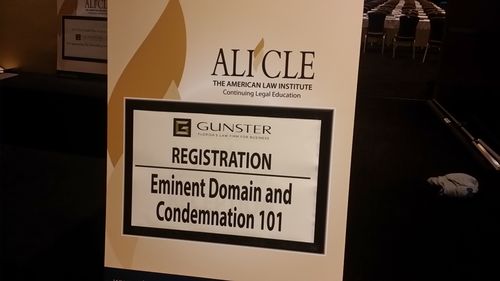
20150204_161439 (1)

Here are the cases which I spoke about this morning at the 2015 ALI-CLE Eminent Domain and Land Valuation Litigation conference:

Here is our annual “proof of life” photo, the view from the dais. Proof

Continue Reading ALI-CLE 2015 Eminent Domain Conference: Links From Today’s Presentation

Here’s one with a somewhat unusual twist: the condemnee objecting to the taking by a public utility district was the state.

In Public Utility Dist. No. 1 of Okanogan Cnty. v. State of Washington, No. 88949-0 (Jan. 29, 2015), the Washington Supreme Court affirmed the power of the county utility district to take an easement over “school trust lands” for the construction of an high-voltage, high-capacity transmission line and corridor. The land was owned by the public and held in trust for schools, was “a portion of the largest publicly owned tract of shrub-steppe habitat in the Methow Valley,” and was being used for cattle grazing. The grazing leases generated $3,000 per year for the state’s public schools, and also acknowledged that the land may be subject to easements and condemnation. 

The court first concluded that an environmental organization could intervene to address the power of the utility district to take

Continue Reading Washington: State Trust Land Can Be Condemned By County Utility

No, it’s not about the weird dude down at the Planning Department, but a new (draft) article by two familiar property lawprofs, Lee Fennell and Eduardo Penalver. Here’s the abstract:

How can the Constitution protect landowners from government exploitation without disabling the machinery that protects landowners from each other? The Supreme Court left this central question unanswered — and indeed unasked — in Koontz v St. Johns River Water Management District. The Court’s exactions jurisprudence, set forth in Nollan v. California Coastal Commission, Dolan v. City of Tigard, and now Koontz, requires the government to satisfy demanding criteria for certain bargains — or proposed bargains — implicating the use of land. Yet because virtually every restriction, fee, or tax associated with the ownership or use of land can be cast as a bargain, the Court must find some way to hive off the domain of exactions

Continue Reading New Article: “Exactions Creep”

Land users, please read the California Court of Appeal’s opinion in Woody’s Group, Inc. v. City of Newport Beach, No.G050155 (Jan. 29, 2015), which starts off with this straightforward summary:

The language of the law is replete with synonyms for fairness: due process, equal protection, good faith, harmless error are all ways of expressing our commitment to fairness. The City Council of Newport Beach violated at least two basic principles of fairness in overturning a permit application approved by the city’s planning commission. It should come as no surprise, then, that their action also violated California law.

First basic principle: You cannot be a judge in your own case. In this case Councilmember Mike Henn, having already voiced his “strong[]” opposition to Woody’s application, was allowed to appeal the approval of Woody’s application to the very body on which he sits, where he did his best to convince his

Continue Reading Cal App: Zoning Authorities Need To “Play Fair”