The wheels of justice may grind slowly, but they do grind. Yesterday, the Ninth Circuit granted a motion we filed back in June 2013, and permitted us to file this amicus brief on behalf of the Western Manufactured Housing Communities Association in a case that is scheduled to be argued in mid-February 2015, Rancho de Calistoga v. City of Calistoga, No. 12-17749.  

The case is a federal court challenge to a California wine-country municipality‘s decision to deny a rent increase for a mobilehome park subject to the city’s rent control ordinance. The complaint alleged that the city’s failure to allow the ground lease rent to increase to $624 violated the park owner’s rights under the takings, due process, and equal protection clauses. The District Court eventually dismissed the complaint for failure to state a claim for relief under Rule 12(b)(6), because, among other things, the park
Continue Reading 9th Circuit Amicus Brief: How To State A Valid Claim After Lingle – Regulatory Taking, Private Taking, Or Due Process?

This is a longer post, but since we think this case may be going further and is worth watching, we’re going to hit it up in some detail.

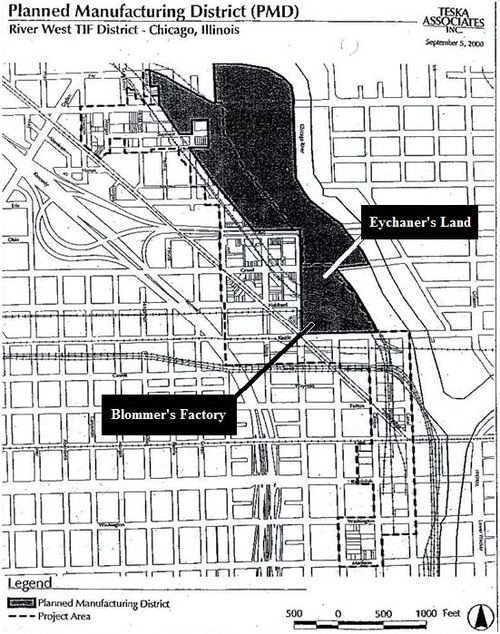
In City of Chicago v. Eychaner, No. 05L050792 (Jan. 21, 2015), the Illinois Appellate Court upheld the taking of private vacant land near the Chicago Loop (Eychaner’s Land on the map below) so that it could be transferred to the owners of a nearby chocolate factory (Blommer’s Factory).

The court viewed this “A-to-B” taking as merely a part of an area redevelopment and tax increment finance plan, which would keep the chocolate factory from moving out as the area gentrified.


1131833

The opinion contains a long recitation of the reasons for the taking, how the Planned Manufacturing District (PMD) was designed to “protect[] the 2,800 industrial jobs located in the area, [to] prevent[] residential encroachment on the existing manufacturing facilities, and

Continue Reading The Chicago Way: City Taking Non-Blighted Property For Economic Development Was Not Pretextual Because … Studies

The Township of Ocean, New Jersey downzoned the plaintiffs’ residentially-and-commercially-zoned land to “Environmental Conservation.” The EC district allows “only very low density residential development or other low intensity uses,” with a minimum lot size of 20 acres. 

The plaintiffs, who own 34 acres subject the EC zoning, challenged the zoning ordinance, asserting it was “arbitrary, unreasonable, capricious and illegal,” and that it resulted in an inverse condemnation because it prohibited all uses.

In Griepenburg v. Township of Ocean, No. A-55-13 (Jan. 22, 2015), the New Jersey Supreme Court seemed to agree that there is little chance the property owners can make any use of their land: “[a]lthough plaintiffs’ single-family residence conforms to the ED district’s density requirement of one unit per twenty acres, no further development of their property within the EC district is permitted under the new zoning.” Slip op. at 13. 

The Supreme Court, however, held that the

Continue Reading NJ: Environmental Preservation Zoning Might Prohibit Development, But Owner Must First Try To Develop

Last we checked in with the Bridge Aina Lea case, the Ninth Circuit said it would hold off on a decision until the Hawaii Supreme Court ruled in the associated state court litigation (see 9th Cir Says “Let’s Wait” On Hawaii Supreme Court To Rule In Bridge Aina Lea).

This is the federal court side of a case in which a developer is suing the State Land Use Commission (and certain Commissioners in their individual capacities) after the LUC reclassified its land on the Big Island from urban to agricultural use. Aina Lea filed two actions in state court: an administrative appeal under the administrative procedures act, and an original jurisdiction civil rights complaint. The defendants removed the latter action to federal court. The District Court, however, abstained. After oral arguments in the Ninth Circuit, the panel withdrew the case from submission to allow the Hawaii Supreme Court

Continue Reading 9th Cir: No Need For Pullman Abstention In Aina Lea After Hawaii Supreme Court Ruling

Here’s the latest in a case we’ve been following, the property owner’s cert petition, filed last week, in which a U.S. District Court invalidated a Florida county’s “Right of Way Preservation Ordinance” which allows it to land bank for a future road corridors by means of an exaction. The court concluded the ordinance is “both coercive and confiscatory in nature and constitutionally offensive in both content and operation,” and struck it down under Nollan/Dolan

The transportation corridor protrudes into Hillcrest’s undeveloped commercially-zoned property. Hillcrest wanted to build a shopping center and it submitted a plan to the Review Committee, which rejected the application because it did not account for the corridor. Hillcrest submitted a second plan which was rejected, and a third plan which was eventually approved, which required Hillcrest to dedicate the right of way to the county. Hillcrest reserved its right to object

Continue Reading New Cert Petition: Must A Plaintiff Challenging An Ordinance For Facial Invalidity File Suit Before Her As-Applied Claim Has Ripened?

It’s always a safe bet to predict that the Supreme Court will deny review in a case, and if that’s what you had guessed for Kurtz v. Verizon New York, Inc., No. 14-439 (cert. petition filed Oct. 14, 2014), today’s order list would prove you right. 

That’s the case in which the Second Circuit threw out a complaint on Williamson County ripeness grounds, which, were the claim a takings claim, isn’t all that certworthy. The odd thing was, the court concluded that a procedural due process claim was not ripe under Williamson County‘s exhaustion of state remedies prong. Say what?

We submitted an amicus brief in the case, because the Second Circuit’s ripeness mission creep wasn’t warranted: Williamson County‘s rationale, is built on a takings-specific rationale and has no application to a due process claim, and our brief called for the Court to both reverse the Second Circuit

Continue Reading Cert Denied In Kurtz: Williamson County Lives! (For Now)

20150115_091355-1
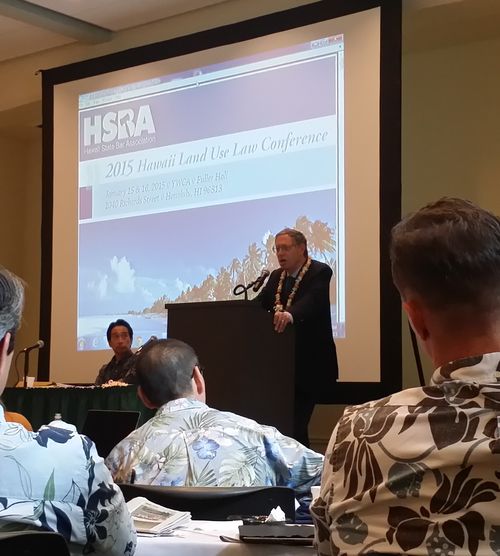
Ben Kudo and David Callies, leading off

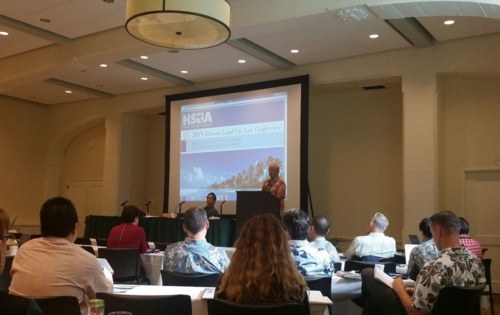
Professor Richard Epstein began the Hawaii Land Use Law Conference with the keynote presentation on “Stealth Takings: Exactions, Impact Fees, and More,” which was his usual comprehensive and non-stop takedown of takings law. 

20150115_100935

Our panel on Impact Fees and Exactions After Koontz followed, and here are the promised links and other materials which I mentioned:

Later today, I will also post up a recording of my short backgrounder on the exaction issue, to give you a flavor of the panel discussion (the Hawaii State Bar Assocation

Continue Reading 2015 Hawaii Land Use Law Conference

Here’s the final program and faculty list for the 2015 Hawaii Land Use Conference, coming up Thursday and Friday, January 15-16, 2015, in downtown Honolulu.

This is the bi-annual gathering of Hawaii’s land use mavens, and this year’s program has two very special presenters. Storied lawprof Richard Epstein (perhaps more than a “mere mortal”) will be presenting the keynote talk on “Stealth Takings: Exactions, Impact Fees and More,” and our ABA colleague Patty Salkin, Dean of the Touro Law School, will get us our Ethics CLE credits with her usual exciting program on ethics topics. (As someone who has attended more than few of her presentations, we can report that it is worth the price of admission alone, and even though “ethics CLE” and “exciting” are words we usually do not associate with each other, Dean Salkin’s presentation is the exception.)

Our panel on “

Continue Reading Still Time To Join Us For The 2015 Hawaii Land Use Conference (Jan. 15-16)

Ralph v. State of Washington Dep’t of Natural Resources, No. 88115-4 (Dec. 31, 2014), is a Washington-specific case because it involves the Washington Supreme Court’s view of a state statute governing where lawsuits “for any injuries to real property” “shall be commenced.” But since one of the claims brought by the plaintiff for flooding he alleged was caused by the State’s poor forestry practices was for inverse condemnation — and many states have similar statutes — we thought we’d give you a heads-up on the decision.

Ralph’s land in Lewis County was flooded when “heavy rains caused the Chehalis River to overflow its banks.” He asserted the DNR’s had “made its land unstable, which allowed landslides to form and debris to flow into the Chehalis River, which in turn displaced river water, flooded the river basin, and caused damage to [his] property.” Slip op. at 3. He filed suit in

Continue Reading You Really Should File Your Inverse Condemnation Complaint In The County In Which The Land Is, But If You Don’t, That’s OK With The Washington Supreme Court

Mauitemple

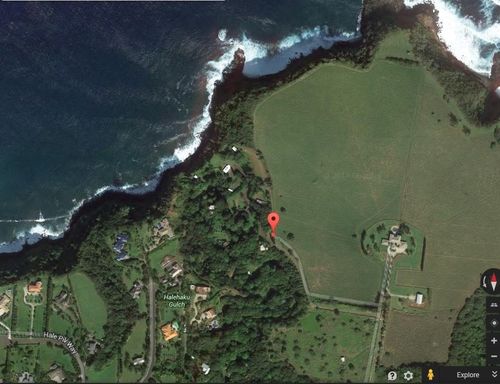
Here’s the latest for you RLUIPA mavens, a complaint recently filed in Hawaii federal court by a Maui “integral yoga” temple and its leader against the County for not permitting it to use their site on Maui’s north shore for things like weddings and religious observations. Parking was the proffered reason, it appears.  

Dwight Merriam and Evan Seeman have all the details here, at RLUIPA-Defense blog

Complaint, Spirit of Aloha Temple v. County of Maui, No. 1:14-cv-00535-RLP (D. Haw. Nov. 26, 2014)

Continue Reading New RLUIPA Complaint vs Maui: “‘Integral Yoga’ Group and Swami Hope to Find Their Inner Balance in Federal Court”