Continuing with our year-end opinion dump, here’s the conclusion of the Texas Court of Appeals in City of Blue Mound v. Southwest Water Co., No. 02-13-00343-CV (Nov. 13, 2014):

Because as a matter of law the City is attempting to condemn Appellees’ water and wastewater system as a going concern, because as a matter of law Appellees are entitled to compensation for going-concern value as an element of this purported taking, because the general Texas condemnation statutes provide no mechanism for the awarding of going-concern value as held in Lone Star Gas Co., and because Lone Star Gas Co. remains binding precedent, we hold that Appellees conclusively established their entitlement to summary judgment on the ground that no statutory procedures exist authorizing the City’s condemnation suit in this case in district court.

Slip op. at 29.

City of Blue Mound v. Southwest Water Co.

Continue Reading Tex App: City Can’t Condemn Wastewater Facilty
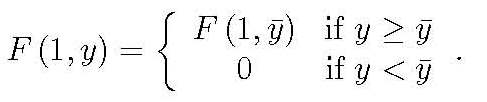
If you, like us, went to law school to avoid things like this:

Untitled Extract Pages

then perhaps this recently-published paper is not going to be your cup of tea.

But seriously, folks, this one might be worth your time, even if you are numbers-challenged, because it is a look at the “holdout” issue from the standpoint of economists.

In “Private Takings,” the authors “examine[] the implications associated with a recent Supreme Court ruling, Kelo v. City of New London.” From the Introduction:

This paper examines the implications associated with a recent Supreme Court ruling, Kelo v. City of New London. Kelo can be interpreted as supporting eminent domain as a means of transferring property rights from one set of private agents — landowners — to another private agent — a developer. Under voluntary exchange, where the developer sequentially acquires property rights from landowners via bargaining, a holdout problem arises.

Continue Reading New Article: “Private Takings” (via Fed Reserve Bank of Chicago)

The Texas Supreme Court is generally pretty good about property rights. See this opinionthis one, and this one, for examples.

So when the legal analysis in one of its regulatory takings/inverse condemnation opinions has the following language — especially in a case where a municipal government has treated the plaintiffs/property owners very badly — it would be understandable if you predicted the court was coming down on the side of the property owners:

The right to acquire and maintain private property is among our most cherished liberties. As Locke explained, the value of private property lies not only in its objective utility, but also in any personal investment therein. See John Locke, Two Treatises of Government 134 (Thomas I. Cook ed., Hafner Press 1947) (1689). Accordingly, the right to undisturbed enjoyment of residential property is all the more sacred. The unique importance of the home is reflected in our Bill of

Continue Reading Texas (Reluctantly) Finds No Regulatory Takings Claim

Back in February, we blogged about an opinion from the Maine Supreme Court involving littoral property (that’s beachfront property to all you non-lawyers and Navy people), in which the court concluded that those who were asserting a prescriptive easement over the plaintiffs’ beachfront property– the Town  and several neighbors — had not rebutted Maine’s presumption of permissive recreational use of open land, when they introduced evidence that people generally made recreational use of the beach in front of the plaintiffs’ properties, without showing specifically where. Which meant that the public did not have a right of access over the plaintiffs’ beachfront land. The court also held that Maine does not recognize an “easement by custom.” 

Maine apparently allows a party who is disappointed with the court’s ruling to ask for reargument. Similar rules for reconsideration also are present in other courts, but with rare exception in our experience, those

Continue Reading Maine: On Second Thought, We Were Right When We Said That Beach Property Is Not Subject To Special Rules

Here’s the Verified Complaint in a case recently filed in U.S. District Court in New Jersey:

Plaintiffs Jenkinson’s Pavilion, a corporation of the State of New Jersey and Jenkinson’s South, Inc., a corporation of the State of New Jersey, (collectively “Plaintiffs”), bring this action, inter alia, (a) for a declaration as a matter of law that the United States Army Corps of Engineers (“USACOE”) has not required, and does not require, for purposes of the “Manasquan Inlet to Barnegat Inlet Storm Damage Reduction Project,” the acquisition of perpetual rights in privateproperty for purposes of establishing recreational public beaches landward of the area already subject to public ownership and rights of public user pursuant to the New Jersey Public Trust Doctrine, and (b) enjoining the Defendants from taking actions in furtherance of the “Manasquan Inlet to Barnegat Inlet Storm Damage Reduction Project,” in advance of a determination on the relief

Continue Reading Federal Court Challenge To NJ’s Beach Replenishment Plan

Remember that case we posted about here, when it was set for oral arguments in the Hawaii Supreme Court a few months ago, where the plaintiff was asserting that the County of Hawaii Planning Department was liable for negligence for not maintaining its subdivision files accurately?

Last month, the Hawaii Supreme Court issued a unanimous opinion which declined to impose a duty of reasonable care on the Planning Department.

The opinion noted that “policy considerations counsel against the judicial creation of such a legal duty under the common law, and also hold that there is no basis under [Hawaii’s open records statute or the Planning Department’s rules of procedure], to impose negligence liability upon the Planning Department based on the temporary absence of a government record from its files. Slip op. at 2. Rebecca Copeland has more background on the case (including the briefs) here at her Record on

Continue Reading HAWSCT: Agencies Have No Duty To Keep Their Records Accurately

We bring you the latest guest post by colleague Paul Schwind, who has been tracking the issues and arguments that recently led the Hawaii Supreme Court to conclude, in DW Aina Lea Development, LLC v. Bridge Aina Lea, LLC, No. SCAP-13-0000091 (Nov. 25, 2014), that the Hawaii Land Use Commission wrongfully rescinded an earlier reclassification of land (read: “rezoning” to all you non-Hawaii land users).

The oral argument recording is posted above.

We’ll post up our thoughts on the decision in a separate post. 

—————————————————————-

Hawaii Supreme Court In Aina Lea: The Rationales Behind The Opinion

by Paul J. Schwind*

Robert has asked me to summarize the rationales behind the holdings in the Hawaii Supreme Court’s recent opinion in DW Aina Lea Development, LLC v. Bridge Aina Lea, LLC, No. SCAP-13-0000091 (Nov. 25, 2014), which he summarized the following day, outlining the litigation history of the

Continue Reading Guest Post – Hawaii SCT In Aina Lea Case: The Rationales Behind The Opinion

2015 Hawaii Land Use Law Conference Banner - Credits

Registration is now open for the 2015 Hawaii Land Use Law Conference, to be held in downtown Honolulu on Thursday-Friday, January 15-16, 2015.

This is the bi-annual conference, co-chaired by U. Hawaii lawprof David Callies and land use lawyer Ben Kudo, that brings together the big names in our area of law. In other words, the one conference you don’t want to miss if you are a Hawaii land use or property lawyer, in-house counsel, a planner, an appraiser, a property owner or manager, or a law student interested in these topics. 

Download the full brochure here, or view it below. 

The keynote speaker this year is lawprof Richard Epstein, addressing “Stealth Takings: Exactions, Impact Fees and More.” Immediately following his talk, I will be moderating a panel on “Impact Fees and Exactions After Koontz,” with colleagues Bruce Voss and David Brittin. The rest

Continue Reading Registration Open: 2015 Hawaii Land Use Law Conference, Jan. 15-16, 2015

This opinion from the Maryland Court of Appeals may be too land-usey for you takings mavens, but it starts off with an attention-getter:

Few cases inflame such deep passions as a dispute involving individual property rights. The belief that fundamental concepts of liberty entailed strong property rights informed and influenced the Founders as they undertook the epochal task of drafting our Constitution. See Sharon A. Rose, Kelo v. City of New London: A Perspective on Economic Freedoms, 40 U.C. Davis L. Rev, 1997, 2002 (2007). Infringers of these cherished rights should beware for “nothing is better calculated to arouse the evil passions of men than a wanton and unredressed invasion of their . . . property rights.” Cameron v. Chi., Milwaukee & St. Paul Ry. Co., 65 N.W. 652, 655 (Minn. 1896).

Appellant, Marquis McClure, seeks our review of the decision of the Circuit Court for Montgomery

Continue Reading Md App Waxes Poetic In A Land Use Opinion

Here’s the Opening Brief on the Merits, filed by the State of California in Property Reserve, Inc. v. California, No. s217738 (Sep. 26, 2014).

That’s the case in which the California Supreme Court is reviewing a court of appeal decision which invalidated California’s entry statute (Cal. Civ. Pro. Code § 1245.010 et seq.), concluding it was unconstitutional because it allowed an uncompensated taking. We summarized the court of appeal opinion here.

The property owner’s answering brief is due to be filed shortly, and amici briefs will be filed thereafter. Disclosure: we are authoring an amici brief in the case in support of the property owner. 

Opening Brief on the Merits, Property Reserve, Inc. v. California, No. S217738 (Sep. 26, 2014)

Continue Reading Opening Brief In Property Reserve: Eminent Domain Is Such A Bother