Update: Here’s a story on the case from the Sacramento Bee (“State Supreme Court to rule in Delta property-rights case“). See alsoProperty Reserve on Hold: Supreme Court to Review Eminent Domain Right of Entry Statutes” from Brad Kuhn at the California Eminent Domain Law Report.

+++++++++++++++++++++++++++++++++++++

Thanks to our New York colleague Mike Rikon at Bulldozers at Your Doorstep, we’ve come to learn that on June 25, 20154, the California Supreme Court agreed to review a very important eminent domain case, Property Reserve, Inc. v. Superior Court, 224 Cal. App. 4th 828 (2014).

That’s the case in which the Court of Appeal held that California’s entry statute (Cal. Civ. Pro. Code § 1245.010 et seq.), was unconstitutional because it allowed an uncompensated taking. We summarized the Court of Appeal opinion here.

California’s entry statute is much like similar provisions in other

Continue Reading Cal Supreme Court To Review Eminent Domain Entry Statutes – A Free Pass, Or A Taking?

Our thanks to Jacob Cremer for the heads-up on the Florida Court of Appeals’ decision in Ocean Palm Golf Club Partnership v. City of Flagler Beach, No. 5D12-4274 (May 30, 2014). Jacob did not post any analysis (undertstandable because his law firm is involved in the case) so we’ll add our two cents.  

Here’s the BLUF: the city’s refusal to change the zoning on a 9-hole golf course and a surrounding parcel to allow residential development did not deprive the parcels of their value, and were not a taking. 

Here’s the longer story. The case involved two parcels, one the golf course, and the other, a vacant parcel. At one time, they were a single parcel owned by a single owner, but by the time of the litigation, they had been subdivided and separately owned by two separate but related entities. Back in the day, the city

Continue Reading Fla App: Because A Golf Course That Eventually Went Broke (And Was Later Bought By The City) Was “Profitable,” City Not Liable For A Taking

Battle for Brooklyn film poster

You remember Battle for Brooklyn, the documentary which chronicles the eminent domain fight over New York’s Atlantic Yards project? (Read our review of the film here to refresh your recollection.)

Well here’s the latest chapter. Or perhaps “epilogue” is more appropriate, because the former property owners have long since been evicted, the homes have been razed, and the New Jersey Brooklyn Nets are ensconced in the Barclays Center. (The promised affordable housing and “jobs, jobs, jobs?” Eh, not so much, but who’s counting?)

According to this story in the New York Times, preservationists are planning to award the private beneficiaries of the city’s exercise of eminent domain something called the “Jacqueline Kennedy Onassis Medal.” Seriously:

The Municipal Art Society is well known for campaigns to save Grand Central Terminal and Lever House and to stop towers that would have cast long shadows over

Continue Reading Atlantic Yards: How About Calling It The “Jay Z” Medal?

Here’s the latest from the Federal Circuit, a decision involving regulatory takings, the big auto bailout, and the nature of property rights. A&D Auto Sales, Inc. v. United States, Nos. 13-5019, 13-1520 (Apr. 7, 2014)

In the TARP and the related bankruptcy cases, the federal government bailed out the two big American auto manufacturers, General Motors and Chrysler. Part of the $55 billion assistance deal required GM and Chrysler to terminate the franchises of many dealerships. Not surprisingly, those dealerships didn’t care for the idea that their businesses were not “too big to fail,” and objected in the Court of Federal Claims to the idea that they should be sacrificed to the greater good with a takings claim against the federal government. 

Although the automakers were already reducing their dealer ranks over time and GM’s initial viability plan had included additional dealer terminations, the government determined that

Continue Reading Fed Cir: Big Auto Bailout Could Be A Taking

Remember the Lost Tree case? That’s the one where the Federal Circuit concluded that a single parcel owned by the plaintiff was the relevant parcel against which the impact of the Corps of Engineers’ denial of a § 404 wetlands dredge and fill permit is to be measured. The court overturned a Court of Federal Claims decision which concluded the relevant parcel was that single plot plus an additional nearby lot, plus “scattered wetlands in the vicinity” also owned by the same owner. 

The case got remanded to the CFC, which now has issued its opinion determining the loss of economic value caused by the denial of the 404 permit. The CFC concluded that the “after” value was $27,500, and the “before” value was $4,245,388, a diminiution in value of a whopping 99.4%. Lost Tree Corp. v. United States, No. 08-117L (Fed. Cl. Mar. 14, 2014).

The court held that

Continue Reading CFC: Denial Of Wetlands Dredge And Fill § 404 Permit = Taking = $4.2M Just Compensation

This is a longer post, but we think it’s worthy of your time. That’s because even though there’s a lot going on in the opinion by the California Court of Appeal in Property Reserve, Inc. v. Superior Court, No. C067758 (Mar. 13, 2014), it cuts through much of the unnecessary doctrinal fog surrounding takings law, especially the U.S. Supreme Court’s bizarre ripeness requirement first enunciated in Williamson County Regional Planning Comm’n v. Hamilton Bank, 473 U.S. 172 (1985).

The Bottom Line

Although the entire thing is worth reading (44 pages of majority opinion, followed by 46 pages of dissent), if we had to pick out one passage as the takeaway, here it is: 

Eminent domain authority must be exercised in strict conformity to the constitutional protections and procedures that limit its operation. If a condemnor intends to take private property or intends to perform actions that will result

Continue Reading Cal App States The Inconvenient Truth: There’s No Substitute For Eminent Domain – Gov’t Must Condemn First If It Wants To Enter Land

Next week, we’ll be in New Orleans for the 2014 edition of the ALI-CLE Eminent Domain program, now in its 31st year. 

As usual, my Owners’ Counsel colleagues Leslie Fields and Joe Waldo (the programming co-chairs) have put together a fantastic 2.5 day of programming, taught by expert faculty.  At 11:00 a.m. on the first day of the program, I will be joining Professor James Ely to speak about “The Full and Perfect Equivalent for Just Compensation: The Historical Context and Practice.” 

Should be fun. If you are not joining us in-person, ALI-CLE is producing it as a live webcast, and will make the coursebook and video and audio available for later listening or viewing. 

More details here, or download the brochure here, or below. 

31st Annual Eminent Domain and Land Valuation Litigation, ALI-CLE Program (CV023) (Jan. 23-25, 2014) New Or…

Continue Reading 31st Annual ALI-CLE Eminent Domain And Land Valuation Litigation (New Orleans)

Cover_42_3_ The Urban Lawyer, the law review produced by the ABA Section of State & Local Goverment Law has published my article Recent Developments in Regulatory Takings, 45 Urban Lawyer 769 (2013).

Here’s the Introduction to the article:

THE SUPREME COURT’S 2012 TERM promised to be a banner year in regulatory takings law, with no less than three cases on the Court’s docket. In Arkansas Game and Fish Commission v. United States, a case involving a takings claim against the federal government for compensation resulting from a flood, the Court held that flooding need not be “permanent” in order to result in liability, and reinforced the principle that categorical takings are not favored, and stated that the default analysis is the multi-factored Penn Central test. In Koontz v. St. Johns River Water Management District, the Court held that monetary development exactions fall within the reach of the

Continue Reading New Article: Recent Developments in Regulatory Takings

Here’s the government’s Brief in Opposition in Mehaffy v. United States, No. 12-1416 (cert. petition filed June 3, 2013. 

In that case, the Federal Circuit, in an unpublished opinion, held that Mehaffy failed the Penn Central ad hoc takings test solely because he purchased the property alleged to have been taken after the governmentt adopted the Clean Water Act. As a matter of law, he could not have any “reasonable investment-backed expectations” because his land was subject to regulations that, as applied to his land, are alleged to take property.

That reasoning seems somewhat circular, and would seem to run smack-dab into the Supreme Court’s determination in Palazzolo v. Rhode Island, 533 U.S. 606, 626 (2001), rejecting a per se rule that “postenactment purchasers cannot challenge a regulation under the Takings Clause.”

But for some reason, the lower courts have applied (or, in some cases, have not

Continue Reading Govt’s BIO In Mehaffy: Preexisting Regulations Wipe Out Penn Central’s Reasonable Expectations

DHM_IMLA

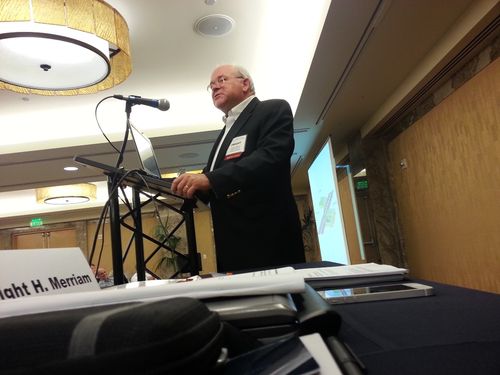
A big thanks to my Owners Counsel of America and ABA State and Local Government Law Section colleague Dwight Merriam for emceeing today’s well-attended double session on land use and takings law at the International Municipal Lawyers Association’s 2013 annual meeting in San Francisco. Dwight and I were joined by land use expert Cecily Barclay, who presented sessions on Harvey Cedars, while I covered Koontz and Dwight did the relevant parcel/Lost Tree sessions. Continue Reading IMLA Conference Session On Koontz, Harvey Cedars, Relevant Parcel