



IMLA
On Monday, September 30, 2013, we’ll be speaking along with Dwight Merriam and Cecily Barclay at the International Municipal Lawyers Association’s annual meeting in San Francisco, about three important cases/issues: Koontz, Harvey Cedars, and Lost Tree.

That’s a pretty wide range of cases, but we have some time and we’re sure we’ll have a good discussion. If you are attending the IMLA conference, please be sure to join us: 2:15 – 3:15pm, Hilton San Francisco Union Square (Plaza B, Lobby Level). Continue Reading Upcoming IMLA Panel On Koontz, Harvey Cedars, And Lost Tree

This past term, the U.S. Supreme Court in Arkansas Game and Fish Comm’n v. United States, 133 S.Ct. 511 (2012), held that government-induced flooding could result in takings liability, even if the flooding was merely temporary. The Court remanded the case to the Federal Circuit to determine whether the flooding resulted in liability.

The Federal Circuit ordered supplemental briefing, and the parties and amici responded. Earlier this month, the court held oral arguments.

2009-5121_962013

The government’s counsel argued that the Supreme Court adopted a new test for temporary flood takings that looks like a hybrid Penn Central test, while the Commission’s counsel argued that the Court expressly did not adopt a new test, and that temporary flooding cases are to be treated just like any other physical invasion under the existing test.

With the arguments submitted, now we wait. Continue Reading But … What If Penn Central Terminal Is Flooded?

Here’s the cert petition filed earlier this week, asking the Supreme Court to review the Ninth Circuit’s decision in MHC Financing Ltd. P’ship v. City of San Rafael,714 P.3d 1118 (9th Cir. 2013).

That’s the case in which the Ninth Circuit overturned the District Court’s ruling (after two trials) that MHC had proven a Penn Central taking and was entitled to just compensation for the City’s mobilehome rent control ordinance. The panel’s rationale was that MHC purchased the mobilehome park with the oppressive regulations already in place, so it had no “investment backed expectations” of operating free of the regulations.

We posted our thoughts on the Ninth Circuit’s ruling here, so we won’t go into the details of the cert petition, except to note two things:

  • We didn’t get how the Ninth Circuit just ignored Palazzolo. We still don’t.
  • The second Question Presented (below) is particularly fasinating.


Continue Reading New Regulatory Takings Cert Petition: 9th Circuit Made Hash Of Penn Central

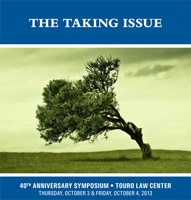
Taking_coverimage_webIf you are anywhere within striking distance of Touro Law School (Central Islip, Long Island), you should make plans to attend a conference that promises two days of fantastic programming on October 3 and 4, 2013.

The Taking Issue – 40th Anniversary Symposium” is dedicated to the memory of the legendary Professor Fred Bosselman, and lead author of The Taking Issue, a 1973 report to the President’s Council on Environmental Quality. While the themes in the book have been overtaken by the Supreme Court’s takings cases, it remains a touchstone work for anyone interested in the subject.

Conference co-Chairs Dean Patricia Salkin and Professor David Callies (a co-author of The Taking Issue) have assembled an excellent faculty and agenda. There will be panels on partial takings, the Nollan/Dolan/Koontz issue, the relevant parcel question, and one on ripeness which we’ll be moderating

Continue Reading Conference Announcement: The Taking Issue – 40th Anniversary Symposium

Word comes that the California Supreme Court has denied review of the Court of Appeal decision in Lockaway Storage v. County of Alameda, No. A30874 (1st Dist. May 9, 2013). The court also rejected a request to “depublish” the First District’s opinion. Congratulations are again in order for colleague Tim Kassouni, who represents the property owners. 

Lockaway is the case in which the First District upheld the trial court’s finding of a Penn Central taking, affirming that the County of Alameda is liable for a temporary regulatory taking, and awarding the property owners nearly three-quarters of a million in attorney fees. This means the only avenue left open is a cert petition to the U.S. Supreme Court. If the County does so, it will probably have as much luck as the private property bar with convincing the Court to take a Penn Central case.

Here’s the (now-denied) Petition

Continue Reading Cal Supremes Deny Review In Property Owner Penn Central Victory

Please join us this upcoming Monday, August 19, 2013 from 1:00 – 2:30 p.m. Pacific Time for a telebriefing, “Regulatory Takings Claims in California – Implications of Recent Decisions and Advice for Practitioners and Government Agencies.”

Brad Kuhn (Nossaman, California Eminent Domain Report) is the program Chair and will serve as moderator, and Timothy Kassourni (Kassouni Law) will give us more details on his recent big win in a case under the Penn Central test. I’ll be talking Koontz and the Ninth Circuit’s latest foray into regulatory takings challenges to rent control.

It promises to be a fast-paced and informative hour, and there’s much here for the non-California practitioner. More information here (from Brad’s blog), and registration information is posted here. Continue Reading Telebriefing: Regulatory Takings Claims In California

Here’s the latest from William W. Wade, Ph.D., a resource economist with the firm Energy and Water Economics (Franklin, Tennessee). Bill is a frequent author and speaker on the regulatory takings issue, and he’s brought much needed clarification to an often confusing issue about how to apply the Penn Central test. He has authored several guest posts for the blog, and we’re glad to have him back with a short piece on regulatory takings.Here, he responds to a recently-published article on the “economic impact” prong of the Penn Central test for a regulatory taking.

++++++++++++++++++++++++++++++++++++

A Note on Economic Impacts andAverage Reciprocity of Advantage

William W.Wade, Ph. D.

Daniel L. Siegel, SupervisingDeputy Attorney General, California Department of Justice, published anarticle, Evaluating Economic Impact in Regulatory Takings Cases in the summer 2013 West NorthwestJournal of Environmental Law & Policy.[1]Perhaps a brief rejoinder by an economist is suitable

Continue Reading Guest Post: A Note on Economic Impacts and Average Reciprocity of Advantage

 Babe1

Did you know that in 2002, the voters of Florida adopted a “pregnant pig” amendment to the state’s constitution? Well, neither did we. The amendment, effective in 2008, makes it unlawful for “any person to confine a pig during pregnancy in an enclosure, or to tether a pig during pregnancy, on a firm in such a way that she is prevented from turning around freely.”

Farmer Basford’s pig farm used such “gestation crates,” and he was forced by the amendment to go out of business. He tried other things like peanut farming, but those didn’t work, so in 2010, he filed an inverse condemnation claim and a claim under Florida’s Bert Harris Act, arguing that the pig amendment deprived him of all economically viable use of his far. The trial court dismissed the Bert Harris Act claim, and after a trial, held that he was entitled to $505,000

Continue Reading Fla App: “Pregnant Pig” Constitutional Amendment Took Farmer’s Property

Here’s the amicus brief filed today by Pacific Legal Foundation in Mehaffy v. United States, No. 12-1416 (cert. petition filed June 5, 2013).

That’s the case in which the Supreme Court is being asked to review to review the Federal Circuit’s unpublished opinion in which the court affirmed the Court of Federal Claims’ grant of summary judgment to the government, holding that Mehaffy failed the Penn Central test solely because he purchased the property alleged to have been taken after the governmentt adopted the Clean Water Act.

PLF has posted a more in-depth summary of the case and the arguments in its brief here.

The cert petition is posted here, and another amici brief urging the Court to grant the writ is posted here.

Brief Amicus Curiae of Pacific Legal Foundation in Support of Petitioner, Mehaffy v. United States, No. 12-…


Continue Reading One More Amicus Brief In “Investment-Backed Expectations” Case: Can’t Regulate Away Right To Compensation

Do regulations that exist at the time that a property owner purchases his land negate any expectation that he will be able to use the land productively? Not according to this amici brief, filed today in Mehaffy v. United States, No. 12-1416 (cert. petititon filed June 5, 2013).

The cert petition asks the Supreme Court to review the Federal Circuit’s unpublished opinion in which the court affirmed the Court of Federal Claims’ grant of summary judgment to the government, holding that Mehaffy failed the Penn Central test solely because he purchased the property alleged to have been taken after the governmentt adopted the Clean Water Act.

The amici brief, filed by the National Federationof Independent Business Small Business Legal Center, the Cato Institute, and the Chapman Center for Constitutional Jurisprdence poses the Question Presented this way:

In Palazzolo v. Rhode Island, 533 U.S. 606 (2001), this Court

Continue Reading Amicus Brief In “Investment-Backed Expectations” Case: Are Most Takings Claims Snuffed Out At Transfer Of Title?