Screenshot 2024-09-26 at 09-41-29 Too Far Imagining the Future of Regulatory Takings

There’s still time to join us next Friday, October 4, 2024, at the Antonin Scalia Law School (George Mason University) for the symposium “Too Far: Imagining the Future of Regulatory Takings.”

Co-produced by our outfit (Pacific Legal Foundation) and the Journal of Law, Economics & Policy, the symposium will feature the most cutting-edge legal academics and courtroom practitioners discussing what is on the horizon in regulatory takings. Here’s the description of the program (full agenda and presenter list below):

A century ago, Supreme Court Justice Oliver Wendell Holmes cautioned government that if property regulations went “too far,” they would be “recognized as a taking.” Flash forward to today, where governments are constantly trying to push the limits while the courts struggle to define what exactly “too far” means.   

Join Pacific Legal Foundation and George Mason University’s Journal of Law, Economics, and Policy for a day-long symposium

Continue Reading Too Far: Imagining the Future of Regulatory Takings (Friday, Oct. 4, 2024)
A frequent vibe in cases where a member of the public asks a court to compel a local government to do something about an undesired land use (i.e., “the city should stop my neighbor from illegally renting their property,” or “the police should remove the pop-up unlicensed food stand on the sidewalk in front of my restaurant”) is that zoning enforcement is often viewed by courts as a discretionary municipal function or a question about allocation of enforcement resources — and therefore the judiciary takes a hands-off approach.

That vibe, however, did not carry the day when the Arizona Court of Appeals tackled Brown v. City of Phoenix, No. CV23-0273 (Aug. 27, 2024). In that case, the court upheld a trial court’s preliminary injunction ordering Phoenix to do something about the notorious “zone” that the trial court determined was a public nuisance “created or maintained” by the

Continue Reading Court To Phoenix: Clean Up Your Act!

We were all set to write up a scintillating and detailed analysis of the New Jersey Appellate Division’s opinion in Englewood Hospital & Med. Center v. New Jersey, No. A-2767-21 (June 27, 2024), when we thought, ah, why not just ask you to read our New Jersey colleague Joe Grather’s scintillating and detailed analysis.

Short story is right there in the title of this post. As Joe puts it:

In short, the hospitals argued that requiring them to provide charity care and Medicaid care at a loss was an unconstitutional taking of private property without just compensation.  The trial court analyzed the claims as an “as-applied” challenge.  Therefore, it dismissed some of the claims because of a failure to exhaust administrative remedies.  The “slightly different reason” was that the Appellate Court found the claims were a facial challenge to the constitutionality of the statute, and therefore it analyzed the takings claims under the familiar rubric of whether there was a “direct government appropriation or physical invasion of private property,” or an “uncompensated regulatory interference with a property owner’s interest in their property.” Slip op. at 14.

No physical taking, no Penn Central taking. We recommend you read his entire post “As We Approach Our Nation’s Birthday, a New Jersey Appellate Court Rejects Hospitals’ Takings Claims.”

Joe ends it this way: “I bet the hospitals are preparing their petition for certification to the New Jersey Supreme Court now.  Happy 4th of July!”

That means to stay tuned for more.

Englewood Hospital & Med. Center v. New Jersey, No. A-2767-21 (N.J. App. Div. June 27, 2024)

Continue Reading New Jersey: Forcing Hospital To Provide Care At A Loss Isn’t A Taking

Today at 10am Hawaii Time (1pm PT/4pm ET), the Hawaii Supreme Court will hear oral arguments in a case asking whether a 1922 deed restriction imposed by the Territory of Hawaii on a land patent conveying fee simple title to a private owner, subject to the land always being used for “church purposes” (i.e., a fee simple determinable) void under either the Hawaii Constitution’s Establishment Clause, the U.S. Constitution’s Establishment Clause, or a Hawaii statute declaring that “[e]very provision in … a written instrument relating to real property that purports to forbid or restrict the conveyance … to individuals because of .. religion” is void? 

Here’s how the Judiciary’s web site describes the case:

In 1922, the Territory of Hawai‘i sold property to Heber J. Grant, trustee for the Church of Jesus Christ of Latter-Day Saints, pursuant to a Land Patent.  The Land Patent contained a restriction requiring

Continue Reading Argument Preview: Is Gov’t Imposed “Church Purposes” Deed Restriction Void?

BetterCoastalCommnReportCover

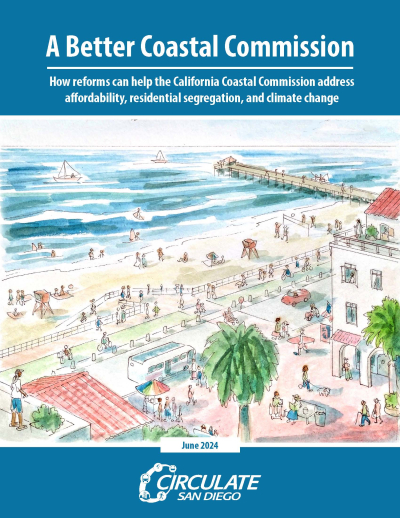
The California Coastal Commission is infamous for being the most out-of-control governmental agency in the nation. This regulatory leviathan fancies itself the undisputed czar of land use and other activities in its fiefdom, the California coastal zone.

Created in 1976 as an agency with regulatory authority across California’s 1,000+ miles of coast (and land in a defined shoreward zone), it has since expanded to its current role as a government-outside-the-government, whose main role it often seems is more about wielding an iron fist over anything that happens in the coastal area, than protecting coastal access and resources while also respecting property rights as its governing statutes require.

The Commission has been blessed with procedures that appear insanely unfair to anyone not familiar with how things work in California. For example, any two Commissioners may file an administrative appeal of a municipalilty granting a development permit to get it

Continue Reading Can The California Coastal Commission Be Reined In?

A short one (per curiam is one two-sentence paragraph), with an interesting concurring opinions from the Florida District Court of Appeals (4th District).

In Vazquez v. City of Hallandale Beach, No. 4D2023-0833 (June 12, 2024), the court held that a restrictive covenant that ran with Vazquez’ land (and others in his subdivision, including the city, which had agreed to be bound by the covenant in the settlement of a 1969 lawsuit) is not a compensable real property interest that must be compensated when wiped out by what otherwise would be a regulatory taking.

Vazquez sued the city, asserting that its marina and parking lot violated a buffer zone which had been created by the 1969 settlement. The city was a party to that lawsuit and settlement agreement. The city agreed that yes, the buffer zone indeed had that effect. But we’re the government and even though we agreed to

Continue Reading Fla App: Govt Agreed To Be Bound By Restrictive Covenant, But So What!

Games people play
Night or day they’re just not matchin’
What they should do
Keeps me feelin’ blue
Been down too long
Right, wrong, I just can’t stop it

This one isn’t about takings, but is nonetheless a must-read.

In Health Freedom Defense Fund, Inc. v. Carvalho, No. 22-55908 (June 7, 2024), a panel of the U.S. Court of Appeals for the Ninth Circuit (yes, the Ninth Circuit!) held that the litigation was not moot even though the government had revised the challenged regulation. The Ninth Circuit also vacated and remanded the District Court’s dismissal of the challenge to the Los Angeles Unified School District’s requirement that its employees be vaccinated 

The sequence of facts is important. Check out the shell game shenanigans that LAUSD went through, after which it told the courts with a straight face that this was just routine and not it playing litigation games:

  • LAUSD


Continue Reading Games Government Play: Ninth Circuit Doesn’t Buy Attempt To Moot Constitutional Challenge To Co-19 Vaccination Policy By Sandbagging And Withdrawing

1000002646

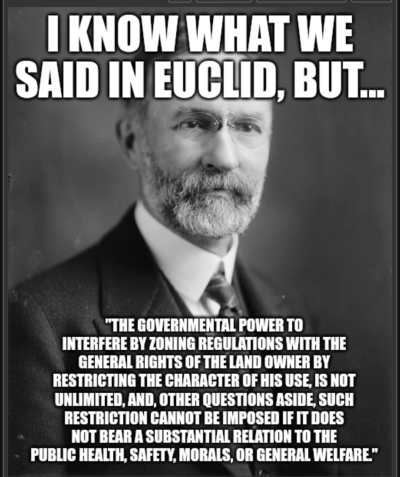
It was on this day in 1928 when the U.S. Supreme Court issued its second most famous decision about zoning, Nectow v. City of Cambridge., 277 U.S. 183 (1928). 

We say “second” because everyone knows that the first is the Court’s decision issued just two years earlier which generally upheld comprehensive use, height, and density regulations as a valid exercise of the government’s police power to regulate property uses to further the public health, safety, welfare, or morals. See Village of Euclid v. Ambler Realty Co., 272 U S. 365 (1926). 

Partly because of the hype surrounding Euclid and the broad governmental embrace of exclusionary land use policies that Euclid unleashed, we think that Nectow has not received the attention it is due. After all, it should be seen as the companion case to Euclid: it was authored by same Justice who wrote Euclid (Justice Sutherland)

Continue Reading Happy Birthday, Nectow v. City of Cambridge!

Check out the North Carolina Court of Appeals opinion in North Carolina Bar and Tavern Ass’n v. Cooper, No. COA22-725 (Apr. 16, 2024).

We’re not going to go into great detail, mostly because this one tracks the most common judicial approach to takings challenges to business shut-down orders during the Co-19 period. The court concluded that the State’s selective shut down of certain bars but not others was neither an “emergency commandeering” under North Carolina’s emergency response statute, not a physical, Lucas, or Penn Central taking. Read the opinion for the reasons why.

But there is more than one way to skin that cat. The court held that the trial court should not have rejected the plaintiff’s motion for summary judgment on its North Carolina’s Fruits of Labor Clause claim.

That provision states:

We hold it to be self-evident that all persons are created equal; that they are endowed

Continue Reading Blinded Me With Science! No Taking For Selective Co-19 Business Shut-Down, But Might Violate North Carolina’s Fruits Of Labor Clause

PXL_20240422_045016733.MP
There are some rewards for working late in the 808

Yesterday was the last day of instruction for the Spring 2024 semester at the University of Hawaii Law School. Did these last few months ever go by fast. 

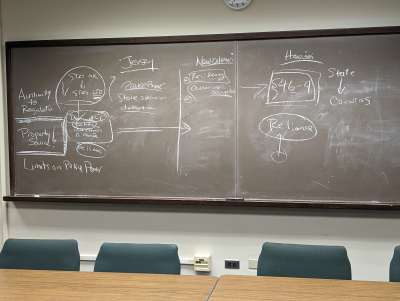
A big thank you to Professor Mark M. Murakami, with whom I guest-lectured at the Old School (both of us earned our JD’s at the Law School) over the semester, on such topics as Euclid, vested rights and development agreements, and of course limitations on the police power such as takings.

Although our students have another couple of weeks to finish up with their final papers, we can say with certainty that the future of Hawaii land use law is in good hands. We had some very intriguing and educational discussions over the past few months. 

PXL_20230426_222214630

Law of the Splintered Paddle

PXL_20240423_050055849.MP       
Old School chalkboards remain in some of the classrooms.

Continue Reading Aloha To Another Semester Of U. Hawaii Land Use