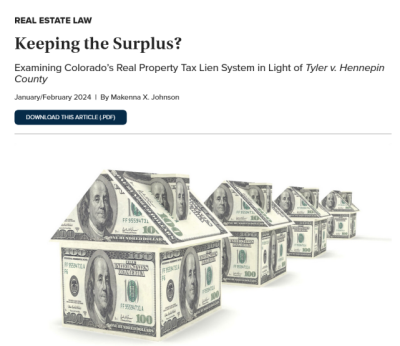
Screenshot 2024-01-04 at 09-57-31 Keeping the Surplus Colorado Lawyer

How thrilled are we that an alum of our William and Mary Law School courses, up-and-coming Colorado property lawyer Makenna X. Johnson, has published an article in the area of law we all love (dirt law)?

Let’s just say that we’re thrilled. Makenna writes:

Colorado’s real property tax system resembles Minnesota’s principally in that it provides no mechanism for a property owner to recover any surplus or equity in excess of the taxes and fees owed. Although in Colorado a surplus may be retained by either a private party or a municipality, the result is the same: the owner’s property interest in the surplus is forfeited. Applying the logic of Tyler, a court might deem unconstitutional any system that requires property owners to forfeit the surplus without allowing them an opportunity to request a refund.

Check it out in the Colorado Lawyer (Jan-Feb 2024): Keeping the Surplus?
Continue Reading New Article: “Keeping the Surplus? Examining Colorado’s Real Property Tax Lien System in Light of Tyler v. Hennepin County” (Makenna Johnson)

As 2023 comes to a close, here are a few of the decisions that we wanted to blog about, but didn’t have the time.

  • Bruce v. Ogden City Corp., No. 22-4114 (10th Cir. Dec. 1, 2023): city demolishing a building that was damaged by fire was not a Lucas taking because the owner still has use of the land (even though the building is gone). And no Penn Central taking because… Penn Central.
  • Moriarity v. Indiana, No. 22A-PL-2899 (Ind. Ct. App. Nov. 15, 2023): State ordering removal of illegal dam was not a taking under U.S. or Indiana Constitution. The owners don’t have a property right to build an illegal dam. Thus, the “background principles” exception to Lucas rules the day. And no Penn Central taking because the owners never had any investment-backed expectations they could build this dam.
  • Lafayette Bollinger Dev., LLC v. Town of


Continue Reading 2023 Year-End Clean Up

Here are the cases that Michael Berger and I discussed in today’s presentation to the ABA State and Local Government Law Section’s Land Use group. It was good seeing everyone, even virtually:


Continue Reading Cases And Links From Today’s ABA State & Local Govt Law Land Use Presentation

Screenshot 2023-12-26 at 07-40-26 “to protect all the essential elements of ownership ” Late Nineteenth Century Emergence of the Regulatory Takings Doctrine

A must-read from Professor James Ely, “to protect all the essential elements of ownership:” Late Nineteenth Century Emergence of the Regulatory Takings Doctrine, 13 Brigham-Kanner Prop. Rts. J. ___ (forthcoming 2024).

Professor Ely, who presented this paper at the recent Brigham-Kanner Property Rights Conference, lays out the case that the regulatory takings doctrine didn’t suddenly spring from the mind of Justice Holmes in Pennsylvania Coal Co. v. Mahon, but “the doctrine of regulatory takings began to take shape in the last decades of the nineteenth century[.]”

Here’s the abstract:

This article examines the gradual emergence of the regulatory takings doctrine in the years between the end of the Civil War and the decision in Pennsylvania Coal v Mahon (1922). It is often asserted that the takings clause of the 5th Amendment, and its state counterparts, were understood to cover only appropriation of title and physical invasion

Continue Reading Professor Ely: Regulatory Takings Didn’t Begin With Pennsylvania Coal v. Mahon

PXL_20230223_024826759

Starting in January, we’ll be helping our friend and former law partner Mark M. Murakami with the venerated and oh-so-important Land Use course (Law 580) at the University of Hawaii’s Law School.

We’re temporarily stepping into some mighty big slippers (this is Hawaii, so we don’t always wear shoes), as this is the course that our mentor Professor David Callies taught for decades. And is there a better venue in which to teach and study land use law and regulation, and its limits? After all, Hawaii may be the most heavily-regulated land on the planet, and is a focal point for every issue you can think of, from zoning to environmental restrictions to takings to public trust to subdivision to admin law to … well, you get the drift.

We’ll cover those topics, as well as the fundamentals. And we have a few surprises up our sleeves — some impressive

Continue Reading Hawaii Five-80: More Land Use (Law 580) At The University Of Hawaii

We’ve been eagerly waiting for the new season of the Institute for Justice’s podcast series, “Bound by Oath” to drop. Not only because it’s a great series – produced by John Ross, it is more like an audio documentary than a typical podcast – but also because John was kind enough to ask us to participate again (our last appearance was in Season 1, where we guested on the episode about the origins of the “incorporation” doctrine).

This season is all about property rights, and episode 2 is all about regulatory takings. Pennsylvania Coal Co. v. Mahon, and Penn Central Transp. Co. v. New York City, to be exact.

So just over a year ago, John and I headed up to anthracite coal country in Pennsylvania. We wanted to be on site on the exact 100th anniversary of the Supreme Court issuing the Mahon
Continue Reading “Groping in a Fog” – Bound by Oath Podcast, S3 E2: Regulatory Takings – Penn Coal And Penn Central … Unplugged!

PXL_20231202_194330453.PORTRAIT

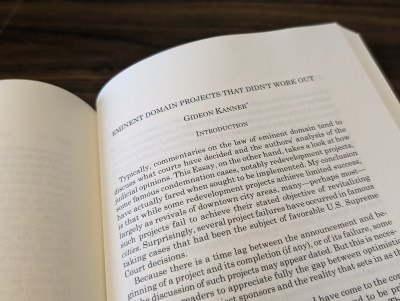
Here it is — Professor Gideon Kanner’s final law journal article, published shortly before his passing:

Gideon Kanner, Eminent Domain Projects That Didn’t Work Out, 12 Brigham-Kanner Prop. Rts. J. 171 (2023).

Appropriately, we think, published in William and Mary Law School’s Brigham-Kanner Property Rights Journal, named in part in Gideon’s honor.

This isn’t a typical law journal article, but an essay collecting Professor Kanner’s thoughts, comments, and (best of all) opinions on, well, eminent domain (and redevelopment) projects that didn’t work out.

In Gideon’s own words, from the Introduction:

But whether you favor widespread use of eminent domain or not, and whether the projects created by its use are sound or not, it is deplorable that the power of eminent domain has been often deployed to the detriment of racial and politically powerless minorities. Typically, redevelopment projects tend to displace middle class and poor people from

Continue Reading Professor Kanner’s Final Article: “Eminent Domain Projects That Didn’t Work Out,” 12 Brigham-Kanner Prop. Rts. J. 171 (2023)

Pace
22nd annual Alfred B. DelBello Land Use
and Sustainable Development Conference

Come, join us (and others) on Thursday-Friday, December 7-8, 2023, at Pace Law School in White Plains, New York for the Land Use and Sustainable Development Conference (this year’s conference theme is “Balancing Economic Realities with Environmental and Social Concerns”).

We’re speaking about the 100th anniversary of the modern regulatory takings doctrine, which got its start nearly 101 years ago with the Supreme Court’s opinion in Pennsylvania Coal Co. v. Mahon, where the Court held that property may be regulated, but if the regulation “goes too far,” it will be deemed a taking.

Here’s a description of the program:

The 100th Anniversary of Pennsylvania Coal vs. Mahon: How the Takings Clause Became the Primary Check on Government Power When SCOTUS Abandoned Review Under the Due Process and Contracts Clauses During the New Deal

The Takings Clause and 100

Continue Reading Join Us For 100 Years Of Pennsylvania Coal (Pace Land Use Conference, Dec. 8, 2023)

Screenshot 2023-11-24 at 11-46-32 Tyler v. Hennepin County - Harvard Law Review

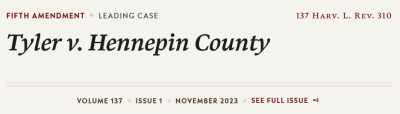
Check this one out, the Harvard Law Review‘s summary of Tyler v. Hennepin County, the “home equity theft” takings case decided unanimously by the Supreme Court.

Some highlights:

Beginning with traditional principles, Chief Justice Roberts suggested that a property interest in surplus equity had English origins — King John proclaimed in the Magna Carta that when collecting debts owed to him by a deceased person, any surplus “shall be left to the executors.” Parliament endorsed this principle, giving the Crown the power to seize and sell a taxpayer’s property to satisfy a tax debt but requiring the surplus to be returned to the original owner.And according to Blackstone, the English common law required the same.

So too did historic and contemporary American laws.

While the Tyler Court continued the trend of a robust Takings Clause, it introduced novel evidence of a taking: a lack of internal consistency

Continue Reading Harvard Law Review On Tyler v. Hennepin County: Reflecting The “Diminishing” Role Of State Property Law In Takings

Euclid_front

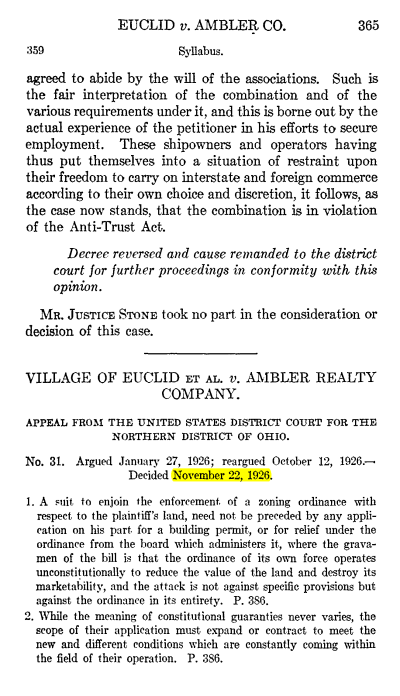
On this day in 1926, the United States Supreme Court issued its landmark opinion in Village of Euclid v. Ambler Realty Co., 272 U.S. 365 (Nov. 22, 1926).

You know this one (shame on you if you don’t!) – it is the case in which the Supreme Court first upheld — against a facial due process challenge — the validity of this thing we call “zoning.” While in the intervening century, zoning has become a catch-all term for regulatory restrictions on the uses of real property, land users know that “zoning” — ackshually — refers only to the regulation and separation of uses, and restrictions on density, and height regulation.

While “Euclid” and “Euclidean zoning” have become part of the land use lexicon and landscape, the decision might have been seen at the time as somewhat surprising. After all, the Supreme Court was in

Continue Reading (Un)Happy 97th Birthday, Euclid!