Check this out, our law firm colleague Joshua Thompson talks about regulatory takings, and his big Supreme Court victory in Cedar Point Nursery.

If you are reading this blog, you already know what that means. Regulatory takings. Bundle of sticks. Penn Central (bleh), and right to exclude. Here’s the description of the program:

In this thought-provoking episode, Bob Stetson and Joshua Thompson, Director of Equality and Opportunity Litigation at the Pacific Legal Foundation, discuss the landmark case of Cedar Point Nursery vs. Hassid and explore the intricate balance between private property rights and public interests. What constitutes a ‘taking’ and how far government regulations can go in the name of the public good?

Stream it above, or listen on Spotify here.

(Our own thoughts on the Cedar Point case here.)Continue Reading New Podcast: The Cedar Point Takings Case (From The Guy Who Argued Cedar Point)

Here’s the merits brief in a case we’ve been following (naturally, because it is one of ours). This is Sheetz v. El Dorado County, the case which asks whether a condition on development (aka an “exaction”) is exempt from the close nexus and rough proportionality standards of Nollan/Dolan/Koontz simply because the exaction is imposed on every owner who asks for permission to use its property, and not via an ad hoc administrative permit procedure.

Because this is one of ours, we’re not going to go into in further, but leave to you to read our brief:

In this Court’s key exactions precedents—Nollan, Dolan, and Koontz—it held that when government exacts money or real property as a condition on the right to use or develop land, it must establish that the exaction bears an “essential nexus” and “rough proportionality” to an adverse public impact caused by the owner’s proposed

Continue Reading Legislative Exactions Merits Brief (Ours): “the text and history of the Takings Clause admit no exception for legislative takings”

ALI-CLE brochure cover page

Here’s the brochure and the full agenda and registration information for the upcoming ALI-CLE Eminent Domain and Land Valuation Litigation Conference at the JW Marriott in New Orleans, February 1-3, 2024.

This is the long-running nationally-focused conference on all things eminent domain, takings, valuation, and related. We have three tracks, from which you can choose a la carte – Practice, Substantive, and Condemnation 101:

For over 40 years, we’ve been bringing eminent domain practitioners together to examine the latest issues, engage in healthy debate, and get the information they need to stay current in their practice. This year – our 41st – is THE perfect time to reunite with your eminent domain colleagues. There will be plentiful opportunities to meet and mingle with the faculty and other registrants – throughout the conference and at evening social events. Attendees come back year after year to make new friendships and renew

Continue Reading Here’s The Program For The 41st ALI-CLE Eminent Domain And Land Valuation Litigation Conference, Feb 1-3, 2024, New Orleans

Penn Coal

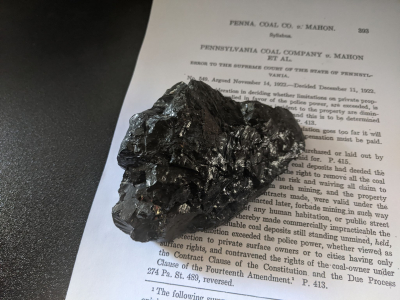
Our thanks to Professor/Dean/Provost Patricia Salkin and Lawprof Simone Freeman for inviting me to drop in on their Touro Law School Land Use class last evening to talk about regulatory takings and some of the interesting details of the Pennsylvania Coal Co. v. Mahon case from 1922.

We discussed the case, using some photos we took during our site visit to the former Mahon property and environs last year on the 100th anniversary of the date the Court issued the landmark opinion. We also emphasized the importance in dirt law cases generally to get yourself on the ground and see the property in question. Even though we have an amazing set of technical tools by which we can remotely get a sense of the land (Google Maps, Street View, for example), there is no substitute for getting yourself to the site to feel the ground, touch the dirt, understand the

Continue Reading We Want A Lump Of Coal For Christmas (As Long As It Is Pennsylvania [Anthracite] Coal)

A short one from the Ninth Circuit on a topic that we keep revisiting, whether the various eviction moratoria adopted and enforced by the feds and many states and local governments during Co-19.

We keep revisiting the topic because the courts keep getting it wrong.

And before we go on, a disclosure: this is one of ours, and our law firm and our colleague Jon Houghton rep the property owners.

This moratorium is from the State of Washington (yes, the same State of Washington whose moratorium was recently challenged unsuccessfully in the state courts). But this challenge is to the City of Seattle’s moratorium, and is in federal court.

Thus, it was the Ninth Circuit considering the question of whether, by commandeering rental property as pandemic public housing, Washington was on the hook for just compensation. Requiring to house residents — whatever the reason — is a physical

Continue Reading CA9: No Physical Commandeering In Eviction Moratorium Because Yee Says “You Let The Tenants In, So You Can’t Complain About Keeping Them (For Free)”

Here’s what we’re reading about the Supreme Court’s property rights docket — some good, some disappointing — this day.

  • Niina Farah, “Supreme Court flooding case could ripple across the energy sector (E & E News / Energywire) – About the Devillier case (which we summarized here), in which we were quoted: “The Supreme Court decision to hear the Devillier case comes after a concerted effort in recent years to convince the court to address procedural maneuvers that have made it challenging for property owners to bring their claims to court, said Robert Thomas, director of property rights litigation at the Pacific Legal Foundation. The nonprofit is among the groups that has asked the court to address takings cases and has lent its support for the property owners in Devillier in a ‘friend of the court‘ brief. ‘There’s a lot of gamesmanship going on


Continue Reading Supreme Court Property Rights Round-Up

092923zr_q8l1_Page_1
I’ll take ‘Words I Like to See’ for $800, Alex.

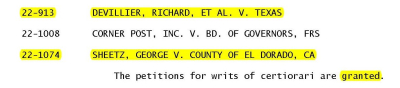
In this Order, the U.S. Supreme Court agreed to hear two important property rights cases (are there any other kind?). Both are cases we’ve been following — and indeed are now playing a part in.

The first is detailed in this post.

In the second, Sheetz v. El Dorado County, the Court is finally getting to the long-unresolved question of whether an exaction or permit condition is exempt from the usual requirements of “logical nexus” and “rough proportionality” simply because the condition is imposed uniformly by legislation, and not ad hoc via an administrative or other permit decision.

We commented on the Sheetz case in this post (“Whether $23K Traffic Fee Is Proportional To One Single-Family Home Is Beyond The Ken Of Judges“) and won’t repeat the facts or comments here.

But here’s

Continue Reading Cert Grant #2 – SCOTUS (Finally!) To Resolve Whether Legislative Exactions Are Subject To Nollan-Dolan-Koontz Nexus And Rough Proportionality

IRWA 6-2023 summary jpg

Thanks to our co-authors for the latest issue of this recurring update.

The International Right of Way Association’s Real Estate Law Committee produces twice-a-year reports “which contain summaries of eminent domain decisions and legislation within the United States.” (This is the “international” right of way association, so that last qualifier is important.)

And what is really nice is that they make the report available.

The laboring oars on this are really Brad Kuhn and Jullian Friess Leivas (both from the Nossaman firm), but they were kind enough to include us. Brad and Jillian wrote up more at the California Eminent Domain Report:

We recently had the pleasure of collaborating with Robert Thomas and Ajay Gajaria once again for the International Right of Way Association’s (IRWA) biannual report covering numerous eminent domain cases at local, state and federal levels from January through the end of June 2023. This


Continue Reading Just Published – IRWA’s “Summary of Major Eminent Domain Cases & Legislation: Jan 1, 2023 – June 30, 2023”

Why is it, you ask, that the ALI-CLE Eminent Domain & Land Valuation Litigation Conference (scheduled next February 1-3, 2024, in New Orleans) is an event that seems to be growing in popularity and attendance. In recent years, we have standing room only in the Conference halls, and have sold out the hotel block. After all, this is a pretty niche area of law. So what gives?

When we were in Austin earlier this year, we thought it might be nice to try and answer that question. We asked Conference participants why they come, year-after-year (and in Austin, despite massive travel disruptions). Yes, it is the various venues (Nashville, Austin, Scottsdale, Palm Springs, to name a few recent locations), and yes, it is the excellent and useful programming.

But as we suspected it is more than that. As the above video notes

Continue Reading ALI-CLE’s Eminent Domain & Land Valuation Litigation Conference (Feb 1-3, 2024, New Orleans): Why Attend? Here’s Why.

This is one of ours — argued by our Pacific Legal Foundation colleague Kady Valois — so we won’t be offering any commentary.

But we just have to post the U.S. Court of Appeals’ opinion in Iten v. County of Los Angeles, No. 22-55480 (Aug. 30, 2023), because it discusses two significant issues, and sets out a roadmap for how to successfully plead a Contracts Clause claim.

First, standing. The court held that a commercial property owner — a retired auto mechanic who leased his premises to an auto repair shop — has Article III standing to challenge the County’s commercial eviction moratorium which prevented the owner from evicting the tenant when it stopped paying rent but did not vacate. The court distinguished the standing requirement of “demonstrating injury in fact” from the question of whether the plaintiff has actually been injured. The first is a pleading requirement and

Continue Reading CA9: Property Owner Has Standing To Challenge Commercial Eviction Moratorium Under Contracts Clause