Weird headline from KITV. No, owners whose property is taken for the rail aren’t “profiting” if they are able to get more for their land than what the condemning agency offered; “just compensation and damages” are required by the constitution, and if they are able to obtain more, in many cases that still leaves them undercompensated and simply means the condemnor’s offer was inadequate.

But besides the headline, KITV does a good report on last night’s community forum on property owners’ rights in eminent domain which we sponsored

Continue Reading Video: Report On Community Meeting On Property Rights And The Honolulu Rail

Metropolitan St. Louis Sewer District v. City of Bellefontaine, No. ED101713 (Feb. 24, 2015), is another one of those cases where construction by a city resulted in damage to property. The water district sued for inverse condemnation, among other things. Only twist here was that it wasn’t exactly “private” property, but property owned by another municipality, a water district. The City responded by arguing that hey man, the water district’s property is already devoted to public use, and the prohibition against takings only applies to private property, so no standing. 

Short story: the Missouri Court of Appeals punted the case up “because of the importance of this question, we transfer to the Missouri Supreme Court.” Slip op. at 7. The interesting thing, especially for those of us who also practice in jurisdictions where a case before an intermediate appeals court can be moved up to the supreme court by transfer, is

Continue Reading Missouri App: Can One Municipality Take Another’s Property? We Don’t Think So, But We’re Not Certain

The State of New York wants to build the Bronx River Greenway, a “23-mile-long ribbon of green with a multi-use path that will extend along the full length of the river in Westchester County and the Bronx.” Who could argue with that?

Amtrak, that’s who. After failing to acquire 6 parcels along the river owned by the “private corporation created by the Rail Passenger Service Act of 1970, 49 U.S.C. § 24101,” in 2008, the state filed notices of appropriation and maps with the county clerk, and title to the land vested in the state. They kept trying to work things out, apparently, but to no avail and in 2012, Amtrak sued in federal court, arguing that the takings were invalid under the Supremacy Clause because they were expressly or impliedly preempted by federal law.

In National Railroad Passenger Corp. v. McDonald, No. 13-4161-cv (Feb. 24, 2015), the Second Circuit

Continue Reading 2d Cir: Amtrak SOL On Claim Its Property Immune From NY’s Eminent Domain Power

A short one from the Texas Court of Appeals. As we noted in this post recently, Texas has bifurcated its eminent domain process. After a petition in condemnation is filed in court, in the “administrative” phase, the court appoints commissioners whose job it is to hold a hearing and render an opinion on value. If any party doesn’t like commissioners’ decision, the “judicial” phase commences and the more familiar process begins. 

In In re Tarrant Regional Water District, No. 12-14-00329 (Feb. 11, 2015), the question was whether the court, in the administrative phase, has the obligation to appoint commissioners even where the court might agree with the property owner’s contention that its property was immune from condemnation. The trial court refused to appoint commissioners, holding it would only do so after a hearing on whether the condemnor could legally take the property. 

The court of appeals granted the

Continue Reading Tex App: Trial Court Cannot Determine Power To Take Until After Commissioners Determine Value

Railiscoming

[To reserve your space, please email your RSVP to me or Mark, or call either of us at (808) 531-8031.]

On Thursday, March 5, 2015, from 6:00 – 7:15 p.m. at the Farrington High School Cafeteria (1564 North King Street, Honolulu, Hawaii), we’re inviting property owners, businesses, and residents whose rights may be impacted by the Honolulu rail project to join us for an informational meeting about the rights of property owners when their property is targeted for acquisition for public transit projects, and how to protect those rights. 

Here’s the invite which we sent out:

Hawaii’s Constitution requires “just compensation” and monetary damages be paid if private property is taken for a public use such as the Honolulu rail project. The Honolulu Authority for Rapid Transit has already begun acquiring privately-owned property it needs for the rail corridor from the airport to Ala Moana, as

Continue Reading Property Owners Invited: Honolulu Rail Project Public Informational Meeting, Thursday, March 5, 2015, Farrington High School

Here’s the latest pipeline takings case from Texas.

This one has been to the Texas Supreme Court before (see our post “‘Common Carrier’ Claim Subject To Actual Judicial Review“). That decision required trial courts to make an actual and factual inquiry into a claim that a pipeline company is a common carrier with the power of eminent domain, and not just accept the fact that the company registered as a common carrier as conclusive. The court sent the case back down, but the trial court concluded that the pipeline operator was a common carrier because after the pipeline’s construction, the operator had the intent to move some CO2 belonging to another entity through the pipeline. It granted the pipeline company summary judgment on the common carrier issue. 

In Texas Rice Land Partners, Ltd. v. Holland, No. 09-14-00176 (Feb. 12, 2015), the court of appeals disagreed after applying

Continue Reading Tex App: Pipeline Isn’t A Common Carrier With Power Of Eminent Domain Just Because Post-Taking It Might Transport Others’ CO2

This is the first of two posts today out of the Tar Heel State (here is the other one). 

North Carolina lawyers no doubt knew this, but we can’t say that we did: the North Carolina Constitution currently does not have a provision that mirrors the Fifth Amendment’s Takings Clause. 

According to these reports (“Eminent Domain bill passes committee” and “NC Lawmakers Look To Restrict Land Seizures With Constitutional Amendment“), the N.C. legislature is considering a measure to add the following text to the state constitution:

Sec. 19.1. Eminent domain.

Private property shall not be taken by eminent domain except for a public use. Just compensation shall be paid, and shall be determined by a jury at the request of any party.”

See the entire bill, and the related proposed amendment to state statutes (which takes out the words “use or benefit” from the

Continue Reading Who Knew? The North Carolina Constitution Doesn’t Have A “Takings” Clause

Yesterday, we were able to attend the Ninth Circuit oral arguments in a case which we posted on last month, Rancho de Calistoga v. City of Calistoga, No. 12-17749.

In that case, the U.S. District Court for the Northern District of California dismissed the complaint filed by the owner of a wine country mobile home park subject to a municipal rent control ordinance which alleged that the city’s hearing officer did not allow a fair return. The court concluded that the complaint did not adequately plead the claims for relief under a regulatory takings, private takings, due process, or equal protection theory.  

We filed an amicus brief in the case on behalf of the Western Manufactured Housing Communities Association

Much of the panel’s time was spent questioning the park owner’s counsel about whether the case was even ripe under Williamson County. Counsel responded that it

Continue Reading 9th Circuit Oral Arguments: Reg Takings, Private Takings, Due Process … And Williamson County

20150205_072910

Here are the links from our opening sessions this morning:

It seems clear that the city and

Continue Reading Links From Day Two, ALI-CLE Eminent Domain Conference

20150204_161439 (1)

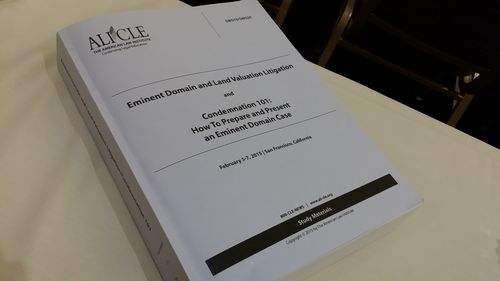
Here are the cases which I spoke about this morning at the 2015 ALI-CLE Eminent Domain and Land Valuation Litigation conference:

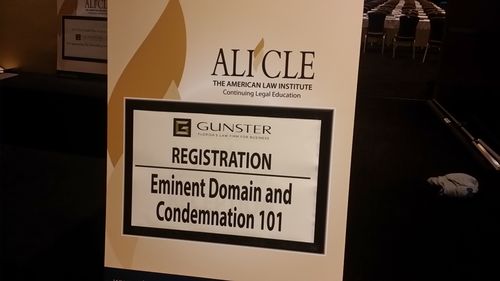
Here is our annual “proof of life” photo, the view from the dais. Proof

Continue Reading ALI-CLE 2015 Eminent Domain Conference: Links From Today’s Presentation