Devillier

Note: this is the second of our posts on the U.S. Supreme Court’s recent decision in Devillier v. Texas. The first — which tries to put the weird post-opinion controversy over which party “won” at the Supreme Court into its proper perspective — is here.

In this post we’ll cover the case’s facts, the odd procedural path that Texas dragged everyone through (only ultimately abandon a key position once at the Supreme Court), and what the Court actually decided, if anything.

The State Flooding Private Property is a Taking Under Everyone’s Constitutions

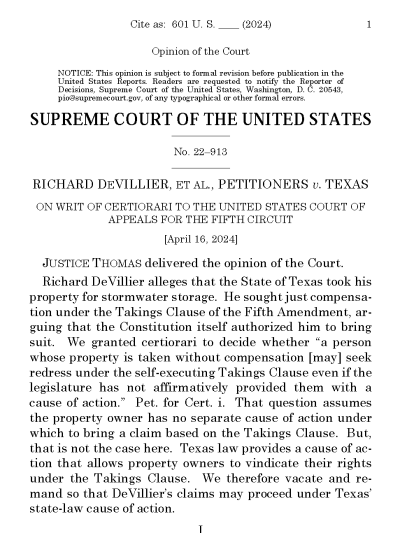
After the Texas DOT flooded his property as part of a freeway project by creating a dam that caused rainwater to collect on his land, Devillier and other landowners sued the State of Texas for a taking, aka inverse condemnation.

The state flooding someone’s property is one of those “classic” cases which are considered takings,
Continue Reading Devillier v. Texas (Part II): After Rope-a-Dope By Texas, Unanimous SCOTUS Saves The State Immunity Issue For Later

The winner takes it all
The loser’s standing small
Beside the victory
That’s her destiny

Note: this is the first of a short series of posts on the U.S. Supreme Court’s recent decision in Devillier v. Texas.

In Part II, we’ll cover the case, the procedural path that Texas dragged everyone through, only to abandon it at the Supreme  Court), and what the Court actually decided, if anything,

Three Common Questions for Lawyers

In the classroom, I often ask students to use their intuition to guess the three most common questions that lawyers almost always get from potential clients. Put yourself in a client’s shoes: what would you want to know?

The students mostly get it right. “What’s this going to cost?” Check. “How long will this take?” Check. And perhaps most obviously, “What are my chances of winning?

That last

Continue Reading In Devillier v. Texas, The Winner Takes It All (Part I)

If there’s a money quote in yesterday’s opinion by the Supreme Court of Nevada which “wholly affirm[ed] a trial court judgment awarding $48 million in just compensation for Las Vegas’s regulatory taking in City of Las Vegas v. 180 Land Co., LLC, No. 24-13605 (Apr. 18, 2024), it might just be this sentence:

Although the City rejected 180 Land’s development proposals, its representatives had previously recognized the site’s ability to be developed residentially.

Slip op. at 8.

That alone should tell you where this one is ultimately headed. But let’s break it down and see how this got there.

Residential PUD Zoning

It started off well for the property owner, who owned land it wanted to use as a golf course, part of a (much) larger 2,200 acre ranch. The city preliminarily approved a request to zone the proposed golf course for residential PUD (planned unit development – which

Continue Reading $48 Million The Hard Zoning Way: Thanks To NIMBYs And NIMTOOs, Las Vegas Must Pony Up A Lucas Takings Judgment

PXL_20231101_125417762.PORTRAIT (Small)
Guess where we stopped for coffee this morning?
(A reminder: this case has nothing to do
with the convenience store.)

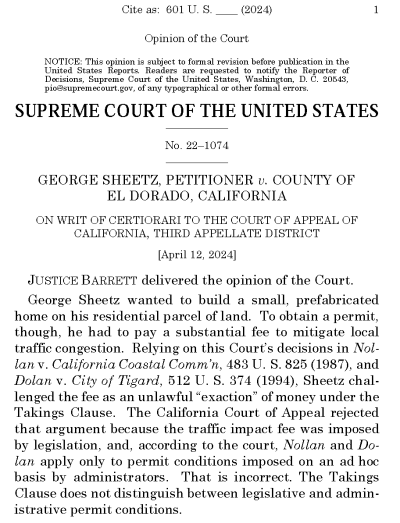
Note: this is the first of two posts on the recent Supreme Court opinions in Sheetz v. County of El Dorado, the case in which the unanimous Court held that exactions imposed by legislation are not exempt from the essential nexus (Nollan) and rough proportionality (Dolan) standards. Here’s the second post, which covers the concurring opinions.

[Disclosure: this case is one of ours.]

In this post, we cover the background, and the Court’s unanimous opinion.

* * * *

Does the government have the unfettered ability to demand “the goodies” (as one municipality’s chief land use planner famously called them in the 1980s), simply because a property owner needs the government’s approval to make use if his or her land?

That’s the

Continue Reading Sheetz pt. I – “Radical Agreement” At SCOTUS: “Your Money Or Your Rights” Isn’t OK Just Because A Legislature Does It

Here’s what folks are saying about yesterday’s unanimous U.S. Supreme Court decision in Sheetz v. County of El Dorado, where the Court held that impact fees and exactions imposed by legislative action are not categorically immune from the close nexus and rough proportionality requirements already applicable to ad hoc/administratively-imposed exactions under Nollan, Dolan, and Koontz.


Continue Reading Sheetz Round-Up

Sheetz

This just in: the U.S. Supreme Court has issued a unanimous opinion in Sheetz v. County of El Dorado, a case we’ve been following (not only because it is one of ours).

The Court, as predicted, held that an exaction (in this case a traffic impact fee) isn’t immune from the Nollan/Dolan nexus and rough proportionality requirements merely because the exaction is imposed by legislation.

At heart, this is a very pro-YIMBY decision because it gives property owners and housing builders a path to object to barriers to creating housing and the government’s use of the land use approval process as a way of exacting “goodies” that increase housing costs.

While we digest the opinion and the multiple concurring opinions — we shall post more once we do so — you can either read the opinions themselves, or see what we thought after the oral arguments. Or

Continue Reading Unanimous SCOTUS Delivers A YIMBY Blow: “The Takings Clause does not distinguish between legislative and administrative permit conditions.”

This one takes a bit of sifting through, but if you do so, you will eventually savor the arguments. Try and follow this thread.

In 2014, pistachio growers with what seemed to be established rights to pump groundwater for irrigation of their trees and who never had to pay fees or were subject to other governmental regulation, were subject to the newly-adopted Sustainable Groundwater Management Act. This statute, designed to manage groundwater, empowers local groundwater agencies to create management plans and the typical things that such regulatory agencies do.

In the course of determining the “sustainable yield” of the groundwater basin that supplies the pistachio growers’ water, the local agency purported to determine the rights of various users relative to each other. The agency concluded that “public pumpers” have entitlement to 100% of the native groundwater, the pistachio growers’ preexisting water rights notwithstanding. If the pistachio farmers wanted to pump

Continue Reading Pay To Play? Cal SCT Asked If Challenger Must First Pay A Fee To Object To Zero Water Allocation As A Taking

Screenshot 2024-04-09 at 12-04-36 https __pd.pacificlegal.org (Small)

Have thoughts about where regulatory takings are (or should be) headed? Here’s your chance to get in on the conversation, and to shape the future of the law.

Our outfit, the Pacific Legal Foundation, in cooperation with the Antonin Scalia Law School’s Journal of Law, Economics, and Policy, are calling for papers on “Imagining the Future of Regulatory Takings.” There will be an in-person discussion of these papers at the Law School in October 2024.

Here’s the full description:

A century ago, Oliver Wendell Holmes, speaking for the Supreme Court, assured us that “[t]he general rule at least is that while property may be regulated to a certain extent, if regulation goes too far it will be recognized as a taking.” In the ensuing one hundred years, courts have struggled to draw the line defining “too far.” Some still wonder whether such a line should even exist. As Justice

Continue Reading Commit To Submit: Call For Papers “Imagining the Future of Regulatory Takings”

Here’s one about Lucasbackground principles” of property law, or maybe the Supreme Court’s current focus on “history and tradition” when it comes to defining private property for purposes of the Takings Clause. 

In So. Cal. Edison Co. v. Orange County Transp. Auth., No. 22-55498 (Mar. 13, 2024), the U.S. Court of Appeals for the Ninth Circuit affirmed a grant of summary judgment denying a takings claim by a public utility which sought compensation after the County ordered it to move its equipment off of a public right-of-way for a streetcar line at its own expense.

The utility raised a physical takings claim, but the court didn’t get to that issue, instead focusing on whether it owned property. The court noted that state law “generally” defines property but, citing Tyler, held that there are certain “traditional property law principles” and “historical practices” about

Continue Reading CA9: “Traditional common law rule” That Utilities Bear The Cost Of Relocating From Public Right-of-Way Isn’t A Taking