There’s a lot going on in the U.S. Court of Appeals for the First Circuit’s opinion in Ocean State Tactical, LLC v. Rhode Island, No. 23-1072 (Mar. 7, 2024), involving a challenge to a Rhode Island statute outlawing possession of certain large capacity gun magazines.

But unsurprisingly, we’re going to be most interested in how the court disposed of the takings challenge.

In 2022 Rhode Island added detachable “large capacity magazines” (those capable of holding more than 10 rounds of ammunition) to its existing list of can’t-own-or-possess items. If you already owned or possessed one of these things, the law gave you four options: (1) modify the mag so it will hold 10 or less rounds; (2) sell the items to a federally-licensed firearms dealer or someone out of state; (3) give ’em to an out-of-stater (Connecticut gun aficionados, you are in luck!); (4) give ’em to Five-O. There’s

Continue Reading CA1: No Taking When State Banned Possession Of Big Scary Gun Magazines
Screenshot 2024-03-26 at 09-12-12 Meme Generator - Imgflip

Check this out: lawprof Ilya Somin has posted “Squatters’ Rights Laws Violate the Takings Clause” at Volokh.

His thesis is just as the title suggests, arguing that state statutes that treat trespassers as tenants are government-authorized physical occupations, and thus are takings:

Ideally, state and local governments should make it easy for property owners to swiftly remove squatters, and should subject the trespassers to civil and criminal sanctions. But where they instead facilitate this violation of property rights, the laws that do so violate the Takings Clause of the Fifth Amendment, which requires payment of “just compensation” whenever the government takes “private property.”

Professor Somin relies on Cedar Point, and addresses the narrow exception to the general rule from that case that all physical invasions and occupations are takings without regard to the diminution in use or value or the owner’s expectations, where the government had enabled

Continue Reading Lawprof Ilya Somin: “Squatters’ Rights Laws Violate the Takings Clause”

Here’s our latest, this cert petition, another one asking whether a property owner’s regulatory takings claim is ripe for judicial review.

This is one of ours, so we won’t be commenting in depth other than to say that it doesn’t seem like you should have to seek permission under Futurelaw in order to ripen a claim.

The Question Presented (and the petition itself) set out the issues, and our take on them:

The City of South Burlington, Vermont, established “Habitat Blocks” where all development is banned to preserve open space. It enacted an “interim” land use ordinance that restricted development between 2018 and 2022 while it contemplated the location of its Habitat Blocks. During that period 835 Hinesburg Road, LLC, submitted a development proposal for the construction of commercial and light industrial buildings on its 113.8-acre parcel of undeveloped land, which complied with all elements of the interim ordinance.

Continue Reading New Cert Petition: Denial Of Development Under Existing Law Enough To Ripen A Takings Claim

Zip. Zilch. Zero. Nil. Nada. Squat. Bupkis.

Here’s the latest in a case we’ve been following for a long, long time (see here and here, for example).

In Maunalua Bay Beach Ohana 28 v. State of Hawaii, No. CAAP-19-0000776 (Mar. 18, 2024), the Hawaii Intermediate Court of Appeals confirmed that a state statute declaring certain accreted littoral land to be public property was a temporary regulatory taking of littoral owners’ rights (the common law says that accreted littoral lands belong to the private owner), but that the just compensation the State owes to these owners is a big fat zero.

This case goes back to a statute the Hawaii Legislature adopted in 2003, which made certain land accreted on littoral private property public land. As the court put it, “[i]t effectively made land accreted to the Beach Lots after May 20, 2003, public land not owned by [the adjacent littoral owners].” Slip op. at 3.

Sounds like a taking, and sure enough a lawsuit followed, claiming that the ipse dixiting of accreted land was a taking because it represented a change in the common law under which the adjacent owners would own the accreted land. Nine years later, the legislature “changed the law by terminating the taking effectuated by [the statute].” Slip op. at 9.

The trial court dismissed the takings claim, but the Court of Appeals held that the statute worked an uncompensated taking of the land accreted before the effective date of the statute. (The court rejected a claim that the statute also confiscated future accreted land, but that is another story.) The appeals court sent the case back for a a ruling on whether these plaintiffs own land that qualified, and if so, the valuation of the accreted land.

After a bench trial, the trial court concluded that there was a temporary (nine year) taking, not a permanent one. The parties stipulated that just compensation was to be measured by the “fair rental value of the accreted land” as of the effective date of the statute, subject to the governmental and private restrictions that burdened the land. Slip op. at 5. The trial court concluded that just compensation is $0. 

The court of appeals affirmed, and made short work of the owners’ argument. It based its conclusion entirely on the appellate standard of review:

Beach Lot Owners’ evidence of fair rental value was based on the testimony of Stephany Sofos. The circuit court “did not find Ms. Sofos to be a credible witness” and gave “no weight to her testimony.” “It is well-settled that an appellate court will not pass upon issues dependent upon the credibility of witnesses and the weight of evidence; this is the province of the trier of fact.” Fisher v. Fisher, 111 Hawaii 41, 46, 137 P.3d 355, 360 (2006) (citation omitted).

The circuit court instead credited the testimony of Craig Leong, a licensed real estate appraiser who holds the MAI designation.

Slip op. at 11-12 (footnote omitted).

The State’s appraiser concluded there was no rental value because the size of the accretions were “irregular” and of “narrow widths,” and subject to regulations and restrictions. Slip op. at 12.

The owners couldn’t believe that beachfront property in one of the most desirable residential areas in Honolulu is utterly worthless: “Beach Lot Owners argued that ‘depriving [them] of oceanfront property in Maunalua Bay for 9 years cannot possibly be valued at $0.'” Slip op. at 10. Indeed isn’t it intuitive that ownership of even a small and irregularly-shaped portion of beach — even for a temporary period, and even if open to public access as the plaintiffs stipulated — could be worth something? Especially, as the plaintiffs claimed, as a buffer to the homes built on the adjacent residential lots (what the opinion calls the “Home Lots”).1

Problem is, the plaintiffs making those claims “do not own any Home Lots.” Slip op. at 11. Ouch.

Having noted that the trial court made a determination that the plaintiffs’ appraiser offered incredible testimony (what that testimony was, and what value the appraiser assigned to the accreted lands we don’t know because the opinion does not tell us), and that the government’s appraiser was credible, the court of appeals held the factual conclusion of zero just compensation was not clearly erroneous because there was some evidence in the record to support it. Game, set match.

Also: no nominal damages because the plaintiffs, having scored no just compensation, “did not sustain a ‘technical injury due to a violation of some legal right[.]'” Slip op. at 13. In the court’s view, they were not injured at all.

Finally, the court rejected the argument that the plaintiffs should have been at least awarded attorneys’ fees under the private attorney general doctrine. Read pages 14-20 if you care why (we don’t, sorry).

——————————————–
1. This intuition comes from the “Inversecondemnation on Valuation” treatise by the way. You won’t find a copy of this august work in your law library, sadly. In the end, the trial court found the in-court testimony of expert valuation witnesses a lot more persuasive than your author’s intuition, which, standing alone, is worth doodly-squat in a court of law (as we know). 

Maunalua Bay Beach Ohana 28 v. State of Hawaii, No. CAAP-19-0000776 (Haw. App. Mar. 18, 2024)

Continue Reading Hawaii Beachfront Land Is Worth Nothing: The State May Have Taken Accreted Land, But Just Compensation Is Zero

Screenshot 2024-03-14 at 19-30-43 Fines Forfeitures and Federalism

When it comes to property rights, we’re most often focused on takings, compensation, and due process. But as you all know, the concept of property rights encompasses a whole lot more.

Our colleague, lawprof Jessica Asbridge, has posted on SSRN an article that is forthcoming in the Virginia Law Review, “Fines, Forfeitures, and Federalism,” in which she delves into the question of how the Excessive Fines Clause applies to state and local forfeitures and fines. To resolve the federalism concerns she identifies, the article argues that courts “should look to the exactions doctrine under the Takings Clause.”

Count us as intrigued.

Here’s the Abstract:

Fines are ubiquitous in modern society, and they are imposed for both serious crimes and minor civil wrongs. The U.S. Supreme Court recently recognized that the Constitution’s Excessive Fines Clause applies to the states, but that decision raises previously unexplored questions as to how to enforce the Clause’s protections in the states. A key question is what role, if any, federalism should play in crafting doctrinal rules that apply the Clause’s protections to state and local fines and related property forfeitures. This Article is the first to accord in-depth treatment to that important question.

The extent to which federalism principles should apply does not have an immediate and obvious answer. On the one hand, federalism plays a significant role in the Court’s jurisprudence on the Cruel and Unusual Punishment Clause. The Court therefore generally takes a highly deferential approach in reviewing sentences of imprisonment. Lower courts have applied that same deferential review in the context of the Excessive Fines Clause. On the other hand, fines and forfeitures are unlike other forms of punishment—such as prison—because they are often used as a revenue source for state and local governments, creating a conflict of interest for state and local decision-making bodies.

To address this conundrum, this Article makes the novel argument that the Court should look to the exactions doctrine under the Takings Clause, which often implicates similar concerns of government self-interest and overreaching. Exactions and excessive fines are conceptually similar, but scholars thus far have overlooked the close relationship between them. The exactions doctrine gives minimal weight to federalism concerns, and it applies a heightened-scrutiny standard that is well suited to the excessive fines context. Indeed, differences between federal practice and state and local practices as to fines suggest that discretionary state and local fines should be subject to closer constitutional scrutiny than federal fines. As a recent example illustrates, such heightened scrutiny would ensure that the Excessive Fines Clause is not merely a parchment barrier, while still accounting for variations between states and localities in terms of their communities’ values and needs.

Check it out. Download your copy on SSRN here.
Continue Reading New Article: “Fines, Forfeitures, and Federalism” (Jessica Asbridge)

Screenshot 2024-02-28 at 13-12-21 Call for Papers Too Far Imagining the Future of Regulatory Takings PDF Justice Crime & Violence

Have thoughts about where regulatory takings are (or should be) headed? Here’s your chance to get in on the conversation, and to shape the future of the law. Our outfit, the Pacific Legal Foundation, in cooperation with the Antonin Scalia Law School’s Journal of Law, Economics, and Policy, are calling for papers on “Imagining the Future of Regulatory Takings.” There will be an in-person discussion of these papers at the Law School in October 2024.

Here’s the full description:

A century ago, Oliver Wendell Holmes, speaking for the Supreme Court, assured us that “[t]he general rule at least is that while property may be regulated to a certain extent, if regulation goes too far it will be recognized as a taking.” In the ensuing one hundred years, courts have struggled to draw the line defining “too far.” Some still wonder whether such a line should even exist. As Justice Clarence

Continue Reading Call For Academic Papers: “Too Far: Imagining The Future of Regulatory Takings”

In Rhone v. City of Texas City, No. 22-40551 (Feb. 14, 2024), the U.S. Court of Appeals for the Fifth Circuit held that a municipality’s conclusion that Rhone’s apartment building had not been properly maintained, and a subsequent municipal court demolition order, might be a taking … or it might not be.

We won’t get too far into the facts, except to say that Rhone argued that the city had it out for him, and that the municipal court judge who issued the demolition order was in a contractual relationship with the city by which the judge had to submit for approval all of the court’s decisions to the city attorney (the very party pressing the nuisance claims against Rhone). Weird, but apparently a product of Texas law. Short story, according tot the court: “[a]ll of this, facially at least, is a declaration of a lack of independence of

Continue Reading Too Soon For CA5 To Figure Out Whether City Demolishing Property For Code Violations Is A Taking

Screenshot 2024-02-27 at 16-35-17 Post Feed LinkedIn

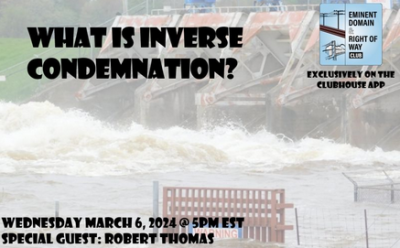
Save the date (and time): next Wednesday, March 6, 2024, at 5:00 p.m., Eastern Time, as we rejoin our friends and colleagues Patrick McAllister and Beth Smith, as they co-host the Eminent Domain and Right of Way Club.

We’ll be joining them to try and answer that question, “What is Inverse Condemnation?” As Patrick and Beth note, “[w]e will find out what it is, how it works and when does it happen….and probably a lot more.” Sounds intriguing.

For those of you who may not have participated in one of these sessions before, you may be wondering “what is this ‘Clubhouse’ thing?” Here’s the description, straight from their site:

The Eminent Domain & Right of Way Club is on the Clubhouse Drop in audio app. This Club is geared toward right of way professionals & anyone interested in the acquisition of land rights for infrastructure projects.

In short, it

Continue Reading “What is Inverse Condemnation?” Join Us In the EDROW Clubhouse, March 6, 5pm, To Find Out (And More)

ALI-CLE brochure cover page

When it comes to the longstanding ALI-CLE American Law Institute-CLE Eminent Domain and Land Valuation Litigation Conferences, we’re always ready to go. You know that. But this year’s version — the 41st — was buzzing like no other in recent memory.

Maybe it was the New Orleans venue with its atmo, food, and music for our after-class activities, or even the timing (the second-to-last week on the Mardi Gras parade season, and our conference hotel was right on the routes). It might have been the nice weather (oh, it rained buckets one evening, but there wasn’t an ice storm like we experienced in Austin in 2023). Or maybe it was the capacity crowd, and new topics and speakers on the agenda. Or maybe it was just the prospect of seeing our friends and colleagues again after a year.

Here’s a photo essay of some of the Conference highlights.

And

Continue Reading Pass A Good Time: Our Report From The 41st ALI-CLE Eminent Domain & Land Valuation Litigation Conference, Feb 1-3, 2024, New Orleans

The DC Court of Appeals’ (note: not the U.S. Court of Appeals for the D.C. Circuit) opinion in Gordon v. District of Columbia, No. 20-CV-0568 (Feb. 15, 2024), presents a good cross-section of property rights issues. Not a good outcome on property rights issues, mind you.

If nothing else, be sure to check out the outrageous facts in the case. They will make your toes curl. 

The Gordon brothers own a home in the District, in the Forest Hills area. They didn’t want to be owners of this home, and instead wanted to sell it. Consequently, they took some of the usual steps one takes when one wants to sell a home – they retained a real estate agent, authorized certain entries for looky-looks (but did not ok free access or open house showings), and the like.

This aroused the ire of some of the area’s residents, who were

Continue Reading DC App: $350k Loss In Value Due To Home’s Historic Designation Not A Penn Central Taking