Yesterday, the other shoe dropped. In this order the U.S. Supreme Court denied review to a case that we’ve long been following, which challenged aspects of New York’s draconian rent control laws as a taking, 74 Pinehurst v. New York.

We say the “other shoe” because ever since the Court denied review months ago to other challenges to rent control (yet kept relisting Pinehurst, which was always among the two strongest of the multiple challenges), it appeared this round of petitions was doomed, and the Court was holding off denying review, to allow one or more Justices to write something. To us, it was unlikely that the Court would deny some of the petitions outright, while at the same time agreeing to take up the issue in another case. Grant-and-hold seemed the most likely scenario there. Absent that, we didn’t expect these last two to be granted. 

So
Continue Reading SCOTUS Denies Review To Remaining Rent Control Takings Petitions: “Important and pressing question” (Just Not In This Case)

Check out the U.S. Court of Appeals’ opinion in Peace Ranch, LLC v. Bonta, No. 22-16063 (Feb. 13, 2024), where the court concluded that the owner of a mobilehome park could bring a federal court challenge to a California statute, even before the state applied the statute and enforced it.

There’s a mobilehome park in Southern California — Rancho La Paz — that straddles the line between two separate municipalities, Anaheim and Fullerton. When the owner of the park upped the rent, the municipalities undertook efforts to impose a form of rent control. But those efforts ultimately failed.

Not to be outdone, the state representative from the area pushed for, and got adopted a state statute that seems curiously tailored to cover only Rancho La Paz: certain “qualified” mobilehome parks can only raise the rent a certain amount. The definition of a “qualified” park in the statute is limited

Continue Reading Peace Out: CA9 OK’s Pre-Enforcement Challenge To Rent Control Statute

PXL_20230509_183011703

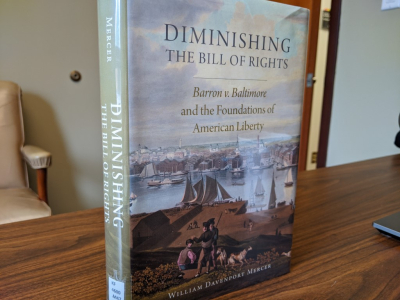
Today’s the day, 191 years ago, when — a mere 5 days after oral arguments — the U.S. Supreme Court issued its (in)famous opinion in Barron ex rel. Tiernan v. Mayor and City Council of Baltimore, 32 U.S. 243 (1833).

Generations of law students study this one in their Con Law classes, and it is mostly known as the case which held that the Bill of Rights limits only the federal government and does not limit the power of states. For the latter, one must look to state constitutions. Barron, of course, was overruled or otherwise neutralized by the Fourteenth Amendment (privileges or immunities clause or the due process clause, take your pick).

But the reason we’re posting our sad birthday wishes today isn’t for that reason, but more because in our estimation, Barron was the first “takings” case considered by the U.S. Supreme Court.

The case was instituted

Continue Reading Sad 191st Birthday To You, Barron v. Baltimore (Feb. 16, 1833) – The First SCOTUS Takings Case?

Illinois adopted a statute that tweaked public pensions:

On January 1, 2020, Public Act 101-610 became effective and amended, in pertinent part, portions of the pension code to consolidate all applicable local police and firefighter pension fund assets into two statewide pension investment funds, one for police and the other for firefighters. Pursuant to the Act, the local pension funds were required to transfer custody and investment responsibility for their fund assets to the respective statewide funds, which are now tasked with collectively investing and administering the pooled assets. The Act provided a transition period that ended on June 30, 2022, for the transfer of securities, assets, and the investment function from the local funds to the statewide investment funds.

There’s more detail on the statute in the Illinois Supreme Court’s opinion in Arlington Heights Police Pension Fund v. Pritzker, No. 129471 (Jan. 19, 2024), but we’ll leave those

Continue Reading No State Takings Problem In Amending Public Pension Plan

A quick per curiam from the Ohio Supreme Court.

In State ex rel. AWMS Water Solutions, LLC v. Mertz, No. 2023-0125 (Ohio Jan. 24, 2024), the court issued a gentle (or maybe not-so-gentle) “benchslap” to the court of appeals. Here’s the scenario.

First of all, recall that Ohio does not recognize a claim for “inverse condemnation” or “regulatory taking.” Instead, if a property owner believes that the government has de facto taken property but has not provided just compensation, the owner seeks a writ of mandamus asking the court to compel the government to institute an eminent domain action (what CJ Roberts calls “an upfront taking”).

AWMS thought this was the case and sought a writ to compel Mertz, an official with the state Department of Natural Resources, to take and pay. The court of appeals entered summary judgment for Mertz, but the Ohio Supreme Court held

Continue Reading Ohio: We Really Meant It When We Remanded For Weighing Of Evidence – Appeals Court Had No Business Dismissing

Screenshot 2024-02-05 at 12-23-56 Missed Opportunities in State Takings Challenges to Pandemic-Era Restrictions

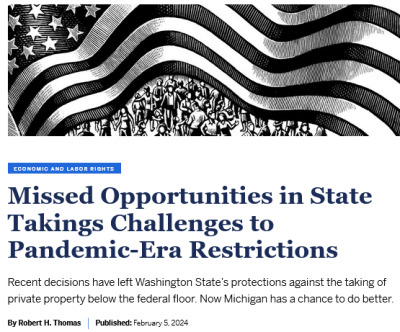
Thank you to the Brennan Center for Justice at NYU Law School’s State Court Report (#statecourtreport) for publishing our piece “Missed Opportunities in State Takings Challenges to Pandemic-Era Restrictions.” The title gives a hint about what this is about: how state and local government’s reaction to Co-19 spurred challenges not only under the U.S. Constitution, but under state constitutions. We give examples of — and comment on — missed opportunities and out-and-out errors in several approaches.

Here are the opening paragraphs:

Responding to the Covid-19 pandemic, the federal government and many state and local governments imposed a variety of restrictions on individuals and businesses. The Centers for Disease Control and Prevention, for example, purported to suspend the ability of property owners to evict nonpaying tenants — a move the U.S. Supreme Court rejected as beyond the agency’s power. State and local governments adopted similar eviction moratoria, and many directed

Continue Reading New Article: Missed Opportunities in State Takings Challenges to Pandemic-Era Restrictions (Brennan Center’s State Court Report)

One week ago today, the U.S. Supreme Court heard oral arguments in Devillier v. Texas.

We wrote up our thoughts in this post, “Rogue States: Today’s Argument In Devillier v. Texas – ‘Aren’t the Courts supposed to do something’ About Violations Of The Constitution?,” and now bring you other reports:

  • Niina H. Farah, “Supreme Court leans toward landowners in Texas flooding case” (Politico E&E News) (we were quoted in this piece: “Robert Thomas, director of property rights litigation at the Pacific Legal Foundation, said critiques of Texas appeared to cut across the ideological spectrum on the court. ‘Even those justices who you might not usually think of as viewing property rights favorably, they didn’t seem to appreciate what I would call the gamesmanship [from Texas],’ said Thomas, who wrote a friend of the court brief to the Supreme Court in support of landowners.).
  • Lydia Wheeler,


Continue Reading Devillier Oral Argument Round-Up

Don’t miss out!

We promise: this is the last time we’re going to try to entice you to the upcoming ALI-CLE Eminent Domain & Land Valuation Litigation Conference in New Orleans. We are getting close to capacity, but there is still room. In recent years, we have standing room only in the Conference halls, and have sold out the hotel block. After all, this is a pretty niche area of law. So what gives?

When we were in Austin last year, we thought it might be nice to try and answer that question. We asked Conference participants why they come, year-after-year (and in Austin, despite massive travel disruptions). Yes, it is the various venues (Nashville, Austin, Scottsdale, Palm Springs, to name a few recent locations), and yes, it is the excellent and useful programming.

But as we suspected it is more than that.

Continue Reading No FOMO: There’s Still Room For You To Join Us In New Orleans Feb 1-3, 2024 For The 41st ALI-CLE Eminent Domain & Land Valuation Litigation Conference

We’d guess that most people, if asked whether the courts can “do something” when the government acts beyond the authority delegated to it in the Constitution, would respond that “doing something” is exactly what courts are for. 

Bottom Line Up Front

And that is what drives our BLUF on today’s Supreme Court oral arguments in Devillier v. Texas: we’re predicting that the property owner’s arguments in will convince a majority of the Justices, and that the Court will answer the Question Presented with a “yes” –

May a person whose property is taken without compensation seek redress under the self-executing Takings Clause even if the legislature has not affirmatively provided them with a cause of action?

Courts Exist to “Do Something” When Government Violates Rights, Right?

Justice Kagan, as if often the case, drove right to the heart of the matter. For the “money quote” in the transcript or

Continue Reading Rogue States: Today’s Argument In Devillier v. Texas – “Aren’t the Courts supposed to do something” About Violations Of The Constitution?

“No need to ask, he’s a smooth operator…”

On Tuesday, January 16, 2024, the Supreme Court will hear arguments in a case we’ve  been following closely because it involves the fundamental limitation on the sovereign power to take private property. In our system, the sovereign indeed has the power to take private property against the will of the owner, but only if the taking is accompanied by just compensation.

Before we go on, a disclosure: we filed an amicus brief supporting Devillier’s arguments, so we’ve have an obvious bias. Special kudos to our law firm colleagues — and self-executing Just Compensation mavens — Deb La Fetra and Kady Valois for this brief.

Texas Flooded Devillier’s Property

Here are the facts in Devillier v. Texas. As part of a road project, the Texas Department of Transportation caused Devillier’s property to flood. The state flooding someone’s property is one of those

Continue Reading Devillier v. Texas Argument Preview: Do Courts Need Congress’ Permission To Enforce The Right To Just Compensation?