Here is a collection of commentary on the oral arguments in Sheetz v. El Dorado County, heard by the Supreme Court earlier this week. (Our own thoughts here.)


Continue Reading Sheetz Argument Round-Up

DSCF3357

If you were looking for deep clarity from the Justices about land use law and whether a legislature imposing monetary conditions on property development always gets the free judicial pass of rational basis review in this morning’s oral arguments in Sheetz v. County of El Dorado, you may not discover a lot of predictive insight when you listen to the argument recording or read the transcript.

But it is definitely worth your time to listen or read. Yes, there were some head-scratching moments as several of the Justices struggled with how to differentiate between monetary land use exactions that are subject to the nexus and rough proportionality standards, and other government requirements to pay money such as user fees, tolls, and property taxes that presumably are exempt. But there were also moments of clarity. Important moments.

In other words, there’s gold in them thar transcript hills if you

Continue Reading Today’s Arguments In Sheetz v. El Dorado County: “[R]adical [A]greement” On The Key Issue

Conf-2024-flyer
Bismarck in January is looking pretty good.

Here’s what we’re reading today:

  • Christian Britschgi, Court’s Wild Zoning Decision Blocks ‘Montana Miracle’, Reason (Jan. 2, 2024) (“In an eyebrow-raising decision, a Montana judge has halted the implementation of two laws legalizing duplexes and accessory dwelling units on residential land across the state, writing that they’d likely do ‘irreparable’ damage to residents of single-family neighborhoods.”).
  • Richard Frank, The U.S. Supreme Court & Environmental Law in 2024, LegalPlanet (Jan. 3, 2024) (“First up before the Court in 2024 is this “regulatory takings” case from California…. Over the past four decades, U.S. Supreme Court decisions have developed the so-called ‘unconstitutional conditions’ sub-doctrine of regulatory takings law, but to date have only applied it to individually-negotiated land use permit conditions and fees. California state courts–including in the Sheetz case–have consistently refused to extend the doctrine to broadly-applicable fees and conditions imposed on landowners


Continue Reading What We’re Reading Today, Property Rights Edition

Sheetz

Get ready for Sheetz v. El Dorado County, No. 22-1074, the “legislative exactions” case at the Supreme Court. [Disclosure: this is one of our firm’s cases, so we won’t be doing an analysis here. Besides, you already know where we stand on the issue.]

With the final merits brief filed last week (Petitioner’s Reply), the case is now teed up for argument next week. Wow, that seemed to come at us very quickly.

Screenshot 2024-01-01 at 15-41-45 Search - Supreme Court of the United States

Here’s the Question Presented:

George Sheetz applied, to the County of El Dorado, California, for a permit to build a modest manufactured house on his property. Pursuant to legislation enacted by the County, and as the condition of obtaining the permit, Mr. Sheetz was required to pay a monetary exaction of $23,420 to help finance unrelated road improvements. The County demanded payment in spite of the fact that it made no individualized determination

Continue Reading Sheetz v. El Dorado County Argument Preview: Do Blanket Exactions Present The Same Risk As Ad Hoc Exactions?

As you may remember, from time to time we’ve visited the sites of well-known dirt law cases. Kaiser Aetna, Loretto, Mahon, PruneYard, Chicago Burlington, the High Line, Dolan, Nollan, Seneca Village, and Hadacheck are the ones that readily come to mind.

Yes, we have a lot of tech available that makes it pretty easy and inexpensive to “see” a location and get a sense of it without having to actually go there, but very often Google Maps or GIS just isn’t enough. As you property lawyers know, nothing helps in your understanding of a case or issues more than being on the ground at the site, feeling the earth beneath your feet, looking around at the environs, hearing the birds, smelling the air, taking a few of your own photos, talking to neighbors and others, just seeing what is nearby. There’s

Continue Reading Takings Pilgrimage: Boomer v. Atlantic Cement Today

As 2023 comes to a close, here are a few of the decisions that we wanted to blog about, but didn’t have the time.

  • Bruce v. Ogden City Corp., No. 22-4114 (10th Cir. Dec. 1, 2023): city demolishing a building that was damaged by fire was not a Lucas taking because the owner still has use of the land (even though the building is gone). And no Penn Central taking because… Penn Central.
  • Moriarity v. Indiana, No. 22A-PL-2899 (Ind. Ct. App. Nov. 15, 2023): State ordering removal of illegal dam was not a taking under U.S. or Indiana Constitution. The owners don’t have a property right to build an illegal dam. Thus, the “background principles” exception to Lucas rules the day. And no Penn Central taking because the owners never had any investment-backed expectations they could build this dam.
  • Lafayette Bollinger Dev., LLC v. Town of


Continue Reading 2023 Year-End Clean Up

Here are the cases that Michael Berger and I discussed in today’s presentation to the ABA State and Local Government Law Section’s Land Use group. It was good seeing everyone, even virtually:


Continue Reading Cases And Links From Today’s ABA State & Local Govt Law Land Use Presentation

Screenshot 2023-12-26 at 07-40-26 “to protect all the essential elements of ownership ” Late Nineteenth Century Emergence of the Regulatory Takings Doctrine

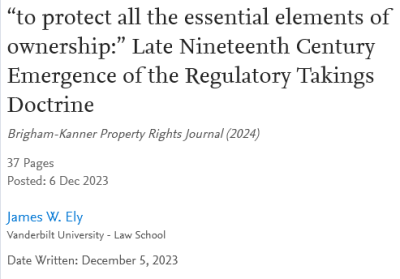
A must-read from Professor James Ely, “to protect all the essential elements of ownership:” Late Nineteenth Century Emergence of the Regulatory Takings Doctrine, 13 Brigham-Kanner Prop. Rts. J. ___ (forthcoming 2024).

Professor Ely, who presented this paper at the recent Brigham-Kanner Property Rights Conference, lays out the case that the regulatory takings doctrine didn’t suddenly spring from the mind of Justice Holmes in Pennsylvania Coal Co. v. Mahon, but “the doctrine of regulatory takings began to take shape in the last decades of the nineteenth century[.]”

Here’s the abstract:

This article examines the gradual emergence of the regulatory takings doctrine in the years between the end of the Civil War and the decision in Pennsylvania Coal v Mahon (1922). It is often asserted that the takings clause of the 5th Amendment, and its state counterparts, were understood to cover only appropriation of title and physical invasion

Continue Reading Professor Ely: Regulatory Takings Didn’t Begin With Pennsylvania Coal v. Mahon

DSCF3357
The place hasn’t changed that much since 1980, has it?

As you know, the legendary Gideon Kanner left us in November. The tributes continue to be published. You’ve no doubt seen our remembrance of Professor K, as well as this one from Southern California Appellate News, this memorial from Loyola Law, our colleague Charles McFarland’s thoughts, and Professor Kanner’s colleagues at the Owners Counsel of America.

Or maybe you’ve read his final law journal article, or listened to his final media appearance on the Bound by Oath podcast.

But one of the ways we’re remembering Gideon is by listening to the recording of his U.S. Supreme Court oral arguments in Agins v. City of Tiburon, 447 U.S. 255 (1980) (stream it above, or listen at Oyez here). Professor Kanner at his full-throated best!

Argued in the spring of 1980 and decided two

Continue Reading Listen: Gideon Kanner’s Oral Arguments, Agins v. City of Tiburon (Apr. 15, 1980)

Here’s the latest in a case we’ve been following.

In this Order, the U.S. District Court for the District of Hawaii made permanent its earlier ruling that Honolulu’s ordinance which expanded the minimum rental term to 90 days because it did not account for those owners who were already legally renting their properties for 30 days. The state Zoning Enabling Act requires zoning ordinances account for preexisting uses.

We covered the issues and the court’s preliminary injunction ruling here, and won’t go over those again. About the only difference between that one and this one is that the court rejects the City’s “several new legal arguments[,]” including Pullman abstention, and the claim that this isn’t a zoning ordinance covered by the ZEA, but rather a “rental regulation.” See slip op. at 10.

The City’s attempt to reframe the issue first presented during preliminary injunction proceedings more than a

Continue Reading Hawaii Federal Court: Honolulu Can’t Increase Minimum Rental Term To 90 Days Without Accommodating Existing Uses