Here’s the latest in an issue we’ve been following.

Let’s say the government thinks you have committed a crime (or someone else has). To investigate, it seizes property as evidence or potential evidence. But after things wrap up and it no longer needs the property as evidence, the government doesn’t return it to its owner. Taking or no taking?

Some courts say it could be a taking. Others say no.

In Jenkins v. United States, No. 22-1378 (June 28, 2023), the U.S. Court of Appeals for the Federal Circuit said maybe. Or at least it isn’t not a taking simply because the government was lawfully exercising its police power. And if there may be open questions about the whether the owner sought recovery of the property through available procedures or outright abandoned it, then a court entering summary judgment for the government isn’t right.

Most of the
Continue Reading CAFED: Just Because The Govt Seized Property As Evidence Doesn’t Mean It Can Keep It Without Compensation

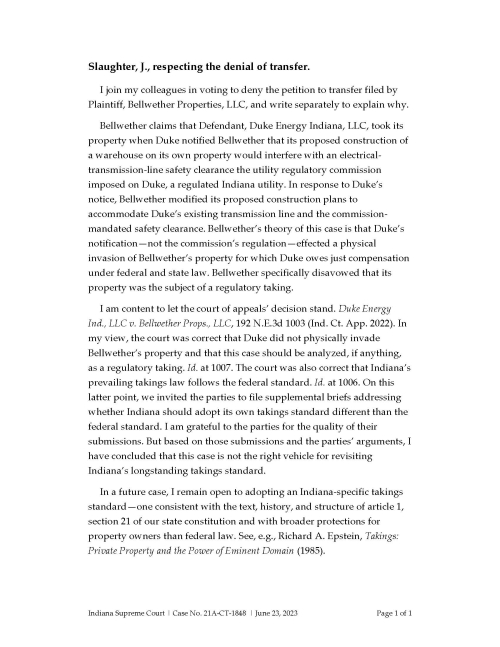
In this Order the Indiana Supreme Court declines to take up the question of when property is taken by regulation. We post it here to note the statement of Justice Slaughter, who agreed that this case isn’t the right vehicle to examine whether Indiana law should adopt a takings test different than the federal test but that he “remains open” to considering it in the right case.

So, Indiana friends, heads-up. Be sure in your next regulatory takings matter, you plead and argue both federal and Indiana takings.

Slaughter_statement

Order at 2.

Order, Duke Energy Indiana,…

Continue Reading Indiana SCT: We’re Not Going To Decide Whether Indiana’s Takings Tests Should Be The Same As Federal Tests (But We’d Like To In A Future Case)

One from the Louisiana Court of Appeal, 3000-3022 St. Claude Avenue, LLC v. City of New Orleans, No. 2022-CA-0813 (June 22, 2023) demonstrating that the standard of judicial review for zoning matters (rational basis) is pretty powerful.

The owner wanted to develop its New Orleans property, but first needed a zoning amendment from residential to commercial, followed by a conditional use permit for its proposed use. The city denied the request. After much procedural back-and-forth, including a trip to the court of appeal to resolve, the case was sent back to the city council to state the basis for the denial. The council held a public meeting at which it denied the rezoning, and declined to state more, including the reasons why.

So back to court the owner went. The trial court thought it had been clear enough: you were supposed to say why you denied the rezoning. Hearing

Continue Reading Nectow Is Meaningless Because It “relies on pre-Lochner administrative review jurisprudence”

In Sterling Hotels,LLC v. McKay, No. 22-1345 (June 22, 2023) the U.S. Court of Appeals for the Sixth Circuit considered whether a hotel could sue a state elevator inspector who barred the hotel from operating its elevators for reasons the state’s Elevator Safety Board had not approved. As a result, the hotel couldn’t rent rooms on five of its six floors. 

Federal complaint — including a takings claim against the inspector in his individual capacity — followed. The district court declined to address whether the inspector had qualified immunity from the takings claim. Next stop, Sixth Circuit.

Did the inspector violate the hotel’s “clearly established constitutional rights” and thus not enjoy immunity? Nope:

Sterling next argues that McKay engaged in an unconstitutional regulatory taking when he sealed the elevators. At the time of the alleged taking, however, no court in this circuit had yet decided whether an officer could

Continue Reading CA6: We Haven’t Already Said Individual Govt Officials Can Be Liable For Takings, So They’re Immune

Thanks to lawprof Josh Blackman for the reminder that our un-favorite case, Penn Central Transp. Co. v. New York City, 438 U.S. 104 (1978), turned 44 today.

DSCF3117
If you know, you know.

Time has not treated the opinion well. Practitioners, judges, and legal scholars across the spectrum have called the three-factor Penn Central test for an ad hoc regulatory taking “demanding,” “fuzzy,” a four-part test, “neither defensible as a matter of theory nor mandated as a matter of precedent,” and “problematic” and “mysterious.” Courts mess up the basic meaning of the factors, treat what is supposed to be a fact-centric “ad hoc” test as a legal question decided on the pleadings, and gatekeep most of these cases from juries.

The definitive deconstruction of the case was Gideon Kanner’s “Making Laws and Sausages: A

Continue Reading Sad Birthday Wishes To Penn Central – Some Things Don’t Get Better With Age

Here’s the cert petition, filed last week, in a case we’ve posted about. See here (Ninth Circuit arguments) and here (en banc petition).

The Ninth Circuit affirmed dismissal of a takings claim because (it held) the claim isn’t ripe. The government hasn’t made up its mind, and just might allow the owners to make some use of their residentially-zoned land (even though the property is also subject to an overlay zone that expressly prohibits residential development). More background here

This is one of ours, so we’re not going to be saying too much more about it. The petition also lays out the situation.

Here are the Questions Presented:

Randy Ralston and Linda Mendiola (Ralstons) wish to build a retirement home on their residentially-zoned land in San Mateo County, California. However, their property sits entirely within an overlay zone, the Montecito Riparian Corridor (Corridor), which categorically bans residential

Continue Reading New Takings Ripeness Cert Petition (Ours): Knowing The Permissible Uses “to a reasonable degree of certainty” Is All You Need For A Claim To Be Ripe

Screenshot 2023-06-16 at 07-52-47 How Did Property Rights Fare at the Supreme Court What Happened in the 2022 Term and What's Next ALI CLE

On Wednesday, August 9, 2023 at 1:00 – 2:00 p.m. (Eastern Time), please join us for ALI-CLE’s web program, “How Did Property Rights Fare at the Supreme Court? What Happened in the 2022 Term and What’s Next.”

Here’s the course description:

This has been a blockbuster U.S. Supreme Court term for property law, with the Court deciding three major property cases: Tyler v. Hennepin County (government’s keeping the excess value when seizing and selling a home to satisfy a property tax debt is a taking), Wilkins v. United States (is the federal Quiet Title Act’s statute of limitations a jurisdictional bar?), and Sackett v. EPA (the scope of Clean Water Act wetlands jurisdiction). To gain a better understanding these opinions, the current state of takings and property law, and what these cases mean for your practice, join a distinguished panel of experts for this one-hour webcast. The faculty will

Continue Reading Join Us August 9, 2023: ALI-CLE’s “How Did Property Rights Fare at the Supreme Court? What Happened in the 2022 Term and What’s Next”

Here’s what we’re reading this Tuesday:

Worth checking Continue Reading Tuesday Round-Up: Sackett, Tyler, Defending Zoning, Canada Property Rights … And More

Missed our law firm colleagues Jeff McCoy, Damien Schiff, and Christina Martin when they were live, talking about their SCOTUS wins in Wilkins v. United States (is the statute of limitations in federal Quiet Title Act cases a jurisdictional bar?), Sackett v. E.P.A. (scope of Clean Water Act wetlands jurisdiction), and Tyler v. Hennepin County (government’s keeping the excess value when seizing and selling a home to satisfy a property tax debt is a taking)?

We recorded it, so you can watch and listen at your leisure.

This is more than just a victory lap, the advocates offer their thoughts on the implications of the wins, and what might be next.

Bon appétit.Continue Reading ICYMI: “Property Rights Hat-Trick: Breaking Down PLF’s Supreme Court Victories” (vid)

In Livingood v. City of Des Moines, No. 22-0586 (June 9, 2023), the Iowa Supreme Court held that the city’s use of the Iowa’s process by which the government can satisfy all or part of a taxpayer’s debt to a public agency by grabbing someone’s tax refund. In a nutshell, after trying to collect the debt by more conventional means:

the income offset program allows the department of administrative services to collect debts for public agencies by offsetting the debts against any income tax refund owed to a taxpayer. The city entered into a memorandum of understanding with the department of administrative services to use the income offset program.

Slip op. at 4-5.

The debt owed in Livingood is for traffic violations caught on camera.

Is it a taking under the Iowa Constitution to not give the taxpayer/cam-violator the full amount of tax refund?

No. First, the court held

Continue Reading Iowa: City Of The Monks Keeping Part Of Your Tax Refund Isn’t A Taking, Red-Light Runners