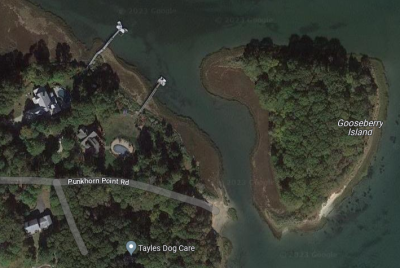
Screenshot 2023-06-07 at 07-14-12 Google Maps

Here’s the latest from the U.S. Court of Appeals for the First Circuit on takings ripeness, Haney v. Town of Mashpee, No. 22-1446 (June 6, 2023). 

The case centers on Gooseberry Island, Massachusetts, which is zoned by the Town of Mashpee as R-3. But under the Town’s zoning code, any residence must have at least 150 feet of frontage and a paved access roadway within 150 feet.

Which is problematic because Gooseberry Island is, well, an island — separated from the mainland by a 40 to 80 foot channel depending on the tides. There’s no bridge, although you can wade across the channel at low tide. No bridge means no roads, and no roads means no residential development.

So the owner sought variances from the frontage and roadway requirements in 2013. Denied. The road and frontage requirements are about emergency access. Next, the owner sought approvals to build a


Continue Reading CA1: Despite Two Variance Denials, Takings Case Not Ripe Because It Isn’t Futile To Try Again

Here’s the latest in a case we’ve been following, one of the multiple challenges to New York’s latest ratcheting up of rent control.

We think the Questions Presented spell out the issues pretty well:

New York has implemented the most sweeping and onerous rent control provisions the United States has ever seen in its Rent Stabilization Laws and accompanying regulations (“the RSL”). As recently amended, the RSL makes New York’s once “temporary” rent stabilization regime permanent for over one million apartments. Petitioners are owners of apartment buildings regulated by the RSL. The RSL expropriates a definitional feature of Petitioners’ real property—the right to exclude—by granting their tenants a perpetual right to renew their leases. The RSL closes off all viable exit options for Petitioners to change the use of their property and thus avoid RSL regulation. These provisions, when combined with the RSL’s ceiling on the rents that landlords

Continue Reading Another Cert Petition Challenging NY’s Draconian Rent Control As A Taking

Here’s the latest in a case we’ve been following since before it became one of ours.

In Gearing v. City of Half Moon Bay, No. 21-16688 (Dec. 8, 2022), the Ninth Circuit upheld the district court’s dismissal of a regulatory takings case, holding that federal courts should abstain from considering regulatory takings cases in favor of pending state court eminent domain actions, even when the condemnor instituted the state court action after the federal takings lawsuit was filed.

In the time since the Ninth Circuit issued the opinion, our law firm has joined up with our colleague Kristen Renfro who represented the owner in the court of appeals. That’s why we won’t be commenting further, and instead suggest you read the cert petition we filed today, chiefly authored by Counsel of Record Deborah LaFetra (lately of the Tyler v. Hennepin County takings case)

Here is the Question

Continue Reading New Takings Cert Petition (Ours): Can Govt Thwart Federal Court Regulatory Takings Claims By Seeking Abstention In Favor Of State Courts?

Here are what others are saying about Supreme Court’s recent ruling in Tyler v. Hennepin County, No. 22-166 (U.S. May 25, 2023), the case in which the Court unanimously held that the county’s keeping the excess equity in Ms. Tyler’s home over what she owed in property taxes and fees is an uncompensated taking of private property.

  • As usual, lawprof Ilya Somin was first out of the gate with “Major Unanimous Supreme Court Victory for Property Rights in Tyler v. Hennepin County” (“While the Supreme Court decision left some notable issues unresolved, it nonetheless sets a significant precedent. Most obviously, the jurisdictions that currently authorize home equity theft—some twelve states and the District of Columbia—will no longer be allowed to do so. In addition, the holding that states cannot just redefine property rights at will has important implications for other property rights issues. It makes it harder


Continue Reading Tyler Takings Round-Up

DSCF3117
If you know, you know.

Pacific Legal Foundation (that’s us) has put out a call for papers about “Rethinking Penn Central.” Here’s the details (pdf).

Here’s some of the suggested topics:

  • Can Penn Central be salvaged or does it need to be fully replaced?
  • If it is to be replaced, what should the new test be?
  • Alternatively, what improvements can be made to Penn Central that would address problems raised by critics without uprooting the test entirely?
  • Is economic loss primarily relevant to compensation owed rather than the threshold question of whether a taking has occurred?
  • Can a more categorical approach, like those taken in cases including Cedar Point Nursery v. Hassid, Hodel v. Irving, or Lucas v. South Carolina Coastal Council, adequately address regulatory takings?
  • What insights does the original meaning of the Takings Clause offer regarding how to fix or replace Penn


Continue Reading Rethinking Penn Central: A Call For Symposium Papers

Caesar
We’ll be rendering to unto Caesar, but first we must
decide: classic or creamy?

That was quick: it seems like it was only yesterday — or maybe more accurately, less than a month ago — that we were listening in live to the Supreme Court as it heard arguments in Tyler v. Hennepin County, No. 22-166, our law firm’s case which argues that Hennepin County’s keeping the excess equity in Ms. Tyler’s home over what she owed in property taxes and fees is an uncompensated taking of private property and also violates the Excessive Fines Clause.

This morning, the Court issued this unanimous opinion authored by Chief Justice Roberts (again proving he’s the Court’s “property guy”), in which the Court held that the County’s seizing Ms. Tyler’s condo to satisfy her tax debt and then “keeping the change” is a taking. It’s a relatively short opinion with no

Continue Reading Unanimous SCOTUS: “state law cannot be the only source” Of Property Rights, And “traditional property law principles” As Enforced By The Takings Clause Play A Role

When a court’s opinion (even a trial court’s opinion) starts out with the epigram, “‘Freedom and property rights are inseparable, you cannot have one without the other.’- George Washington,” you know you are in for a ride.

So begins the opinion of the Clay County, Iowa District Court in Navigator Heartland, LLC v. Koenig, No. EQCV034863 (May 3, 2023). The issue was the validity under the Iowa Constitution of Iowa’s precondemnation entry statute, which allows pipeline condemnors to enter property for land surveys:

After the informational meeting or after the filing of a petition if no informational meeting is required, a pipeline company may enter upon private land for the purpose of surveying and examining the land to determine direction or depth of pipelines by giving ten days’ written notice by restricted certified mail to the landowner as defined in section 479B.4 and to any person

Continue Reading Iowa Trial Court: Pipeline Precondemnation Entry Statute Is Facially Unconstitutional

Here’s the latest in a case we’ve been following since its inception, this cert petition seeking Supreme Court review of the U.S. Court of Appeals for the Second Circuit’s affirming the district court’s dismissal of a complaint alleging that New York (state)’s sweeping amendments to its Rent Stabilization (rent control) statute effected categorical and Penn Central takings:

Petitioners’ physical-takings claims would have been allowed to proceed if they were brought in the Eighth Circuit. That is because the Eighth Circuit has correctly held that property owners plead a physical taking under Cedar Point where a law prohibits them from terminating a tenancy at the end of a lease term. See Heights Apartments, LLC v. Walz, 30 F.4th 720, 733 (8th Cir. 2022), reh’g en banc denied, 30 F.4th 720. But the Second Circuit held here—as has the Ninth Circuit—that the physical-takings principles articulated in Cedar Point are

Continue Reading New Cert Petition: Forcing Owners To Rent To Tenants Indefinitely Is A Categorical Taking

Sidewalk

A good opinion from the U.S. Court of Appeals for the Sixth Circuit in Knight v. Metro. Gov’t of Nashville, No. 21-6179 (May 10, 2023), holding that conditions imposed on every development — and not just ad hoc administratively-imposed conditions — must conform to the Nollan-Dolan-Koontz close nexus and rough proportionality standards.

You takings and land use mavens can stop right there, because you know what this means: the Sixth Circuit has added to the growing split in the lower courts about whether legislatively-imposed conditions on development which cover everyone are, as some courts characterize them, mere land use regulations subject only to Euclid‘s rational basis review, or are constrained by N-D-K ‘s requirements (see here, and here for examples). The Supreme Court has been presented with the lower court disagreement, but so far has not stepped in and resolved the issue.

The Sixth Circuit experienced

Continue Reading CA6: Legislative Conditions Are Subject To Nexus-And-Proportionality Requirements

Harding

Here’s a new cert petition, filed this week by Michael Berger that asks whether Knick‘s no-need-to-exhaust-or-chase-state-compensation rule applies retroactively.

The Second Circuit held that no, the owner’s claims were too late, and although Knick overruled the Williamson County rule that kept him from a timely filing in federal court, that’s just too bad:

We also agree with the district court that the remaining claims are largely time barred. Demarest filed this lawsuit in June 2021, yet much of the conduct targeted by his complaint dates from long before. Since a § 1983 claim adopts the limitations period for a state personal injury tort-which in Vermont is three years, see Morse v. Univ. of Vt., 973 F.2d 122, 125-27 (2d Cir. 1992)-claims accruing before June 2018, which comprise the majority of Demarest’s complaint, would be time barred. Although Demarest argues that his claims accrued only when a

Continue Reading New (Michael Berger) Cert Petition: Knick “Changed the world of takings litigation” And Applies Retroactively – And Statutes Of Limitations Are Affirmative Defenses