Here’s the cert petition, filed today by SCOTUS superstar Paul Clement in a case we’ve been following out of Northern California.

Here are the Questions Presented:

This case involves a stretch of private property along the California coast known as Martins Beach. The California Coastal Commission and the County of San Mateo want Martins Beach to be open to the public, but they do not want to pay to purchase the property, or even for an easement. Instead, they have taken the position that the owner of the property cannot exclude the public unless it first obtains a permit deemed necessary for any change, including a decrease, in the “intensity” of the public’s use of or access to the ocean under the California Coastal Act. In their view, because the previous owner of Martins Beach chose to allow members of the public to access the property upon payment of
Continue Reading New Cert Petition: Beach Access, Temporary And Permanent Takings, And Permits To Exercise The Right To Exclude

Here’s the latest in a case we’ve been following out of Louisiana, involving a local Port’s power to seize a Mississippi River docking facility downriver from New Orleans. The Port took the entire VDP facility, made no change in how the property was used, and eventually turned over operation of the facility to a “hand-picked” private operator. 

In St. Bernard Port, Harbor & Terminal District v. Violet Dock Port, Inc., No. 2017-C-0434 (Jan. 30, 2017), the Louisiana Supreme Court upheld the taking of VDP’s property by the Port so that the Port could run it itself. The owner challenged the power to take, as well as the compensation awarded. The Supreme Court held that the Port has the power to take the docking facility so that the Port could operate the facility, but on the issue of just compensation, the court agreed with the owner that it

Continue Reading Rehearing Sought In Major Public Use Case From Louisiana

Sketch

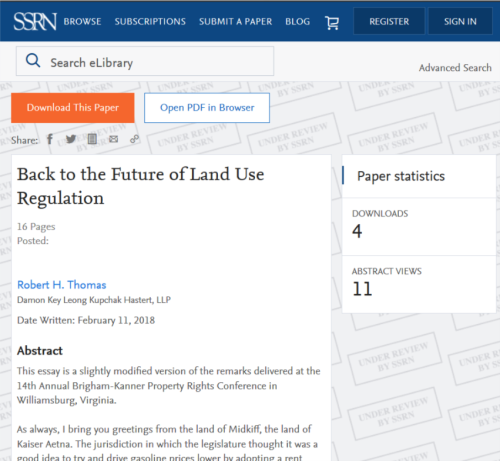
Here’s the (draft) article from our poriton of the first panel at the 2017 Brigham-Kanner Conference, “Back to the Future of Land Use Regulation.” (Also posted on SSRN here.)

This is an expanded version of our talk (listen to the audio here) during the Conference during which the William and Mary Law School awarded U. Hawaii lawprof David Callies the Brigham-Kanner Prize. Our summary of the conference is posted here.

We were part of the panel entitled “The Future of Land Regulation and a Tribute to David Callies,” along with Professors Shelly Saxer and Jim Ely, and past B-K Prize winner Michael Berger. Professor Callies also delivered his opening remarks during this session.

This article has been submitted to the Brigham-Kanner Property Conference Journal which should be published later this year. 

Back to the Future of Land Use Regulation (draft Feb 11, 2018) Continue Reading Back to the Future of Land Use Regulation – Brigham-Kanner Article

20180127_091506_HDR

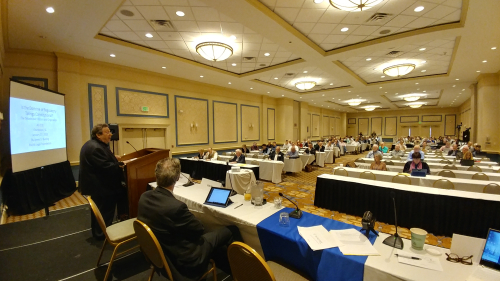
We’re on our third day at the 2018 ALI-CLE Eminent Domain and Land Valuation Conference in Charleston, SC, and as usual, we’re having our headline presentations by takings guru Michael Berger (pictured above), who is updating us on the most interesting and important cases of the past year, and Jim Burling, who will be answering the question, “Should We Rethink Regulatory Takings Law? The Takings Clause, Privileges and Immunities, and Due Process.”

DUjbnOtV4AEgwXW.jpg large

Here are links to the

Continue Reading ALI-CLE Eminent Domain Conference, Third Day: Berger And Burling On Takings

20180126_111558_HDR

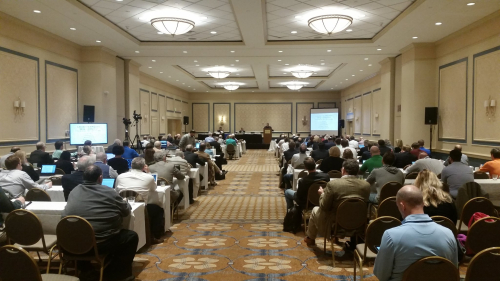
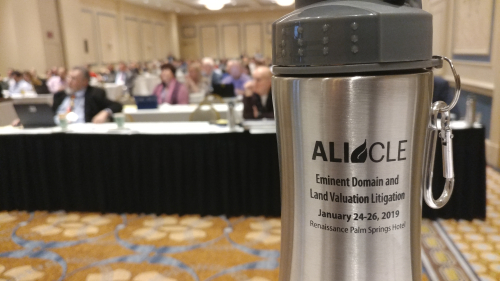
This morning, at the 2018 ALI-CLE Eminent Domain and Land Valuation Litigation Conference in Charleston, South Carolina, we announced the dates and venue for the 2019 Conference: Palm Springs, California.

The conference hotel is the Renaissance Palm Springs Hotel, which has the advantage of being a resort facility, but right in town (so you will have many options for “off campus” activities like art museums, the aerial tram, golf, and whatever suits your fancy). Plus, it’s a short hop from the Palm Springs airport.

This in-person registrations for 2018’s Charleston program sold out, as did our conference hotel, so for 2019 we chose a location and hotel which can accommodate the growth of the conference. But one of the lessons learned from this year’s conference is that you should hold the dates on your calendar now, and when ALI-CLE releases the registration page, you should not wait to

Continue Reading 2019 ALI-CLE Eminent Domain & Land Valuation Litigation Conference Venue Announcement: Palm Springs, CA, Jan 24-26, 2019

Our upcoming American Law Institute-CLE Eminent Domain and Land Valuation Litigation Conference in Charleston, South Carolina has SOLD OUT our in-person registrations. 

We will have a record attendance (with over 100 first-time attendees) and the conference hotel has informed us that we can fit no more people in the meeting rooms. We cannot remember this happening before, but it tells us that we will have an energizing and exciting conference. 

Thank you to all of you who signed up and are coming or joining in online for the webcast — we’ll see you soon at the “four corners of the law.”

And if you delayed too long in registering, please don’t despair. You can still attend from home or the office because ALI has set up a live webcast of the sessions. Go here for more on how to sign up to attend by webcast.

And stay

Continue Reading ALI-CLE Eminent Domain & Land Valuation Conference – In-Person Registration SOLD OUT (But You Can Still Join By Live Webcast)

Here’s the first post-Murr cert petition (as far as we can tell), in a case we’ve been following. As we wrote in “The First Post-Murr Case? Fourth Circuit: No Taking Because Anti-Development Merger Regulations Actually Make Property Developable,” the Fourth Circuit concluded:

[T]he County’s regulations were run-of-the-mill zoning/land use ordinances, and thus were not a taking, nor violations of the related substantive due process and equal protection claims. Because the County had no obligation to extend sewer services to the plaintiff’s parcels, he had no property interest that was taken by the development prohibition. 

The court rejected the owner’s attempt to distinguish Murr. He pointed out that he purchased his property before the restrictive regulations were adopted, and not afterwards like the Murr children. See Murr, 137 S. Ct. at 1945 (“the “expectations . . . an acquirer of land must acknowledge legitimate restrictions affecting

Continue Reading First Post-Murr Cert Petition

35th Annual Advanced Course

Logo_150pxEminent Domain and
Land Valuation Litigation

Live Program | Video Webcast | Video Webcast Segments

Thursday – Saturday, January 25 – 27, 2018
Francis Marion Hotel | Charleston, SC

Do not miss this popular conference! Intended for all eminent domain and land use practitioners, both experienced and those new to the practice. You can even customize the unique curriculum to work for you: freely go between the Advanced and 101 tracks, with additional tracks for Practice and Substantive law.

With a faculty of national experts who offer both condemnor and property owner perspectives, this is the big program, and the one you don’t want to miss.

Recognized and experienced professionals representing the diverse stakeholders in these cases will discuss the issues hitting your desk today or in the future, including:

  • Overlap of condemnation and regulatory takings: Murr and other blurred lines
  • Takings and damaging by flood


Continue Reading ALI-CLE Eminent Domain & Land Valuation Conference – There’s Still Time To Join Us In Charleston

Here’s the amici brief filed earlier this week in Sammons v. United States, No. 17-795, a case we’ve been following. Here’s the cert petition

The issue in this case is the same as in two cases already pending in the Supreme Court, the first a patent case argued in December, and the other a rails-to-trails case in which the cert petition is pending (we filed an amicus brief in the latter case).

Now, we’ve joined a brief in Sammons which argues that like these two cases, this one presents the same issues:  

This petition for certiorari concerns essentially the same issues raised in Oil States and Brott.

In Oil States this Court will decide whether an adjudication before an Article I tribunal “violates the Constitution by extinguishing private property rights through a non-Article III forum without a jury.” In Oil States a non-Article III board invalidated an

Continue Reading New Amici Brief: Of Juries And Article III Courts – Required In Takings Cases?