Austinairport

Here’s what we’re reading today:

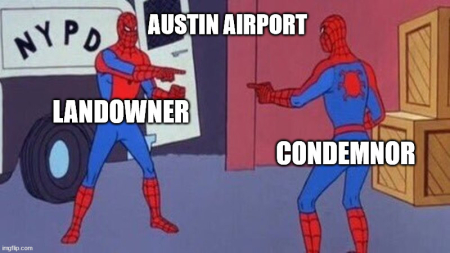
Continue Reading Tuesday Round-Up: Austin Airport Taking Its Own Land?, The Right To Exclude, And More

Anyone who reads this blog regularly knows Tiburon, California, even if you’ve never stepped foot there. Yes, that Tiburon. Well, the beat goes on: the Agins litigation wasn’t the only time that the town and its residents combined forces to try and draw up the drawbridge and prevent the building of more homes in this very exclusive and chichi Marin County waterfront and hilltop community with commanding multi-million dollar views of San Francisco and the Bay. 

For the latest example, read the California Court of Appeal’s opinion in Tiburon Open Space Committee v. County of Marin, No. A159860 (May 12, 2022). It’s 110 pages, but don’t let that discourage you (it’s not necessary to dig into the details, unless you are a true California Environmental Quality Act nerd). The facts alone are hair-raising. But on the other hand, the story may be an old story to

Continue Reading “Something is very wrong with this picture.” Cal Ct App Calls Out CEQA (“fearsome weapon”), Tiburon’s “official hostility,” And “combined animus of two levels of local government”

A developer alleged that the city didn’t live up to its contractual obligations.

The city thought it would be a good place for a new headquarters for something called “Perfect Game Incorporated.” The usual plans ensued, including agreements between the city, a non-profit redevelopment facilitator, and Preston Hollow, a “finance company that funds economic development projects for municipal governments and development corporations.” These agreements dealt with loans by Preston to the city and the facilitator; the loans were used by the facilitator to purchase two parcels in the city for the project, with some of the money remaining in escrow subject to disbursement when certain things happened.

That’s when things allegedly went awry. As the Fifth Circuit put it, “trouble ensued.” Preston claimed that the facilitator insisted on disbursement, even tough it has not yet complied with the conditions. Preston sent a notice of default, and requested that the escrow

Continue Reading When City Busts A Redevelopment Deal, It Might Face The Wheel (But Not For A Taking)

R.S. Radford’s most-recent article, Knick and the Elephant in the Courtroom: Who Cares Least About Property Rights? in the latest issue of the Texas A&M Journal of Property Law, should be next on your to-read list. 

Here’s the summary of the article:

Throughout the thirty-four-year history of Williamson County, one fact was taken for granted. Never directly mentioned but always looming in the background of two rounds of oral argument before the Supreme Court in Knick was the premise that relegating takings claims to state court made it less likely that property owners would prevail on those claims than if they could be filed in federal court in the first instance. This Article examines that premise and finds little support for it in the historical record.

Part I of this Article discusses Williamson County and highlights the logical, doctrinal, and procedural confusion associated with the opinion, both in its

Continue Reading New L Rev Article: Knick Won’t Mean Much Until Federal Courts Get Over “Strong Distate, If Not Outright Contempt” For Land Use Matters

What’s up with that (sorta) snarky headline, you ask? After all, isn’t the PennEast v. New Jersey case, heard yesterday by the Supreme Court, a real honest-to-goodness eminent domain case about a pipeline?

Doesn’t the transcript show terms like “in rem,” “takings,” “eminent” and “eminent domain” were used a whole lot? Aren’t a lot of the media reports saying this is a big eminent domain case (see here and here for example)?

Pages from 19-1039_8758

But read the transcript or a listen to the recording (stream above or download the mp3 here) and see what you think, eminent domain mavens.

If you are like us, you understand that the case isn’t going to tell us a lot about eminent domain generally, or about valuation, or the power to take (except in very limited circumstances). After all, the case asks whether the State of New Jersey – not some mere private landowner –

Continue Reading Listen (Or Read) As SCOTUS Hears Arguments In A (Sorta) Eminent Domain Case

Charlie Brown got a bag of rocks for Halloween.

But you aren’t so cruel, and want to give better gifts this holiday season to the dirt lawyer in your life, no? Here are our 2020 suggestions for stocking stuffers that will make property mavens celebrate the season. 

Start with this one, Professor Bart Wilson’s newly-published “The Property Species – Mine, Yours, and Human Mind.” As describe in the book blurb: “Arguing that neither the sciences nor the humanities synthesizes a full account of property, the book offers a cross-disciplinary compromise that is sure to be controversial: Property is a universal and uniquely human custom. Integrating cognitive linguistics with philosophy of property and a fresh look at property disputes in the common law, the book makes the case that symbolic-thinking humans locate the meaning of property within a thing.”

Property book cover image

We are so confident that the book is sure


Continue Reading Holiday Suggestions For The Dirt Lawyer On Your List (2020 Edition)

Screenshot_2020-11-05 Legal challenges regarding COVID-19 emergency orders

Join us next Tuesday, November 10, 2020 at 3pm ET (12 noon Pacific) for the free webinar “Shutdowns, Closures, Moratoria, and Bans,” produced by Pacific Legal Foundation and Owners’ Counsel of America.

Along with my colleagues Leslie Fields (Executive Director, OCA), and Jim Burling (PLF), I’ll be talking about the legal foundations for objections, some of the cases that have made their way to decision, and what the future might look like. To register (did I mention it was free?) go here.

Here’s the program description:

Governors and state legislatures across the country have implemented an array of policies in an attempt to contain the virus and its socioeconomic impacts. Many of these policies broadened the scope of government power while placing a heavy burden on property owners and businesses already struggling with the pandemic.

Join representatives from Pacific Legal Foundation and Owners’ Counsel of America as

Continue Reading Join Us: Tuesday, Nov. 10, 2020 (3pm ET, 12n PT) For Free (!) Webinar: “Shutdowns, Closures, Moratoria, and Bans”

When an opinion starts off with “[t]his case offers a feast of legal issues – ranging from procedural to constitutional – but its main course is a cautionary tale to government entities: they must follow the exact statutory requirements for bringing a condemnation action[,]” you just know that you have to read the entire thing.

That’s exactly what we recommend with the Utah Court of Appeals’ opinion in Salt Lake City Corp. v. Kunz, No. 20190010-CA (Oct. 16, 2020). The court concluded that when a statute requires that a condemnor provide the property owner with at least 10 days written notice and an opportunity to be heard before the condemnor takes a final vote to approve exercising eminent domain, “substantial compliance” isn’t sufficient. We make this recommendation that although this sort of statutory requirement is quite common — as are examples of condemning agencies not strictly adhering to

Continue Reading Utah App: “All bets are off for any actions other than exactness.” Close Enough Isn’t Good Enough In Condemnation – When The Statute Requires Notice To Property Owners Within 10 Days, It Means 10 Days

Here’s the Virginia Supreme Court’s order (over vociferous dissents) extending a ban on state courts issuing writs of eviction and processing unlawful detainer (eviction) proceedings:

“Effective August 10,2020, and through September 7,2020, pursuant to Va. Code § 17.1-330, the issuance of writs of eviction pursuant to unlawful detainer actions is suspended and continued. However, this suspension and continuation shall not apply to writs of eviction in unlawful detainer actions that are unrelated to the failure to pay rent.”

Order at 2.

Remind us again why there’s no such thing as a “judicial taking?”

As if the dissenters are reading our minds, you should jump forward to page 12 of the dissent by Justice Kelsey (joined by Chief Justice Lemons and Justice Chafin), who focus on the takings issues:

Next, prohibiting the issuance of a writ of eviction to a landlord with an unlawful detainer judgment arguably sanctions a continuing trespass

Continue Reading Dissenting Virginia Supreme Court Justices: By Suspending Evictions, Courts May Be Liable For Judicial Takings

California law has decriminalized weed. Local governments, however, may regulate the use, sale, possession, and other things (like it can regulate other perfectly legal things). You know, police power kind of regulation.

Under that latter authority, the County of Santa Cruz adopted an ordinance that prohibits a medical weed facility from growing more than 99 plants. A dispensary was growing way more than 99 plants: more like 2,200 to be precise. This is Santa Cruz, man. 

Well, the Sheriff’s Department didn’t quite see it the same way. Under the authority of the ordinance, they seized the weed, and issued a notice of violation of the law. The dispensary sued for a taking (and other causes of action), and among the remedies sought was a return of the plants. The trial court demurred (without leave to amend, for all you California practitioners), on the basis that it isn’t a taking for

Continue Reading Is It A Taking When Five-O Bogarts Your (Legal) Weed?