Our Louisiana friends have a great word — lagniappe — that we’re not sure we understand precisely, but to us has always meant that little something extra. As Mark Twain wrote, “[i]t is the equivalent of the thirteenth roll in a ‘baker’s dozen.’ It is something thrown in, gratis, for good measure.” As far as we can tell, however, it’s meant to be something you give to others, not a little something extra you keep for yourself.

Maybe that message didn’t make its way up to Michigan, because until the Michigan Supreme Court’s ruling in Rafaelli, LLC v. Oakland, County, No. 156849 (July 17, 2020), local governments apparently were free to treat themselves to a little something extra when they foreclosed on property for the owner’s failure to keep up with their property tax payments. They would sell the property, pay themselves the taxes owed, and then pocket anything

Continue Reading Michigan: Gov’t Keeping The Change From Tax Delinquency Sale Is A Taking
Here’s the latest in the remaining federal court challenge to Hawaii Governor David Ige’s coronavirus-related series of orders which, among other things, suspended a wide range of statutes, ordered activities deemed “nonessential” to stop or be limited, imposed a two-week self-quarantine on interisland, mainland, and international travelers, effectively shut down one of the main engines of the Hawaii economy—tourism, and compelled most residents to remain at home as much as possible and avoid large indoor gatherings.

The plaintiffs sought a temporary restraining order, and the court scheduled a hearing for Thursday, July 2, 2020. Apparently, the hearing was originally planned to be “virtual,” with the lawyers and parties participating by Zoom, while the public could listen in (audio only) via telephone.

But then yesterday, the Hawaii Attorney General asked the court for “an adjustment to the format” of the hearing, to allow the AG to appear in person. The

Continue Reading Hawaii AG: For The Hearing At Which I Will Argue That Indoor In-Person Gatherings Are Dangerous, Let’s Gather Indoors In-Person!

Short answer: yes, with a caveat. For why there’s an asterisk on this one, take a look at the Supreme Court’s electronic docket for PennEast Pipeline Co., LLC v. New Jersey, No. 19-1039 (cert. petition Feb. 20, 2020) (a case we’ve been following), and tell me whether you think there’s anything unusual about the list of parties, amici, and their counsel.

SCOTUS Überlawyers? Check. Big well-funded parties? Check. Heavy-hitter amici? Check.

But the one thing missing, we noticed, was the property owners’ bar. No Mike Berger, neither of the Ilyas (Somin or Shapiro), no PLF, no IJ, no Carolyn Elefant, no Chris Johns, no NFIB, none of the other individuals or groups who often weigh in on property questions on either side (and yes, no Owners’ Counsel). This might strike you as odd, in a case where the Question Presented is about eminent domain:

Whether the NGA delegates

Continue Reading Should Takings Mavens Follow The Latest Eminent Domain Case At SCOTUS?

IMG_20191209_125404 (1)

Back in December — only a few months ago, yet it seems like another world away — we attended oral arguments in Raleigh in a case we’ve been following for a long time, about North Carolina’s “Map Act.”

This case is the follow up (after remand) of the N.C. Supreme Court’s landmark decision in Kirby v. North Carolina Dep’t of Transportation, No 56PA14-2 (June 10, 2016), in which the court held that the “Map Act,” a statute by which DOT designated vast swaths of property for future highway acquisition, was a taking because the Act prohibited development and use of designated properties in the interim. The court concluded “[t]hese restraints, coupled with their indefinite nature, constitute a taking of plaintiffs’ elemental property rights by eminent domain.” The court remanded the case for a parcel-by-parcel determination of just compensation. Shortly after the decision in Kirby, the North Carolina Legislature

Continue Reading NC: There Isn’t Just One Way To Value An “Indefinite Negative Easement”

As we understand it, at some of our leading law schools the basic Property course is no longer a required 1L course. It’s an elective. Quelle horreur

We think that’s a bad idea. Our Property I course (a 4-credit one-semester monster) is where we learned about things like treasure trove (finders, keepers – losers, weepers), fee tail, and the dreaded Rule Against Perpetuities from the venerable Allan F. Smith. It’s also where we first learned of vested rights and zoning estoppel. Thank you Professor Smith. What a shame it would have been had we not been required to take that course where we learned so much about the vibe of the law (not just property law). 

Hawaii’s vested rights and estoppel rules as developed over the years by the courts are based on constitutional and equitable principles: if someone receives “official assurances” from a government official

Continue Reading How Property Law Helped To Save Hawaii’s Mother’s Day

Even if the world were open today, the doors to most Hawaii state, county, and city offices would still be locked. Because today is the day that Hawaii celebrates Good Friday.

Yes, Good Friday is an an official state-sanctioned holiday in the 808 area code, so we’re reposting our annual recounting of how it came to be that the State commemorates the date of the crucifixion, and how that squares with the Establishment Clause of the First Amendment

Turns out that we don’t really commemorate today as the crucifixion date, and it is just coincidence that the official State “spring holiday” occurs on the same day. (And this being Hawaii, in the end it’s really a public worker’s union thing.)

Good Friday is a legal holiday in the State of Hawaii pursuant to Haw. Rev. Stat. § 8-1. [Barista’s note: here’s a case we argued a couple

Continue Reading Take It Easy: Today Is Hawaii’s Secular Good Friday Holiday

Suppose you’re walking your pooch “Kaiser” in the local dog park. Another owner is walking his dog “Odin” in the same park. Off-leash Odin attacks you and Kaiser, unfortunately killing Kaiser.

Those bastards took Kaiser, my property! A total wipeout Lucas taking (after all, you plainly have been 100% deprived of both the use and value of poor Kaiser, who is no more). 

So you sue. But who do you sue? The owner of the miscreant Odin? Nope, not a state actor, no power of eminent domain. So not liable for a taking. How about Odin himself? After all, courts are entertaining lawsuits by ape plaintiffs, so why not dogs as defendants? Nope, besides the standing problem, like his master, Odin isn’t a state actor and does not have the power of eminent domain.

How about the animal shelter, because it is operated by the county? Genius!

Thus, your

Continue Reading CA4: No, Your Dog Being Killed By Adopted Violent Shelter Dog Isn’t A Taking

Well, here it is. What looks like the first complaint to be filed challenging a state governor’s order to shut down businesses to “flatten the curve.” 

The complaint seeks class action status, and raises section 1983, due process, and Fifth and Fourteenth Amendment takings claims. It seeks damages, compensation, a declaratory judgment, and, interestingly, an injunction prohibiting enforcement of the shut down order “unless, and until, a mechanism is established to provide (a) just compensation for affected businesses and (b) appellate review of Governor Wolf’s classifications determining whether individual businesses are ‘life sustaining.'” Complaint at 39.

We’ve written about this issue recently here:

More, from law.com

Continue Reading First Takings Lawsuit Challenging Business Shut-Down Order

As we noted recently, our spring William and Mary Law course is taking a look at the role of property rights in the debates about the ratification of the U.S. Constitution and the political atmosphere from the founding to the Civil War. Being able to studying these subject in Williamsburg is even better, because we’re right in the center of where some of the most important historical events occurred.

But wait, you say, the ratification debates took place in Philadelphia, not peninsular Virginia, so what gives? Our view is that the unsettled question of whether the U.S. Constitution is a pro- or anti- slavery document was not resolved in law until the Civil War, and that the factual debate continues to this day. And the critical events that set the ball in motion took place right down the road from the law school.

First, Point Comfort, the location

Continue Reading “And although they may be poor, not a man shall be a slave” – A Brief Visit To The Birthplace Of A More Perfect Union

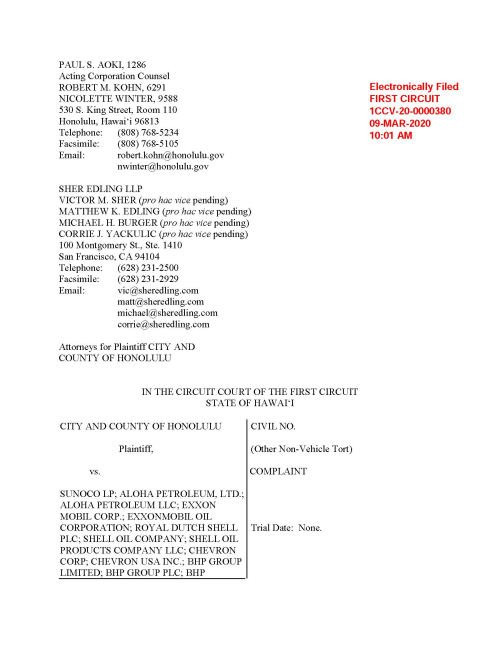
Complaint front page

Make what you will of this 205-paragraph, 114 page (including 128 footnotes) Complaint, filed yesterday by the Acting Corporation Counsel for the City and County of Honolulu and a battery of outside lawyers against gasoline producers, alleging that they are responsible to pay the costs of sea-level rise and other symptoms of what the complaint calls the “climate crisis.”  

It’s a challenging read, but the fun part is in the claims for relief (fast forward to page 99), which include (for you property mavens) nuisance, private nuisance, and trespass (by flooding), as well as affirmative and negligent failure to warn of the dangers of fossil fuel products. 

Will this lawsuit go anywhere? Is a big municipal payday in the cards? Will it get to a local jury? Your guess is as good as ours. But we’ll be following along, for sure.  

Complaint, City and County of Honolulu v. Sunoco

Continue Reading Complaint: Honolulu Sues Gas Companies (For Nuisance) To Recover The Cost Of Sea-Level Rise