This is the second in a series of five posts taking a look at last week’s landmark ruling by a sharply-divided Supreme Court, Knick v. Township of Scott, No. 17-647 (June 21, 2019). Here are the related posts:

In this post, we’ll take a look at the case which finally convinced the Supreme Court that it was time to revisit the Williamson County state-litigation ripeness rule, Knick v. Township of Scott, 862 F.3d 310 (3d Cir. 2017). What we call the Case of the Zombie Zoning Inspectors

* * * *

The Township of Scott, Pennsylvania, apparently

Continue Reading Knick Analysis, Part II: The Court Finds A Vehicle In A Zombie-Zoning Case
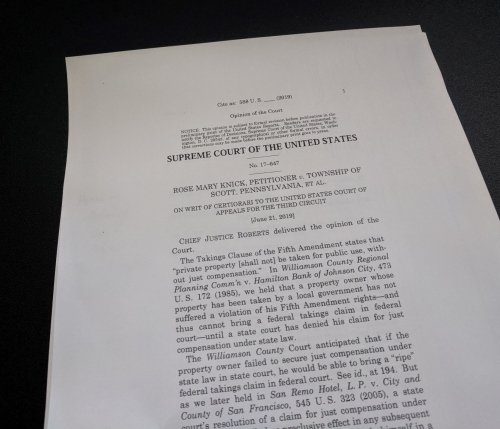
IMG_20190621_150358

This is the third in a series of five posts taking a look at last week’s landmark ruling by a sharply-divided Supreme Court, Knick v. Township of Scott, No. 17-647 (June 21, 2019). Here are the related posts:

In this post, we’ll take a deeper dive into the three opinions: Chief Justice Roberts for the five-Justice majority (Roberts, Thomas, Alito, Gorsuch, Kavanagh), Justice Thomas’ short stand-alone concurring opinion, and Justice Kagan’s dissent (joined by Justices Ginsburg, Breyer, Sotomayor, and Kagan).  

* * * *

BLUFs

Here are the bottom lines up front, the lenses though which we think you should read each of

Continue Reading Knick Analysis, Part III: What It Means To “Take” Property Without Just Compensation – “A bank robber might give the loot back, but he still robbed the bank.”

Ill_be_back

This is the fourth in our series of five posts with thoughts on the landmark decision in Knick. In this installment, the dissent. Related posts:

* * * *

We cannot mask our disappointment with the dissenting opinion. We usually appreciate Justice Kagan’s opinions and measured approach, even while dissenting. And after the first oral arguments in October, we thought there was a chance, albeit slim, that she might see things Ms. Knick’s way.

But even though we were pretty sure she would rule for the government, we didn’t anticipate as vehement a defense of Williamson County‘s “no violation until you sue the government for

Continue Reading Knick Analysis, Part IV: Why Not Let Sleeping Dogs Lie? The Dissent And Stare Decisis

One does knick meme

This is the fifth and last in our series of posts with thoughts on the landmark decision in Knick. In this post, we’ll be puling out our crystal balls, and doing a bit of forecasting. Here are the related posts:

 * * * *

The execrable state-litigation ripeness requirement is overruled. Ding-dong, the wicked witch is dead. No longer will our only federal review of a federal constitutional issue be limited to petitions for cert at SCOTUS. We can “simply” go to federal court. 

So now what?

Continue Reading Knick Analysis, Part V: What’s Next?

A lot is being written about Friday’s Supreme Court opinions in Knick v. Township of Scott, No. 17-647 (U.S. June 21, 2019) (including us). Here’s a sampling. 


Continue Reading Knick Round-Up

Kungfu

We’ll be doing a longer post with our thoughts on the U.S. Supreme Court’s landmark ruling in Knick v. Township of Scott, No. 17-647 (June 21, 2019). But here’s the big picture.

It appears that at least five Justices finally seem to understand what we in the property bar have been saying for decades – that the essence of a federal “takings” claim against a local or municipal government is that “by regulation, you have deprived my property of ‘productive use’ [as Chief Justice Roberts noted on page 14 of the slip opinion], and you have not compensated me.” So it is enough that the government hasn’t paid me, and I have no obligation to “ripen” my federal claim by chasing down the local government for compensation in state court.

So nearly 100 years after Justice Holmes famously opined for the Court in Pennsylvania Coal Co. v. Mahon,

Continue Reading Williamson County Overruled: After Nearly A Century, Supreme Court Finally Has Figured Out What A Regulatory Takings Claim Looks Like

One does knick meme

Property lawyers, dust off your Federal Rules of Civil Procedure, and federal judges your long vacay from dealing with regulatory takings and inverse condemnation cases is over, because this just in: by a 5-4 margin (Chief Justice Roberts authored the majority opinion, with Justice Kagan writing the dissent), the U.S. Supreme Court today finally (finally!) overruled the state-litigation prong of the Williamson County ripeness doctrine. Knick v. Township of Scott, No. 17-647 (June 21, 2019).

Yes, overruled. Not trimmed around the edges. Overruled. 

Here’s what our quick skim turns up as a critical passage:

The Court in Williamson County relied on statements in our prior opinions that the Clause “does not provide or require that compensation shall be actually paid in advance of the occupancy of the land to be taken. But the owner is entitled to reasonable, certain and adequate provision for obtaining compensation” after a taking.

Continue Reading “The state-litigation requirement of Williamson County is overruled.”

Here’s what we’re reading today:

  • New Ruling In Maui Water Case Still Doesn’t Resolve Old Dispute (Honolulu Civil Beat) – about the Hawaii Intermediate Court of Appeals’ recent unpublished memorandum opinion in a long-ongoing water law fight on Maui. The long and the short of it is the court held that whether a short-term license from the State to use water (month-to-month, max one-year as the statute requires) is “temporary” or not (these licenses have been renewed for 18 years to allow the administrative process to be completed) is a factual question that can be resolved by summary judgment. Court held no. In our view, these things operate much like preliminary injunctions, which although they are temporary in nature, can stretch out for quite a long time while the wheels of justice grind. Cert application to the Hawaii SCT coming, for sure. Any guesses on which way this will come


Continue Reading Thursday Round Up: Hawaii Water Law, “New” Property, The Edge Denied!

With the opinion in the Knick v. Township of Scott case to drop as soon as Tuesday (we’re guessing the opinion will be by Chief Justice Roberts, by the way), hold on: we’re about to get super nerdy here. Impossibly nerdy. Yes, we’re revisiting the Star Trek analogies. We’ve been down this road before, even going so far as to have a colleague (who is perhaps even further down the rabbit hole than we are) present a takings CLE in his Starfleet uniform

The bottom line is this (and if you are not into Trek, you can stop right here): to us the key question which the Court is grappling with is whether a state’s judiciary is part of the state’s compensation system. If the majority of the justices conclude that it is, then don’t expect an out-and-out overruling of Williamson County, only a modest trim

Continue Reading Shaka, When The Walls Fell: Yes, Knick Will Be About Takings, But It Will Be More About Federalism

2wnyt3

Pop quiz: Quick! Name the races in the Triple Crown of horse racing… There’s the Kentucky Derby (check) … the Belmont Stakes (check) … and … oh yeah, the Preakness Stakes. We always almost forget that last one. 

But the City of Baltimore sure hasn’t. Because the home city of Pimlico racetrack and the aforementioned Preakness Stakes has sued the owner of the race and track in eminent domain, to take the race so it doesn’t leave town like the Colts did when they bolted for Indianapolis literally in the middle of the nightFool me twice, says Baltimore … shame on me!

Read that again. Baltimore is trying to condemn a horse race. A freaking horse race. (Before we posted this, we checked our calendar to make sure it wasn’t April 1. Suspected we were getting pranked. Nope. Then we checked with news sources. Found a bunch.

Continue Reading All Your Race Are Belong To Us: Baltimore Is Condemning The Preakness Stakes (We’re Serious)