


Here’s the decision in a case we’ve been following from afar in which our colleagues Anthony Della Pelle and Robert McNamara are on the side of property owners, Borough of Glassboro v. Grossman, No. A-4556-17T2 (Jan. 7, 2019). 

This is redevelopment, New Jersey style. We ask that you read the opinion (it isn’t terribly long, and it is worthy of your perusal in its entirety), but here’s the bottom line:

[W]e hold that if a landowner within the redevelopment area contests the necessity of a condemnation pursuant to N.J.S.A. 40A:12A-8(c), the statute logically requires the condemning authority to articulate a definitive need to acquire the parcel for an identified redevelopment project. That articulated need must be more specific than the mere “stockpiling” of real estate that might, hypothetically, be useful for a redevelopment project in the future. In addition, the condemning authority in such a contested case must present

Continue Reading NJ Appellate Division On Land Banking: “Take Now, Decide Later What To Do With It” Isn’t Good Enough

Retroactive continuity — or “retconning” — is, according to that authoritative source Wikipedia, a “literary device in which established facts in a fictional work are adjusted, ignored, or contradicted by a subsequently published work which breaks continuity.”

For example, compare the real-world explanation for why the 1960’s Star Trek show’s Klingons didn’t have butt heads, but the later-produced shows and movies did. The real-world reason was that the TV show had a bare-bones budget, so couldn’t afford the required intricate make-up. The later-produced stuff, having larger budgets, could. But to those concerned with an in-universe explanation that had to line up with the production realities, it turned out to be a big source of contention. Fandom as well as the later shows’ writers struggled to come up with a narrative that accounted for both Klingons with butt heads, and those without

Sorry for the impossibly nerdy

Continue Reading Knick And Klingon Foreheads: Retconning Williamson County

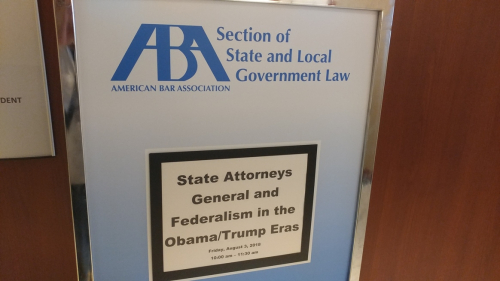
20180803_104034_HDR

One of our last acts as Chair of the ABA’s Section of State and Local Government Law was to green light a CLE program at the recent Chicago annual meeting entitled “State Attorneys General and Federalism in the Obama and Trump Eras.”

The title kind of gives it away, but the main topic was the implications of the multitudinous lawsuits brought by states and their attorneys general against actions by the president’s administration, first grabbing headlines during President Obama’s tenure, and now during President Trump’s. And then switching playbooks after the election, it seems.  

20180803_104204_HDR

One of the good things about the CLE programming we do in our Section is that we try and get speakers from all sides of the ideological spectrum. We think we did a pretty good job here, with (left-to-right — geographically above, not ideologically) Wisconsin Solicitor General Misha Tseytlin (Madison, WI), William Hurd (past

Continue Reading Litigation As A Substitute For Legislation? Coverage Of Our ABA Section’s Federalism CLE

Here is the video of last Friday’s oral arguments in a case we’ve been following, in which the owners of a mobile home park successfully challenged a California municipality’s rent control ordinance as a taking.

In Colony Cover Properties v. City of Carson, a U.S. District Court for the Central District of California jury awarded the park owner just compensation, concluding that under Penn Central, the rent control ordinance was a compensable taking. The total award to the park owner, including damages for lost rental income, attorneys’ fees, and interest, was over $9 million. As far as we can tell, this is the first case in which a mobile home park owner has succeeded in obtaining compensation for a taking for rent control.

Predictably, the city went ballistic, and its brief in the Ninth Circuit argues the City is the aggrieved party:

In April 2006, Plaintiff Colony Cove

Continue Reading Video: Ninth Circuit Penn Central Oral Arguments

The latest in the “Map Act” inverse cases out of North Carolina. This is a longer post, but you really will want to read the summary, or just pick up the opinion and read it.

These are the cases in which the N.C. Department of Transportation, under the power of the state’s Map Act, for decades has designated private property for future acquisition for highway corridors, which prevented present use and development, but hasn’t bothered to actually take the properties.

Hundreds of property owners sued in inverse condemnation (the North Carolina Supreme Court denied class action status). More on the issue and the N.C. Supreme Court’s landmark opinion in Kirby v. N.C. DOT, which concluded the properties’ designation was a taking, here. The cases were remanded for trials for what should have been compensation and damages calculations, but the DOT instead sought to reboot the cases, and

Continue Reading NC App: State Does Not Have Sovereign Immunity From Takings: “sovereign immunity must be juxtaposed with the contrary sovereignty of the individual, whose natural rights preceded government and were enumerated in the federal Bill of Rights”

The Sixth Circuit’s opinion in Lilly Investments v. City of Rochester, No. 15-2289 (Jan. 5, 2017) is not slated for publication, but its worth a read anyhow because it involves Williamson County ripeness, and the “final decision” rule. Here’s how the court summarized the case:

This case concerns Louis Leonor’s efforts to open a dental clinic in Rochester, Michigan. The clinic stands nearly complete, but in May 2013 Rochester issued a stop-work order preventing Leonor from finishing and operating the clinic, prompted by an expert’s finding that the clinic does not comply with the conditions of a city permit. That same expert found compliance a few months later after Leonor made corrective changes. Nonetheless, Rochester refused to lift the stop-work order or take an up-down vote on the project unless Leonor waived any legal claims and paid a $40,000 fee. Unwilling to comply with those conditions, Leonor filed a complaint

Continue Reading 6th Circuit: City’s “War Of Attrition” Meant Regulatory Takings Claim Ripe For Federal Review

Last year, we posted about the Brigham-Kanner Conference, the annual meeting at William and Mary Law School where we talk all things property rights and award the Brigham-Kanner Property Rights Prize. (By the way, this year’s conference will be held in The Hague, The Netherlands in October. But more on that soon, in a separate post.)

What we are posting today is a follow-up about Mike Berger’s presentation at the 2015 conference. His article — then only in draft form — is a critique of the theories of the 2015 Brigham-Kanner prizewinner, Harvard lawprof Joseph Singer. Recall that Berger was presented with the prize in 2014 — the first and thus far only practitioner to receive the award — which makes this article even more important.  

Berger’s article is now finalized, and has been published by the Brigham-Kanner Property Rights Conference Journal: “Property, Democracy, &

Continue Reading Must Read: Michael Berger On “Property, Democracy, & The Constitution”

The issue determined by the Texas Supreme Court in In re Lazy W District No. 1, No. 15-0117 (May 27, 2016), was whether — in a case where one governmental entity is trying to condemn another governmental entity’s property — the trial court must resolve the power to take issue before or after the special commissioners determine value. This was, apparently, an issue in Texas.

Here is the court’s description of the case:

The Water District offered the Lazy W $169,218 for the easement, and when the offer was rejected, petitioned for condemnation in the district court. The day after the petition was filed, without notice to the Lazy W, the district court appointed three special commissioners to determine the value of the proposed easement. When the Lazy W learned of the order, and before the commissioners’ hearing, it filed a plea to the jurisdiction, asserting its immunity

Continue Reading Fighting Eminent Domain, Texas Style: Form Your Own Utility District, Plead Immunity

A good story for your weekend reading from the Los Angeles Times, “U2’s The Edge and his decade-long fight to build on a pristine Malibu hillside,” about the rock guitarist’s decade-long effort to build his dream home compound in the exclusive coastal town. Running smack dab in to the California Coastal Commission, this was a clash between a guy who is touted as being “an activist, an artist, that made his money from spreading peace and love in the world,” and people whom you might expect would support a guy like The Edge. 

Yeah, but it’s still filthy lucre, and even Mr. Edge’s donation of a public-access hiking easement and $1 million to maintain it were not enough. 8-4, project denied. 

Not until the Coastal Commission’s Director-For-Life died, and The Edge replaced his project manager with “an artist and sometime model, who had interrupted his architecture career

Continue Reading California Coastal Development In A Nutshell: Hire Jesus – Moses, Actually – To Sell Your Luxe Home Plans, And Become One With The Mountain.

Are you a lawyer and need something to do for the next 6-12 months? Want to make a recommendation to the Department of Land and Natural Resources about whether it should issue a Conservation District Use Permit to the Thirty Meter Telescope project on the top of the Big Island’s Mauna Kea? Want your decision gone over with a fine-tooth comb by the DLNR, the Circuit Court, and the Hawaii Supreme Court? Are you a glutton for punishment? If so, you are in luck: the DNLR is looking for someone to serve as the Hearing Officer for the contested case (administrative trial) about the TMT.

This is the remand from the Hawaii Supreme Court, which invalidated the DLNR’s earlier issuance of a CDUP to build the telescope. Here are the official qualifications for the job:

  • Being an attorney licensed to practice law in the State of Hawaiʻi and in good


Continue Reading State Looking For A TMT Hearing Officer – You Know You Want To Do This