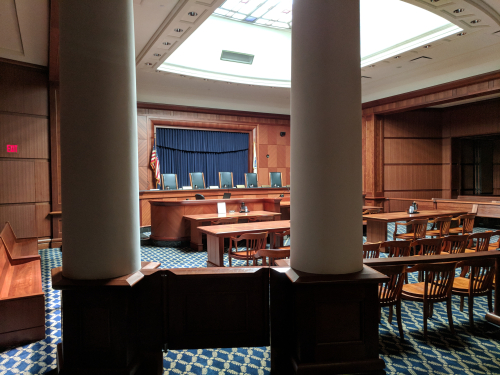
In which we pay a return visit to Clint Schumacher’s Eminent Domain Podcast to catch up with Clint about our new gig, Cedar Point (briefly, since the opinion came down the day we recorded the podcast), just compensation and attorneys’ fees, assessing severance damages in appraisals supporting jurisdictional offers, public use, and our favorite cool courthouses (let’s just say that they range from historic courtrooms to converted doublewide trailers).

If you are not already a regular listener to the Eminent Domain Podcast, you should be! It’s a great one-stop convenient way to keep current on the latest goings-on in the takings business. Continue Reading We Pay A Return Visit To The Eminent Domain Podcast To Talk Takings

License_20131009164108_63618

Another day, another property rights decision from SCOTUS. This time, the unanimous per curiam opinion in a case we’ve been following, Pakdel v. City & County of San Francisco, No. 20-1212 (June 28, 2021).

[Disclosure: our PLF colleague Jeff McCoy is lead counsel on this case, and we pitched in with help on the petition and related.]

Because we’re directly involved in this one, we’re not going to take a deep dive analysis. But the opinion is short, and the result clear: grant, vacate, remand, with instructions:

On remand, the Ninth Circuit may give further consideration to these claims in light of our recent decision in Cedar Point Nursery v. Hassid, ante, p. ___.

Slip op. at 3, n.*.

The Pakdels sued San Francisco for a regulatory taking because of the city’s requirement that as a condition of converting a tenancy-in-common to a condominium, the owners must

Continue Reading Another SCOTUS Property Rights Win, This Time On Williamson County’s “Final Decision” Requirement

More good takings news, hot off the press.

Before Cedar Point came down last week, we were all set to let you know about the Eleventh Circuit’s opinion in South Grande View Dev. Co., Inc. v City of Alabaster, No. 18-14044 (June 21, 2021), in which the court affirmed a jury verdict that the city’s reduction in the developable density on residential-zoned parcel (from R-7 and R-4) to R-2) was a Penn Central regulatory taking. 

The city appealed on an evidentiary issue, arguing that the jury should not have heard evidence of its reasons for downzoning the property, which were not relevant to the takings question and only went to whether the government acted arbitrarily and capriciously (a due process inquiry). The city also raised a ripeness question: the owner had not sought a variance from application of the new zoning, and indeed had never asked the city

Continue Reading 11th Circuit Affirms Penn Central Jury Verdict For Rezoning Resulting In 86% Loss Of Value

IMG_20180720_152126_1

A short, land-usey one today, from the Massachusetts Supreme Judicial Court. In Styller v. Zoning Board of Appeals, No. SJC-12901 (June 7, 2021), the court held that the plaintiff’s “occasional” use of a home to rent to others short-term is not a legal primary use of property in a “single residence’ zoning district.

The facts were not in dispute:

  • 5,000 sf, five bedroom, single-family home, three acres of land
  • “single-residence” zoning district
  • owner rented premises 13 times, totaling 65 days
  • rentals were between 2 and 15 days
  • most were 5 days or less
  • use during the rentals: reunions, board meetings, business retreats,

The town cited the owner, and the Land Court agreed that these uses were illegal “additional” uses because they constituted unauthorized use either as a boarding house or a tourist home. 

The owner appealed, and the SJC took over the case. The owner argued that these uses

Continue Reading Euclid Lives! Mass SJC: “Short-Term” Rental Is Not A Permissible Primary Use In A Residential Zone Because Not Of “Residential Character”

IMG_20180720_152126_1

A short, land-usey one today, from the Massachusetts Supreme Judicial Court. In Styller v. Zoning Board of Appeals, No. SJC-12901 (June 7, 2021), the court held that the plaintiff’s “occasional” use of a home to rent to others short-term is not a legal primary use of property in a “single residence’ zoning district.

The facts were not in dispute:

  • 5,000 sf, five bedroom, single-family home, three acres of land
  • “single-residence” zoning district
  • owner rented premises 13 times, totaling 65 days
  • rentals were between 2 and 15 days
  • most were 5 days or less
  • use during the rentals: reunions, board meetings, business retreats,

The town cited the owner, and the Land Court agreed that these uses were illegal “additional” uses because they constituted unauthorized use either as a boarding house or a tourist home. 

The owner appealed, and the SJC took over the case. The owner argued that these uses

Continue Reading Euclid Lives! Mass SJC: “Short-Term” Rentals Is Not A Permissible Primary Use In A Residential Zone Because Not Of “Residential Character”

Screenshot_2021-05-15 18th Annual Brigham-Kanner Prize Recipient

Mark your calendars for September 30 – October 1, 2021, and join us at the William and Mary Law School in Williamsburg, Virginia for the 18th Annual Brigham-Kanner Property Rights Conference. It’s planned to be in-person, so when we mean “join us” we really mean join us.

This year the Conference will recognize the lifetime work of Professor Vicki Been (NYU Law) with the Brigham–Kanner Property Rights Prize. As noted in the Law School’s press release:

The Brigham-Kanner Property Rights Prize is named in honor of the lifetime contributions to property rights of Toby Prince Brigham, founding partner of Brigham Moore, LLP, and Gideon Kanner, professor of law emeritus at Loyola Law School in Los Angeles. Brigham died earlier this month in Miami. A true legend in the law, he was esteemed by colleagues for the invaluable counsel, knowledge and skills he possessed and shared so generously. The prize

Continue Reading Mark Your Calendars: 2021 Brigham-Kanner Property Rights Conference, Williamsburg, Virginia, Sept 30-Oct 1 (in-person)

We’re hoping that someone can explain the Florida District Court of Appeal’s recent opinion in Bondar v. Town of Jupiter Inlet Colony, No. 4D19-2118 (May 5, 2021) in a way that makes sense other than the old apocryphal tale of “I don’t know why we do things this way, except that we’ve always done things this way.”

Before we get to the details, a slight detour. This is another one of those cases about substantive due process. Now don’t get us started on that one — we get that it might seem odd to suggest that the Fourteenth Amendment’s Due Process Clause limits the government’s power beyond requiring fair procedures. After all, the words are right there in the text: “nor shall any state deprive any person of life, liberty, or property, without due process of law.” But work with us here: we’ve always viewed the phrase much

Continue Reading Fla App Doubles Down On That Weird Property Isn’t “Property” Thing

Order

This In Chambers Order recently issued by a federal district judge may just be the most unusual, flat-out wild judicial opinion we have ever read.

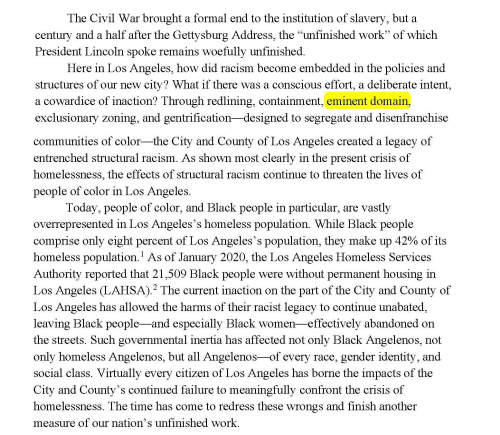
Citing the Gettysburg Address, Brown v. Board of Education, systemic racism (including eminent domain) systemic sexism, and a slew of newspaper articles, the Central District of California (without even holding a hearing), issued a preliminary injunction ordering Los Angeles to immediately address the homeless problem, including ordering that “$1 billion, as represented by Mayor Garcetti, will be placed in escrow forthwith, with funding streams accounted for and reported to the Court within 7 days.” Order at 107.

The city is also ordered to halt any public land sales, figure out how to use said land for the homeless, and report to the court how to address “structural barriers (including but not limited to redlining, highway construction, eminent domain, and health exposure)[.]” Id. at 108.

Continue Reading A Federal Court’s Extraordinary Shot Across The Bow: LA’s Massive Homeless Problem Is Caused (In Part) By Eminent Domain

We suggest you take a read through the California Court of Appeal’s opinion in Felkay v. City of Santa Barbara, No. B304964 (Mar. 18, 2021). It’s all there: Lucas wipeout takings, futility and exhaustion, coastal zone property rights.

This is an inverse condemnation case, seeing compensation for the city denying the owner any economically beneficial use of his property, because it was on a bluff face. Under the city’s ordinances, bluff faces can’t be built on. The planning commission staff said so, but they also recommended to the commission that this would be a taking, and the commission should therefore employ the takings safety-valve provision in the ordinance which allows the city to approve development if denial would be a taking (to paraphrase that old lung-dart commercial, “it’s better to switch than to fight”).

“No deal” the commission said, rejecting staff’s recommendation, “we’ll show ’em who is boss!

Continue Reading Cal App: Taking Verdict Affirmed – When City Asserts That Its No-Development Law “trumps whatever you might submit,” It Would Have Been Futile For Property Owner To Submit Development Application

Dig this: property owners assert that the County’s right of way dedication ordinance is an unlawful exaction. You know the drill – logical nexus, rough proportionality, etc. Nollan, Dolan, Koontz. Here’s the short story: the owners sought subdivision plat approval without the dedication for public roads required by the ordinance. No deal. The County’s process allows for consideration of variances based on extraordinary hardship. The owners assert that the variance procedures violate their right to procedural due process. The District Court granted the County summary judgment.

In Pietsch v. Ward County, No. 20-1728 (Mar. 16, 2021), the Eighth Circuit affirmed. This is a Nollan/Dolan/Koontz claim. The property owners disavow that they are raising a takings claim. But you can’t fool us, property owners, we know a takings claim when we see one. “Plaintiffs’ due process and unconstitutional conditions claims are an impermissible attempt to recast a Takings claim.” Slip

Continue Reading CA8: You Can’t Fool Us, Property Owner, We Know That Nollan/Dollan/Koontz Claim Isn’t A Due Process Or Unconstitutional Conditions Claim, But Really A Takings Claim