Read the allegations in the complaint that the Illinois Appellate Court recounted in Strauss v. City of Chicago, No. 1-19-1977 (Mar. 5, 2021), and they will make your hair curl in horror.

In short: a family rented the ground floor of its mixed residential-commercial building in Chicago to Double Door Liquors (a live music venue). The local alderman “had a personal and financial relationship with the Double Door’s owners.” Slip op. at 3. He “told defendant that only Double Door would be allowed in the building.” Id. (It’s good to have friends, no?) But Double Door was not an ideal tenant, and the noise, drug and alcohol use, and property damage by patrons were a problem to the owners and neighbors. So the owners evicted the club. 

So, according to the family’s complaint, the alderman struck back. Read pages 3- 6 for the details. If true, the allegations are
Continue Reading Complaint Alleged That Chicago Pol Zoned The Chicago Way – But Still No Taking Because Family Owners Only Lost $1 Million

How about buying what you thought was a retirement home, only to be told that if you want the local government’s ok change the form of ownership of the property you’ve got to offer any tenant a lifetime lease? Here’s the cert petition, filed today in a case we’ve been following for a while, first as an outside observer, now as a (minor) participant.

This one seeks review of the Ninth Circuit’s ruling in Pakel v. City and County of San Francisco, in which a 2-1 panel affirmed the dismissal of a regulatory takings claim which the District Court threw out for not being ripe under Williamson County‘s “state procedures” requirement, and because the exaction imposed was accomplished by a generally-applicable legislative requirement and not via an administrative action. The Ninth Circuit rejected en banc review with beaucoup judges dissentaling.

Here are the Questions Presented:

Continue Reading New Cert Petition: “Final Decision” Takings Ripeness, Exhaustion; Unconstitutional Conditions & Legislative Exactions

Regulatory takings challenges are no doubt tough. Especially Penn Central regulatory takings challenges. Facial Penn Central regulatory takings claims, moreso.

The U.S. Court of Appeals’ opinion in Clayland Farm Ents, LLC v. Talbot County, No. 19-2102 (Feb. 9, 2021) – the latest in this case we’ve been following – proves the point. The court affirmed the district court’s summary judgment on the property owner’s takings, due process, and civil conspiracy claims.

The property owner brought its claims in Maryland state court claiming, among other things, that the County’s two indefinite moratoria on development and sewer availability — which prohibited owners from seeking or obtaining County subdivision — was a facial taking:

Clayland’s appellate briefing asserts that Bill Nos. 1214, 1257, and 1229 constitute a facial regulatory taking under both federal and state law. Bill No. 1214 temporarily reduced the permissible density of VC-zoned properties from four units per acre

Continue Reading CA4: No Facial Penn Central Taking By Development Moratoria

Goofus-gallant

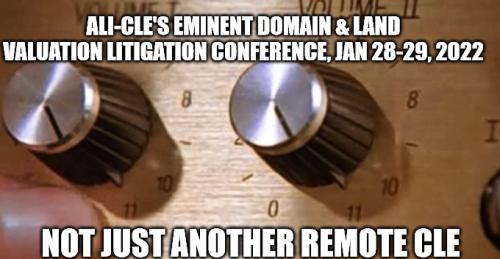
Yes, it starts tomorrow, Thursday, January 28, 2021, but we’re “remote” this year, so it is not too late to register to join us for the 38th Annual ALI-CLE Eminent Domain & Land Valuation Litigation Conference. This is the “big one” where the nation’s best practitioners, scholars, jurists, and other industry professionals gather to talk shop about the subjects we know and love.

Details here (ALI-CLE’s page with faculty, agenda, and times), or here (a recent episode of Clint Schumacher’s Eminent Domain Podcast, where we preview the Conference). Here’s your chance to be a part of what is the best conference on these topics.

We have set it up to take advantage of the remote format, and tuition has been reduced (thank you to ALI-CLE for recognizing this, and for our sponsors for being so generous). We’re seeing a lot of first-time registrations, and this is a great opportunity

Continue Reading Still Time To Join Us: ALI-CLE Eminent Domain & Land Valuation Litigation Conference (Online!) This Thursday & Friday. Tuition Deals! #EminentDomain2021

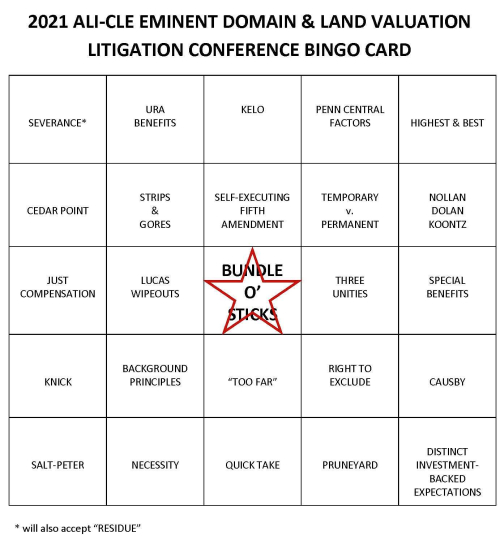
ALI-CLE 2021 Bingo card

If you “get” this, you should be registered for the 38th Annual Eminent Domain & Land Valuation Litigation Conference, to be held remotely on Thursday and Friday, January 28-29, 2021.

The list is growing rapidly, and you need to join us!

This is the “big one” where the nation’s best practitioners, scholars, jurists, and other industry professionals gather to talk shop about the subjects we know and love. We’re having programs with intriguing subjects such as “Planning to Win: Practical Strategies for a Successful Inverse Condemnation Case,” “How Do I Keep My Firm’s Doors Open When the Courthouse Doors Are Closed? Making Your Practice More Efficient When You Can’t Try Cases,” “Where Is the Supreme Court Headed on Takings Cases? Regulatory Takings Update and Cedar Point Preview,” “No Show and All Tell: Breaking News in Property Rights and Takings,” “More Than the Fifth Amendment: Other Tools for Upholding

Continue Reading Your 2021 ALI-CLE Eminent Domain & Land Valuation Litigation Conference (Jan 28-29, Remote) BINGO Card

1o 11 ALI-CLE

Are you a law student interested in takings, eminent domain, land use, environmental, and other dirt-lawyering related topics? If so, good news: thanks to the generosity of ALI-CLE, you can register gratis (free!) for the upcoming 38th Annual Eminent Domain & Land Valuation Litigation Conference, to be held remotely on Thursday and Friday, January 28-29, 2021.

This is the “big one” where the nation’s best practitioners, scholars, jurists, and other industry professionals gather to talk shop about the subjects we know and love. We’re having programs with intriguing subjects such as “Planning to Win: Practical Strategies for a Successful Inverse Condemnation Case,” “How Do I Keep My Firm’s Doors Open When the Courthouse Doors Are Closed? Making Your Practice More Efficient When You Can’t Try Cases,” “Where Is the Supreme Court Headed on Takings Cases? Regulatory Takings Update and Cedar Point Preview,” “No Show and All Tell:

Continue Reading Law Students: Register Free For The 38th Annual ALI-CLE Eminent Domain & Land Valuation Litigation Conference (Jan 28-29, 2021)

Our thanks to Clint Schumacher for having us on his program to talk about the upcoming Conference. We’re “remote” this year, but that means a different approach to our presentations (and a very modest tuition!).

We’re having programs with intriguing subjects such as “Planning to Win: Practical Strategies for a Successful Inverse Condemnation Case,” “How Do I Keep My Firm’s Doors Open When the Courthouse Doors Are Closed? Making Your Practice More Efficient When You Can’t Try Cases,” “Where Is the Supreme Court Headed on Takings Cases? Regulatory Takings Update and Cedar Point Preview,” “No Show and All Tell: Breaking News in Property Rights and Takings,” “More Than the Fifth Amendment: Other Tools for Upholding Property Rights,” “Evaluating Lockdown, Moratorium, and Emergency Claims,” and more (including Ethics for those of you in MCLE jurisdictions). We’ll have a post with more details. 

Register now!Continue Reading Eminent Domain Podcast’s Preview Of The Upcoming ALI-CLE Eminent Domain & Land Valuation Litigation Conference

The Town of Fort Myers Beach, Florida, barred the sale of alcohol on beaches in 1995. Turns out that a beachfront business was already (legally) selling alcohol on its property at the time of the ban. And we know what that usually means: a grandfathered nonconforming use.

Today’s case from the Florida District Court of Appeal (Second District), Persaud Properties FL Investments, LLC v. Town of Fort Meyers Beach, No. 2D19-1282 (Dec. 11, 2020), is at the intersection of two of our favorite subjects, land use and inverse condemnation.

No one questioned whether Persaud possessed a nonconforming use. The issue was whether it had it abandoned it when it closed the establishment “to begin extensive renovations.”

The Town was well aware of the renovations as various construction permits had to be issued and inspections had to occur; additionally, during the renovation period, multiple stop-work orders were issued by

Continue Reading Florida: You Can’t Unintentionally Abandon A Nonconforming Use

A short one from the Virginia Supreme Court. In Palmyra Associates, LLC v. Comm’r of Highways, No. 191680 (Dec. 17, 2020), the court upheld the exclusion of evidence about a property’s “before” condition in a partial take case, concluding that the proffered evidence of the property’s development potential was too speculative. Or, more accurately, that the trial court did not stray beyond its wide discretion to keep the evidence out.

VDOT needed a portion of Palmyra’s property for a roundabout. The big question was the damage to the remainder (or “residue”) property and its highest and best use. Owner said commercial development; VDOT said existing use.

The owner offered testimony that it intended to develop the property (consistent with the County’s general plan), and had drawn up site plans years ago. But it had not secured entitlements, and further government approvals were needed before those plans could come to

Continue Reading Trial Court Had Discretion To Exclude Unapproved, Conditional, 10-Year-Old Site Plans From “Before” Condition