Here’s the Reply in Support of what we think is a very worthy cert petition, and which responds to the recently-filed BIO.

For the background of the case, check out this post (“What Constitutes a Loss“). The property owner has also summarized the situation thusly in its petition:

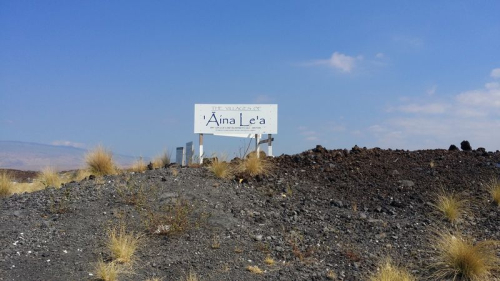
The State of Hawaii zoned for agricultural use land that it knew was not viable or appropriate for such use. At the property owner’s request, it rezoned it for urban use but, after Plaintiff Bridge Aina Le‘a began developing it, the State illegally (as the Hawaii Supreme Court later held) “reverted” the land to agricultural use. A jury found this to be a 5th Amendment taking under this Court’s standards in both Lucas v. South Carolina Coastal Council, 505 U.S. 1003 (1992) and Penn Central Transp. Co. v. City of New York, 438 U.S. 104 (1978).

Continue Reading Reply In Penn Central And Lucas Takings Case
Ainalea

Here’s the State of Hawaii’s Brief in Opposition in a case we’ve been following for what seems like forever.

Check it out. The State waived response, but after a whole bunch of amici filed briefs in support of a cert grant (ours included), at least one of the Justices wanted to hear its arguments in opposition. 

Instead of the State’s “Solicitor General” filing the brief, it hired a SCOTUS player to argue that this case isn’t worth the Court’s time. The need to hire the D.C. big guns with name-recognition instead of relying on the in-house lawyers who are the State’s appellate experts somewhat belies any assertion that the State isn’t concerned about this case. 

Here are the Questions Presented as (re)framed by the BIO:

1. Whether the Ninth Circuit correctly held that Petitioner did not suffer a taking where the State rezoned Petitioner’s property because

Continue Reading BIO In Penn Central And Lucas Takings Case
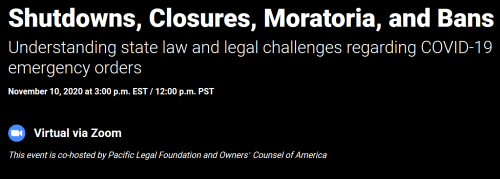
Screenshot_2020-11-05 Legal challenges regarding COVID-19 emergency orders

Join us next Tuesday, November 10, 2020 at 3pm ET (12 noon Pacific) for the free webinar “Shutdowns, Closures, Moratoria, and Bans,” produced by Pacific Legal Foundation and Owners’ Counsel of America.

Along with my colleagues Leslie Fields (Executive Director, OCA), and Jim Burling (PLF), I’ll be talking about the legal foundations for objections, some of the cases that have made their way to decision, and what the future might look like. To register (did I mention it was free?) go here.

Here’s the program description:

Governors and state legislatures across the country have implemented an array of policies in an attempt to contain the virus and its socioeconomic impacts. Many of these policies broadened the scope of government power while placing a heavy burden on property owners and businesses already struggling with the pandemic.

Join representatives from Pacific Legal Foundation and Owners’ Counsel of America as

Continue Reading Join Us: Tuesday, Nov. 10, 2020 (3pm ET, 12n PT) For Free (!) Webinar: “Shutdowns, Closures, Moratoria, and Bans”

This semester, we’re teaching two courses at the William and Mary Law School: the usual Eminent Domain & Property Rights (our regularly-scheduled fall semester course), and Land Use. If we were to try and create a hypothetical for the final exam in either class, we couldn’t do better than the actual fact pattern and arguments presented to the Texas Court of Appeals in City of Dickinson v. Stefan, No. 14-18-00778-CV (Oct. 27, 2020). That case involved a use of property alleged to have been started before the city adopted a zoning code, and claims of vested rights, “grandfathering,” and related.

We won’t recount the entire fact pattern here (we suggest reviewing the entire opinion yourself; it is a decent read), and only note that it covers a range of land use and takings topics, including the aforementioned nonconforming use arguments, exhaustion of admin remedies, and the like. In all

Continue Reading Your Land Use/Takings Exam Hypo: Tex App Considers Nonconforming Uses, Vested Rights, Zoning, Admin Appeals, And Takings

EjqLrfkWAAAB5QF

In between talking about eminent domain-y songs, the goofy cult film “Snakes on a Plane” (yes, we really do have a cast-signed poster of that film in our office), and other fun stuff, we returned to the Pendulum Land Podcast for part II of our guest spot, where we also discussed Virginia Uranium, Inc. v. Commonwealth, No. CL15-623 (July 30, 2020), a recent decision from a Virginia trial court about regulatory takings and “damagings.” 

[Stream the podcast above, or better yet, subscribe and become a regular listener. The podcast is both entertaining and informative.]

The Virginia Uranium case involves a long-standing — but “temporary” — moratorium on uranium mining, and the court’s order analyzes Palazollo, the Salt-peter case (Lord Coke alert!), Penn Central, and Lucas.

The court concluded that the inability to mine uranium was a damaging under the Virginia Constitution because it “directly

Continue Reading In Which We Return To The Pendulum Land Podcast To Talk “Snakes on a Plane,” Eminent Domain Songs, And What Might Be Virginia’s First True Regulatory Takings Case

You know those times you go to the store and try to get a refund on something you’ve purchased, and instead of cash back, you get a gift card, only useable at the same store? Or when, instead of refunding your plane ticket, the airline gives you some limited-time credit for a future flight? Anyone like those?

Well, a fascinating case from the New Mexico Court of Appeals, Premier Trust of Nevada, Inc. v. City of Albuquerque, No. A-1-CA-34784 (Oct. 1, 2020) reminds us of the risks associated with these things.

Albuquerque has an impact fee ordinance which developers must pay to offset the costs of needed infrastructure such as roads, drainage, parks, and public safety facilities. To satisfy the exaction requirement, the property owner could either pay money, build the improvements, or give the city property. If the value of these exactions was more than the impact

Continue Reading NM App: No Property In Impact Fee Gift Card

Here’s the latest development in a case out of Maryland that we’ve been following for a while.

This is the one where Maryland Reclamation Association bought land back in 1990 to operate a rubble landfill. But after the purchase, the County changed its regs to prohibit (guess what) … rubble landfills. Mesne litigation ensued in various tribunals over the years. Eventually, MRA filed a regulatory takings claim under the Maryland Constitution’s takings clause in 2013, and the jury awarded a whopping $45 million in just compensation and interest. Hartford County asserted that MRA should have exhausted its administrative remedies by seeking a variance, and the claim was barred by the three-year statute of limitations because the takings claim accrued in 2007 when the Board of Appeals administratively denied MRA’s variance request.

The Maryland Court of Special Appeals concluded that the “final decision” for purposes of both ripeness and statutes

Continue Reading Cert Petition: Can A State Agency Decide Whether There’s Been A Taking?

IMG_20190925_175845

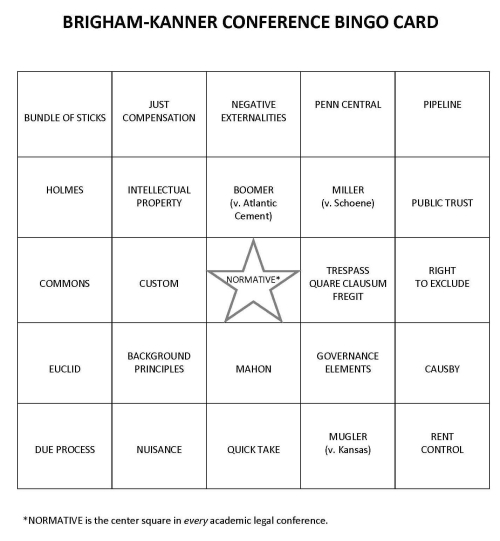
Although it is set to launch this Friday, October 2, 2020, there’s still more than enough time to register (and room at the inn) for you to join us for the 17th Annual Brigham-Kanner Property Rights Conference at the William and Mary Law School.

Like everything else this season, the Conference is online (register here), and although we would have preferred to gather in-person of course, the online format has some advantages: the number of attendees isn’t limited by the classroom size (this year’s registrations are at record levels), you don’t need to travel to Williamsburg, and the Conference is free if you don’t want Virginia CLE credit for attending. What a deal.

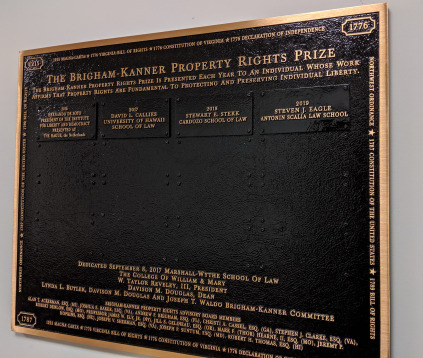
In our opinion, this is the best legal academy/practicing bar conference on property law. This year, the Conference honors the Brigham-Kanner Prizewinner, Harvard Law School Professor Henry Smith.

Here are the panel topics

Continue Reading There’s Still Room: Join Us For The 17th Annual Brigham-Kanner Property Rights Conference (Online, Free!)

News just in: we’ve just received confirmation that the Conference will not be in-person in Scottsdale in January 2021, and we’re going online.

Not a big surprise, but still a bit disappointing, and it’s a shame that the circumstances won’t allow us to meet in-person to talk shop and to renew our friendships like we do every year. 

But rest assured we’re making lemonade out of these lemons, and we’d appreciate everyone holding the dates on your calendars to join your colleagues from across the nation for the online Conference. And no, we’re not going to do two-and-a-half-days remotely, we’re paring down the agenda and will be focusing on hot topics, and great presenters. The remote format has some advantages, and we’re taking advantage of the circumstances to plan a conference more interactive and a bit different than usual.

This will also be a great program for first-time Conference participants.

Continue Reading Breaking: News About The 2021 ALI-CLE Eminent Domain & Land Valuation Litigation Conference (Jan. 28-29, 2021)