KingStreet

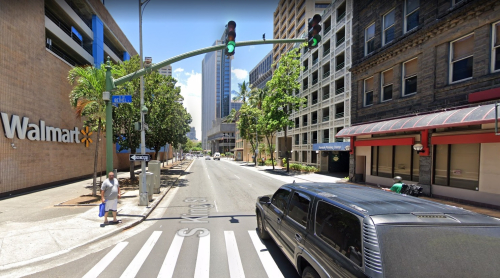
Breaking! In H.C. Cornuelle, Inc. v. City and Cnty of Honolulu, No. 14068 (Haw. July 17, 1990), the Hawaii Supreme Court held that the City and County of Honolulu inversely condemned a strip of private property in downtown when it prohibited development and use of that land because the City intended to acquire it in the future for a road-widening project.

Wait, what? “Breaking,” you say? This memorandum opinion was issued nearly 30 years ago. What gives? Well, we remember this case from back in the day when we were just starting out, but had long forgotten about it. Plus, the same case resulted in one of the first post-Williamson County Ninth Circuit opinions, because the landowners originally sued for the taking in federal court, but were bounced out for ripeness. So they tried the takings case in a Hawaii state court. The Hawaii Supreme Court’s opinion
Continue Reading HAWSCT: City’s Prohibiting Use Of Property Pending City Acquisition Is Land Banking Taking

Please plan on joining us on Wednesday, July 22, 2020, at 1pm ET (10am PT) for a long-form program on “Emergency and Police Power: Property Claims in Times of Crisis.”

Our speakers are Professors Craig Konnoth (Colorado) and John Nolon (Pace), and one of the lawyers on the forefront of the nationwide legal challenges, Harmeet Dhillon (San Francisco). I’ll be moderating, along with Professor Sarah Adams-Schoen (Oregon).

Here’s the program description:

On the eve of the centennial of Pennsylvania Coal Co. v. Mahon (US 1922), this panel will revisit the question: How far can the police power be stretched to protect the public against dangers? The panel will evaluate the scope of state and local authority to respond to emergencies and the implications for private property rights—asking, how far is too far? What is the scope of implied limitations on private property rights in times of crisis? When

Continue Reading July 22, 2020: “Emergency and Police Power: Property Claims in Times of Crisis” (ABA Webinar)

104481738_2170057539806372_2938554143515873721_nphoto: Patricia Salkin

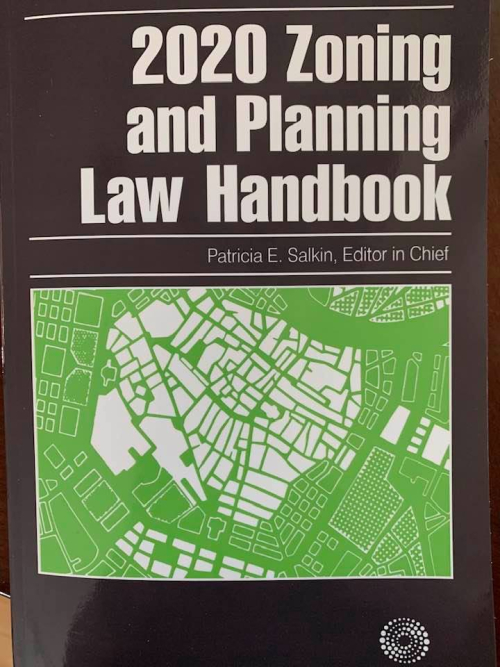
Just published: the 2020 Zoning and Planning Law Handbook (Green Book). The first section of the Summary of Contents is about Takings, and includes as the lead piece Professor Gideon Kanner and Michael Berger’s tour-de-force article, “The Nasty, Brutish, and Short Life of Agins v. City of Tiburon.” It also includes my articles on Murr, “Restatement (SCOTUS) of Property: What Happened to Use in Murr v. Wisconsin?”

Check it out. The Green Book is a one-stop shop for the best articles on land use in a given year, and this edition includes chapters on housing, agriculture, cell tower placement, RLUIPA, and (of course) zoning.

Our thanks to Dean Patty Salkin who edited the volume for including us.

Summary of Contents, 2020 Zoning and Planing Law Handbook (Green Book)

Continue Reading Available Now: 2020 Zoning and Planning Law Handbook (Green Book)

We were all set to dig into the New Jersey Supreme Court’s opinion in Township of Manalapan v. Gentile, No. A-14-19 (June 2, 2020), when our colleague Joe Grather posted about it on their firm’s blog. See also this story (“Manalapan farm owner’s $4.5M eminent domain payday dumped as ‘miscarriage of justice’“) (PS – the video embedded in the story is actually from a different case, not this one). 

The short story is that the property owner’s appraiser opined that the highest and best use of the property was to divide it into smaller lots. The problem was that under its current zoning (RE – “Residential Environmental”) that wasn’t possible. It would need an upzoning to its former designation, R20. But the appraiser did not offer an opinion on whether an upzoning would have been probable, or even possible. During closing arguments, the property owners reminded

Continue Reading NJ: Before Jury Can Make Highest And Best Use Determination, Judge Has “Gatekeeping” Function

Screenshot_2020-05-23 CT CMECF NextGen

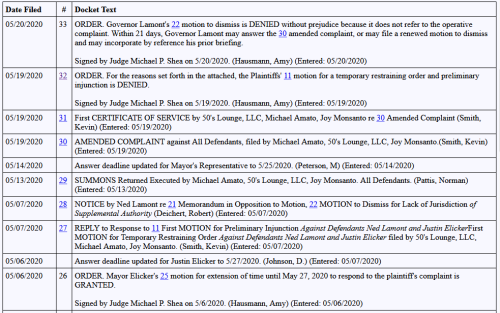
Things moving quickly: remember way back when — in April, was it? — when a Connecticut lounge owner sued a mayor and the governor, asserting that a shut-down order was a taking

Well, the court recently denied the plaintiffs’ request for a temporary restraining order.

There’s nothing in the Ruling about the takings claims as far as we can tell, but we suggest you read it nonetheless because it relies heavily on a U.S. Supreme Court case that has once again become prominent: Jacobson v. Massachusetts, 197 U.S. 11 (1905). That’s the one where the Court held that it was not an unconstitutional deprivation of liberty to require Jacobson to get a vaccine. We think that case and the general sense that courts give a lot of leeway to the other branches when evaluating their responses to emergencies (especially during the emergency) is going to get a

Continue Reading Court Denies Plaintiffs’ TRO In Coronavirus Challenge

WMdoor2

This fall, we’ll be back at the William and Mary Law School (hopefully in-person, depending on the circumstances and the yet-to-be-announced approach to be taken by the College of William and Mary), teaching two of our favorite subjects.

Not only will this be the third time leading Eminent Domain and Property Rights (Law 608), but we’ll also be undertaking another subject, Land Use Control (Law 425). This semester, we’re stepping into the (big, figuratively speaking) shoes of Professor Lynda Butler who recently retired after a stellar and trailblazing career. Thankfully, Lynda is continuing to lead the Brigham-Kanner Property Rights Project and is underway with planning October’s Brigham-Kanner Conference, honoring Harvard lawprof Henry Smith.

Land Use is, of course, related to Eminent Domain and Property Rights, but the law school understands that they are each worthy of separate study, and they should not be folded into a single course (or

Continue Reading Land Use Also On The Fall Semester Agenda At William And Mary Law

Screenshot_2020-05-12 William Mary Law Review

Looking for some property and takings scholarly reading while you cool your heels at home? Well, the William and Mary Law Review has recently published no less than three worthy pieces, all available for download.


Continue Reading Three New Property And Takings Articles From William & Mary Law Review

LUI 2020 slider

Join us starting tomorrow, Tuesday, May 12, 2020 for the 34th Land Use Institute. Originally scheduled for April in Tampa, we obviously couldn’t do tha, so we did the next best thing — moved this venerable course online. The Planning Chairs (Frank Schnidman and Dean Patricia Salkin) have assembled the usual hot topics session and a lineup of expert faculty (we’re speaking at the 2:45 ET session on Federal Laws (in our case, NEPA, Water, and Wetlands (including the Maui case from SCOTUS)). 

The program takes place over three days Tuesday, Wednesday, and Thursday, and you can either register for the sessions or all three days, with various discounts if you are a member of the American Bar Association, and even more if you are a member of the Section of State and Local Government Law. 

Here’s the three-day agenda. There is a lot here to like, and we

Continue Reading Join Us This Week: May 12-14, 2020 For (Virtual) Land Use Institute Webinar Series

Here’s the latest in a case we’ve been following. In Pakdel v. City and County of San Francisco, No. 17-17504 (9th Cir. Mar. 17, 2020), a 2-1 panel of the U.S. Court of Appeals held that a federal takings case was not ripe because the plaintiffs had not sought an exemption (“variance”) from the regulation.

Now, the property owners have asked the en banc Ninth Circuit in this petition to consider the issue. The panel decision created a “target rich environment” as they say: 

The panel decision conflicts with the Supreme Court’s decisions in Patsy v. Board of Regents of State of Florida, 457 U.S. 496 (1982), and Williamson County Reg’l Planning Comm’n v. Hamilton Bank of Johnson City, 473 U.S. 172 (1985), and previous decisions of this Court. Dodd v. Hood River County, 59 F.3d 852 (9th Cir. 1995); Mechammil v. City of San Jacinto

Continue Reading CA9 En Banc Petition: Must A Property Owner Exhaust Admin Remedies Before Filing A Federal Takings Claim?

Thanks to a colleague for cluing us in to the first case on the docket today, that brings to mind ferae naturae, Pierson v. Post, and (of course) takings.

In Britton v. Keller, No. 1:19-cv-01113 (D. N.M. Apr. 16, 2020), the U.S. District Court for the District of New Mexico held that the City of Albuquerque could not be liable for a taking of a homeowner’s property when it set up a “trap, neuter, and release” site for feral cats next to her house. As you might expect, setting up a feral cat farm next to your house results in things like “disease vectors, property damage as a result of cat defecation and urination, and property damage from the feral cats themselves[.]” Slip op. at 2.  

We don’t have much to add to that, except to say the court goes about its analysis in the wrong way. First

Continue Reading Hey All You Cool Cats And Kittens: Creating A Feral Cat Colony Next To Your Property Isn’t A Taking