IMG_20191209_125404 (1)

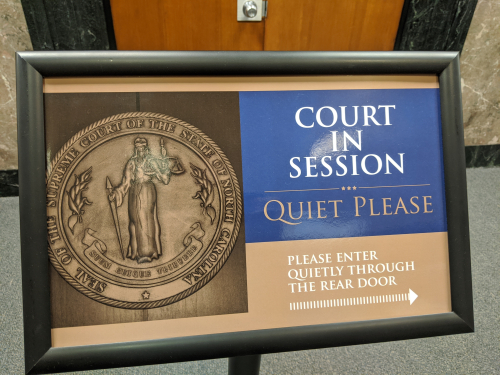
Back in December — only a few months ago, yet it seems like another world away — we attended oral arguments in Raleigh in a case we’ve been following for a long time, about North Carolina’s “Map Act.”

This case is the follow up (after remand) of the N.C. Supreme Court’s landmark decision in Kirby v. North Carolina Dep’t of Transportation, No 56PA14-2 (June 10, 2016), in which the court held that the “Map Act,” a statute by which DOT designated vast swaths of property for future highway acquisition, was a taking because the Act prohibited development and use of designated properties in the interim. The court concluded “[t]hese restraints, coupled with their indefinite nature, constitute a taking of plaintiffs’ elemental property rights by eminent domain.” The court remanded the case for a parcel-by-parcel determination of just compensation. Shortly after the decision in Kirby, the North Carolina Legislature

Continue Reading NC: There Isn’t Just One Way To Value An “Indefinite Negative Easement”

On one hand, there’s a lot going on in the Maryland Court of Appeal’s opinion in Maryland Reclamation Assoc, Inc. v. Harford County, No. 52 (Apr. 24, 2020), a case we’ve been following. The opinion is a whopping 81 pages, and details facts that go back decades. On the other hand, the opinion doesn’t actually say a lot. 

But what it does say is a doozy.

Here’s your BLUF (Bottom Line(s) Up Front):

  • Maryland agencies have jurisdiction to consider and rule on state constitutional issues including takings. Apparently, this is not something the court adopted in this case, but is a long-standing practice in Maryland. Count us as very surprised that agencies have the power to adjudicate constitutional rights. Very, very surprised.  
  • A property owner must raise their Maryland Constitution takings claim and present it for adjudication to very agency accused of taking property without compensation. 
  • The property


Continue Reading Maryland Resurrects California’s Agins Rule: Owner Must Seek Agency Variance, Which If Granted, Means “owner no longer has a takings claim and the right to alternative relief in the form of just compensation”

This morning, the Supreme Court of Virginia heard oral arguments (by telephone) in a case we’ve been following.

This is an inverse case that asks whether less than a total loss of access to a parcel could be taking — did the owner plead enough to put the issue to a jury — and is the government’s mere invocation of a “police power” rationale to cut off access is enough to insulate it from the payment of compensation.

When Hooked proposed to develop its property, the City of Chesapeake closed Callison Drive, the street adjacent to Hooked’s property after the neighbors complained. This cut off Hooked’s direct access to Callison Drive, even though it still had access from and to its property from a second street.

The trial court dismissed (demurred) Hooked’s inverse condemnation claim, concluding that the City was exercising its police power when it closed the street

Continue Reading Supreme Court Of Virginia Oral Arguments In Important Inverse Case: Must An Owner Allege Loss Of All Access To Plead A Taking?

20160114_125445

Here’s an article, just published in the American Planning Association’s monthly magazine, Planning (read the entire April issue here), summarizing the Ninth Circuit’s latest foray into regulatory takings, Bridge Aina Lea, LLC v. State of Hawaii Land Use Comm’n, No. 18-15738 (9th Cir. Feb. 19, 2020).

In Legal Lessons – What Constitutes Loss? we write about the decision and the court’s conclusion that losses short of 100% do not qualify for a per se Lucas taking, and are not enough to tip the scales for a Penn Central taking either. The opinion also adds to the growing confusion about whether the regulatory takings doctrine deals with use or value.  

Our thanks to the APA for asking us to contribute, for making the editing process so easy, and for allowing reprinting of the piece here. Check it out. 

Legal Lessons – What Constitutes a Loss? Planning Magazine (Apr. Continue Reading New Article: Ninth Circuit’s Latest Foray Into Lucas And Penn Central Takings

Real_liberty

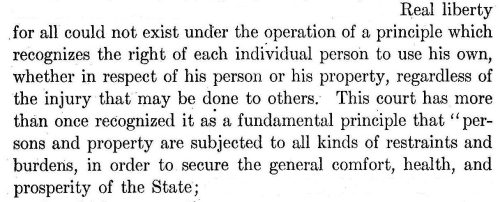
Here’s what we’re reading today, spurred by the headlines swirling around all of us. Mostly cases about the role of the courts when government curtails liberty or property rights under its police or emergency powers. We’ve now seen the first lawsuit claiming that an order to shut down businesses is a due process violation and is a regulatory taking requiring compensation, and we’re hearing about official quarantines, citations for people violating stay-home orders, and the like. 

We started with the vaccination cases. These got us to thinking that if the government can for the most part force people who don’t want vaccinations to get vaccinations (violating their bodily integrity), then how will a court treat seemingly less-invasive intrusions into liberty or property in the name of public health? 

In Jacobson v. Massachusetts, 197 U.S. 11 (1905), the Court distinguished “an absolute right in each person to be, at all

Continue Reading More Readings: “Real Liberty,” Vaccination, Plague, Police Power, And Takings

As long-time readers know, we often kvetch about the way many courts ignore the Palazzolo rule that simply because someone obtains property subject to preexisting restrictions on use does not preclude them automatically from raising takings claims. See here, here, here, and here, for example. More about the Palazzolo case here, including video.

But not all courts get it wrong, however. Now you can add to the plus-column the Florida District Court of Appeal (Second District)’s decision in Jamieson v. Town of Fort Myers Beach, No. 2D19-238 (Mar. 25, 2020).

The court held that a property owner who purchased land that earlier had been designated as 100% “wetlands” on the Town’s land use map was not prohibited from pursuing takings (and since this is Florida, Bert Harris Act) claims. The case is a two-fer, because the court also concluded that the claims were ripe

Continue Reading Talkin’ ‘Bout My Palazzolo: Takings Claim Not Precluded Because Owner Purchased Land Already Subject To Wetlands Regs

Torromeo Industries owned a 12-acre parcel zoned “Industrial.” Two buildings — one a home, the other a 4,000 square foot industrial building — were on the land. Sole access to the property way by a private driveway along the 149 foot frontage of the parcel. Industrial zoning has a minimum lot size of 80,000 square feet, and frontage of 150 feet. Yes, Torromeo’s parcel was one precious foot short of conformity with the frontage requirement.

But land use mavens know what this means: a nonconforming use. So back in 1989, the town’s planning board affirmed that status and that it considered the uses a permitted preexisting use. 

Flash forward to 2015, when the State condemned 2 acres of the land for a service road, along with 30k square feet for easements. This had the effect of subdividing Torreomeo’s formerly single parcel into three lots: (1) a 1/3 acre lot on

Continue Reading NH: Subdivision Of Nonconforming Lot Was Not Reasonably Likely – Availability Of A Variance Is A Factual, Not Legal, Question

Here’s the cert petition we’ve been eagerly awaiting in a case we’ve been following about Seattle’s rewriting of the traditional lessor-lessee relationship.

The petition arose out of facial takings and due process challenges to Seattle’s “first in time” rule for residential leasing. The city adopted an ordinance requiring owners to rent to the first tenant who applies that meets the owner’s screening criteria.

The Washington Supreme Court tossed aside a long line of its own cases which held that the Washington Constitution’s takings clause is not interpreted by the same analysis the U.S. Supreme Court employs for the Fifth Amendment. Not so the Washington court held, we might in the future decide that the Washington Takings Clause provides greater protection, but for the time being we conclude that federal takings doctrine is so clear that we simply adopt it wholesale. (The court based this conclusion on Tahoe-Sierra. Really! Of

Continue Reading New Cert Petition: Seattle’s “First In Time” Tenant Rule Is A Taking And Due Processey

This just in. In Pakdel v. City and County of San Francisco, No. 17-17504 (Mar. 17, 2020), a three-judge panel of the U.S. Court of Appeals for the Ninth Circuit affirmed the dismissal of a regulatory takings claim which the District Court threw out for not being ripe under Williamson County‘s “state procedures” requirement.

Wait, you say, didn’t the Supreme Court toss that requirement out in Knick? Yes, but it also did not disturb the separate requirement that the government charged with a taking have made the final decision applying the regulations to the property which is claimed to have been taken.

The panel thus affirmed on other grounds because the plaintiffs had not obtained an exemption from the regulation. Yes, this is the “variance” argument.  

We’re reading the opinion in more detail, but wanted to push it out quickly so that others weigh in. We’ll have

Continue Reading Williamson County’s “Final Decision” Rule Lives! CA9: You Still Need To Ask The Govt For An Exemption To The Rules

Missed out on the 2021 ALI-CLE Eminent Domain and Land Valuation Litigation Conference swag?

Well fear not: here’s your chance to get your high-class reminder — a kit of road warrior essentials — to save the Conference date on your calendar. We’re already underway with planning the agenda and faculty, so it’s never too soon to block it off (January 28-30, 2021, at the 4-Diamond DoubleTree Resort, Scottsdale, Arizona). 

If you were not able to get your swag in Nashville, send us a note (rht@hawaiilawyer.com) and we shall gladly drop one or two in the mail to you.

While supplies last!  Continue Reading Unboxing The 2021 (Scottsdale) ALI-CLE Eminent Domain Conference Swag: Get Yours Today!