Here’s the latest in a case we’ve been following that involves a local government prohibiting, via a zoning ordinance, the mining of silica (used as “frac sand”). Kind of like how Pennsylvania barred certain coal mining in our old friend, Pennsylvania Coal Co. v. Mahon, 260 U.S. 393 (1922). 

In Minnesota (where our story takes place) the right to subsurface minerals is separate from the rest of the land. Kind of like how Pennsylvania law recognized subsurface rights as a separate “stick” in Mahon. Here, the plaintiff owned several leases which allow it to mine silica. Sounds like a property interest, no? 

Well, no. At least not to a majority of the Minnesota Supreme Court, which held in Minnesota Sands, LLC v. County of Winona, No. A18-0090 (Mar. 11, 2020) (affirming the court of appeals) that the right to mine silica was a property right, but

Continue Reading Pennsylvania Coal Revisited: Outlawing Silica Mining Isn’t A Taking, Even Though Mining Rights Are “Property” Under State Law

Here’s the video of the OA held this morning (March 10, 2020) in a case we’ve been following, about the statute of limitations governing inverse claims. Maryland Reclamation Association filed an regulatory takings claim in 2013, and eventually the jury awarded a whopping $45 million in just compensation and interest. Hartford County asserted the claim was barred by the three-year statute of limitations, and the claim accrued in 2007 when the Board of Appeals administratively denied MRA’s variance request. 

The Maryland Court of Special Appeals concluded that “An inverse condemnation claim ‘accrues when the affected party knew or should have known of the unlawful action and its probable effect.'” Okay, the County responded, MRA discovered the County’s conduct in 2007 when the Board denied the variances. In response, MRA asserted that the taking must become “permanent or stabilized,” and that didn’t occur until the court of appeals affirmed the

Continue Reading Maryland Court Of Appeals Considers Statutes Of Limitations In Inverse Condemnation: Do Appeals Toll Time?

ALICLE-tagline-250x90

At the recent ALI-CLE Eminent Domain and Land Valuation Litigation Conference in Nashville, our colleagues, New York’s Jon Houghton and Hawaii’s Dave Day presented a very informative program on litigating regulatory takings cases. Jon is a property owner-side lawyer, while Dave is a Deputy Attorney General who represents the State of Hawaii in such cases. So it was a practical and balanced presentation.

Well, Jon and Dave are taking (pun intended) it to the next level. On Friday, April 24, 2020 at 2-3pm Eastern Time, they will be presenting “Strategies for Litigating Regulatory Taking Cases” in a webinar produced by ALI-CLE. This isn’t simply a repeat of their Nashville program, but they will be exploring in more detail the practicalities of building and defending these difficult cases. 

Here’s the description of the program:

The U.S. Constitution provides that private property may not be taken for public use


Continue Reading Mark Your Calendars (Friday, Apr 24, 2020): ALI-CLE Webinar – Strategies for Litigating Regulatory Taking Cases

Here’s the latest in a long-running, multi-forum takings case about the development of affordable housing on the Big Island of Hawaii. 

Last we saw, the District Court awarded nominal compensation ($1), after the jury concluded that the State of Hawaii took Aina Lea’s property. The parties cross-appealed: the State argues the district court should have granted the State’s JMOL on liability, while the property owner appealed the $1 judgment. 

Today, the Ninth Circuit reversed the District Court’s ‘s opinion, holding that the district court should have ruled in the State’s favor on liability. The court remanded the case for entry of judgment in the State’s favor (meaning even the $1 just compensation judgment is gone). Bridge Aina Lea, LLC v. State of Hawaii Land Use Comm’n, No. 18-15738 (Feb. 19, 2020).

We’re tied up doing lawyer stuff today, so can’t read or analyze the decision in detail. But once

Continue Reading CA9: Remember That $1 The Court Awarded You For The Jury’s Finding Of A Regulatory Taking? We’re Taking That Away, Too

Profcorner.jpf

Please mark your calendars and join us next Tuesday, February 11, 2020 at 12:30pm ET for the free (for members of the ABA’s Real Property, Trust and Estate Section) webinar, the monthly “Professors’ Corner.”

This one will be on the aftermath of Knick v. Township of Scott, 139 S. Ct. 2162 (2019), in which the Supreme Court formally overruled the “state procedures” ripeness requirement in federal regulatory takings cases. 

We shall be speaking about the case and what’s next along with Professors Stewart Sterk and Michael Pollack (moderated by Professor Shelby D. Green). Here’s the summary of the webinar from the ABA website:

Last term, in Knick v. Township of Scott, the Supreme Court overruled the long-standing requirement that state takings claims first be litigated in state courts. The Court held that a property owner has an actionable takings claim when the government takes property without paying for

Continue Reading Tuesday Feb 11, 2020: Professors’ Corner – The Supreme Shift in Takings Litigation – Knick v. Township of Scott

EOGnEv8W4AAoKnI

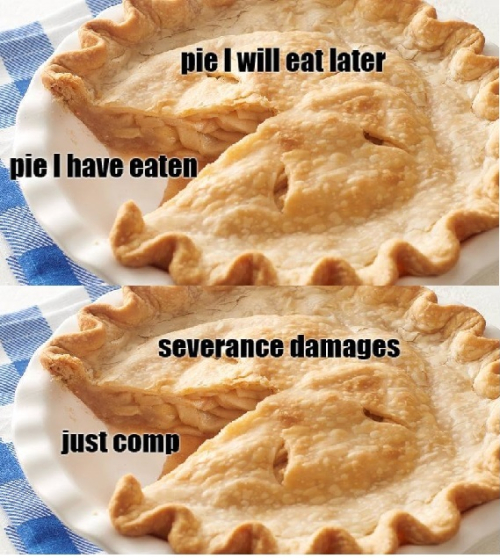
Picture 1: how normal people see pie.

Picture 2: how you see pie if you’re coming to the
ALI-CLE Eminent Domain Conference. 

If you get the above, you probably are already set to join us next week for the 37th Annual ALI-CLE Eminent Domain and Land Valuation Litigation Conference in Nashville. (If not, shame on you!).

And having just reviewed the latest registration list, I can report that we have an all-time record attendance.  But there’s still room for those of you still not committed. Register here. Don’t miss out. There will be pie. Continue Reading Record Attendance (But There’s Still Time For You Last-Minute Filers) At Nashville ALI-CLE Eminent Domain Conference

ELHy3bhUYAAdM4B

If there’s one downside to the law school experience from the teacher’s side of the lectern, it’s grading. Especially at a law school like William and Mary that has a pretty strict mandatory curve.

In an upper-division course like “Eminent Domain and Property Rights Law,” where we’re dealing with some very high-level stuff and the quality of the students is uniformly excellent, that makes for some hard choices at this time of year. But we’ve wrapped up grading, and have submitted the official scores.

Although I cannot share with you all the papers themselves, I don’t think my students would mind if I give you a sampling of the topics and titles, just so you can see how the next generation of lawyers is thinking about this area of law: 

  • One Man’s Castle is Another Man’s Parking Lot: A Homeowner’s Theory of Eminent Domain
  • Native Title: Concept and


Continue Reading The Circle Is Now Complete: A Sampling Of Final Paper Topics From William and Mary Law’s Eminent Domain & Property Rights Course

One does not simply walk to nashville

You can also fly, drive, or bike to the upcoming 37th Annual ALI-CLE Eminent Domain & Land Valuation Litigation Conference. in Nashville. Limited space still available, so don’t delay further and register now. We’re on track to record attendance, so you don’t want to miss the best nationally-focused three-day program on our area of law.

Takings, Knick, compensation, appraisals … and a bit of fun thrown in. We have many new attendees, and many new speakers, too.  Continue Reading (Nearly) Last Chance To Join Us In Nashville For ALI-CLE’s Eminent Domain Conference

Here’s the latest opinion about land use from the Hawaii Supreme Court. Unite Here! Local 5 v. Dep’t of Planning & Permitting, No. SCAP-17-823 (Haw. Dec. 13, 2019).  Because our Damon Key partner Greg Kugle was the prevailing lawyer in the case, we won’t go into detail about the opinion, but leave it to you to delve into it.

It is about procedural due process and the opportunity to object in the administrative appeals process, permit conditions, and the like. Land users, check it out. 

Unite Here! Local 5 v. Dep’t of Planning & Permitting, No. SCAP-17-0000823 (Haw. Dec. 13, 2019) 

Continue Reading HAWSCT: When Agency Includes Conditions In Phase 1 Land Use Permit, But Later Removes The Conditions In Phase 2 Permit, Party Who Asked For Conditions Is Entitled To Notification