Those of you interested in the ongoing debate about vacation rentals (aka TVR’s) (in Honolulu, the minimum period a property owner can rent in a residential district under the zoning code is 31 days, unless the owner possesses a nonconforming use permit) should read the Hawaii Intermediate Court of Appeals’ published opinion in Dao v. Zoning Board of Appeals, No. CAAP-15-565 (Jan. 31, 2019).

You should read the opinion even though it contains a whole lot of detail, because it not only details the applicable law, but also how the City and County of Honolulu Department of Planning and Permitting goes about investigating and prosecuting violations of the ordinance. Let’s just say that the court wasn’t too impressed with the Department’s methods.

The property owner, Mr. Dao, was cited multiple times for renting to tenants for less than the required 31 days. Neighbors dropped dime (this is the source
Continue Reading Hawaii App: Slipshod Investigation By Planning Department Cannot Support Vacation Rental Citation

We’re going to end 2018 with the latest in what we think was the most important issue of the past year (and which, we predict, will be the most important case in takings law for at least a decade when it likely gets decided in 2019), Knick v. Township of Scott, No. 17-647.

That case, as you well know, asks whether a property owner who alleges that a local government action has taken property but hasn’t paid the required just compensation is entitled to bring a lawsuit seeking just compensation under the Fifth and Fourteenth Amendments in a federal court.

Thirty years ago, in Williamson County, the Supreme Court said no. Or at least not until the owner has first pursued compensation via a state’s available procedures to recover compensation, assuming such procedures exist. Add to the mix the rules of preclusion and full faith and credit —

Continue Reading Wrapping Up 2018, And Previewing 2019’s Most Important Case: Final Briefs In Knick v. Township Of Scott

1126181629e_HDR

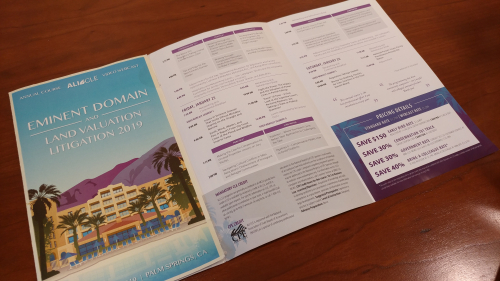
We’re almost there, but we still have room remaining. At the 2018 Conference in Charleston, we both sold out the registrations and the conference hotel, so we planned ahead for the upcoming 2019 Conference in Palm Springs at the Renaissance Palm Springs Resort

Register here. You will also be able to download the print brochure (above), or find out more details about the agenda and faculty on line. As always, we have assembled a great faculty — many of them new speakers — on the hottest topics in eminent domain and takings law: pipelines, jury presentations, challenging the take, an update on the most important decisions of 2018, pre-condemnation planning (from both the condemnor and property owner perspective), the border wall, and relocation. 

And of course, ethics and the “101” track for those new to the field, or experienced lawyers who would like a refresher on the

Continue Reading Space Remaining Is Limited – Register Now For ALI-CLE Eminent Domain And Land Valuation Litigation Conference (Palm Springs, Jan. 24-26, 2019)

Get ready. In this and upcoming posts, we’re going to be featuring the items on our agenda for the upcoming ALI-CLE Eminent Domain and Land Valuation Litigation Conference, January 24-26, 2019, in sunny Palm Springs, California. 

ALI-CLE has released the brochure, which those of you on the mailing list should have received — or will be receiving — in your brick-and-mortar inboxes. If not, download it here. Looking it over, you will see that we have assembled a great faculty with expertise in the range of issues that are driving our branch of the law, locally and nationally.

And, as always, one of the best aspects of this conference is the collegiality. Our attendees and faculty find that one of the most beneficial parts of the conference is to meet your colleagues from across the country, and talk shop about the issues we love.  

Of course we

Continue Reading ALI-CLE Eminent Domain And Land Valuation Litigation Palm Springs Brochure Is Out

Knickrehearing

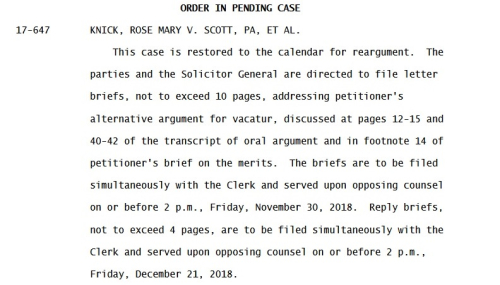
As we guessed immediately after arguments, today in this order the Supreme Court has set the Knick v. Township of Scott case for supplemental briefing, and reargument. 

Here’s the full text of the order:

This case is restored to the calendar for reargument. The parties and the Solicitor General are directed to file letter briefs, not to exceed 10 pages, addressing petitioner’s alternative argument for vacatur, discussed at pages 12-15 and 40-42 of the transcript of oral argument and in footnote 14 of petitioner’s brief on the merits. The briefs are to be filed simultaneously with the Clerk and served upon opposing counsel on or before 2 p.m., Friday, November 30, 2018. Reply briefs, not to exceed 4 pages, are to be filed simultaneously with the Clerk and served upon opposing counsel on or before 2 p.m., Friday, December 21, 2018.

This tells us that there was no clear

Continue Reading More Knick Briefing, Reargument

20181004_152311_HDR

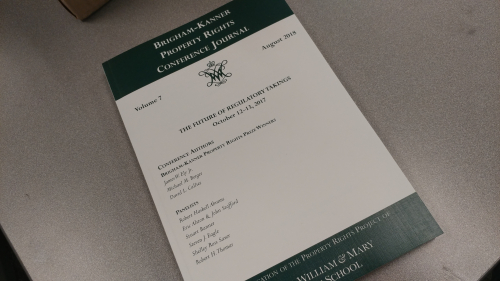
Every year, at the Brigham-Kanner Property Rights Conference, the conference publishes a law journal with the articles, essays, and remarks presented at last year’s conference. So it was this year, and Volume 7, with the theme of “The Future of Regulatory Takings,” is now available

We contributed an essay, “Back to the Future of Land Use Regulation,” which focuses on the rational basis test in land use law — where it came from and where it might be going — as well as some other current issues in property law such as the recent trend of raising general environmental concerns as property claims. Check it out if you are so inclined. 

Here’s the Introduction:

As always, I bring you greetings from the land of Midkiff, the land of Kaiser Aetna. The jurisdiction in which the legislature thought it was a good idea to try and

Continue Reading New Article: Back to the Future of Land Use Regulation – From Hadacheck To “New” Property

Would you pay, say $10 for an undeveloped Maui beachfront parcel that is zoned for hotel and residential purposes, but currently is not developable because the County in the past wanted to condemn the land and turn it into a public park (but then ran out of money)?

In furtherance of its acquisition plan, the County changed the parcel’s Community Plan (known as a “general plan” in most jurisdictions) designation to “park.” But it never amended the Hotel zoning, which allows lesser intensive uses such as single-family homes. But then the County didn’t have enough money — beachfront property, it turns out, was (and is) a lot more spendy than the government appraisers thought — so it never actually acquired the land. But having downplanned the parcel in order to take it, it never bothered uplanning it when it couldn’t: the County never reverted the CP designation to its former

Continue Reading New Amicus Brief In SCOTUS Hawaii Case: Takings Is About Denial Of *Use* Not Whether Property Has Value

20181002_154246_HDR (1)

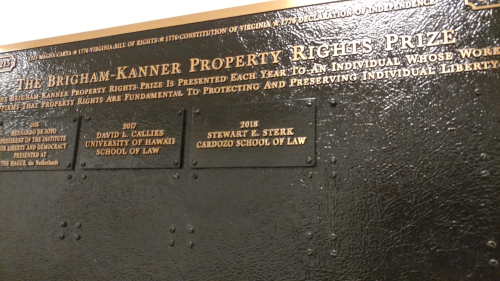
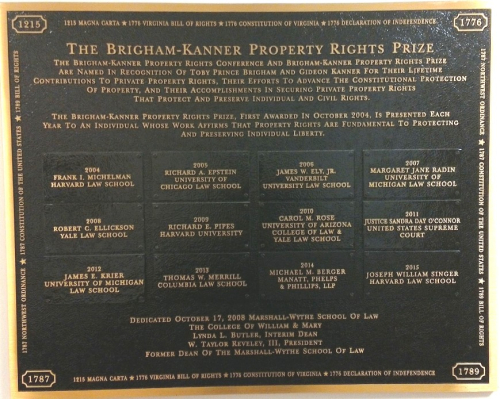
Last week, the 15th Annual Brigham-Kanner Property Rights Conference saw the gathering of legal scholars, judges, lawyers, and law students at the William and Mary Law School to award the B-K Property Rights Prize to Cardozo lawprof Stewart Sterk, followed by a day-long conference focusing on Professor Sterk’s work and the latest developments in property rights law.

Professor Sterk joins the pantheon of property law scholars (and a judge and a practitioner) who have been awarded the Prize. Pretty impressive:

WIN_20151002_13_15_51_Pro

As always, the program starts off with a candlelight dinner and award presentation in the historic Wren Building, definitely a highlight of the Conference. More about the Conference here

And there’s nothing like spending the following day addressing some of the most pressing issues in our area, along with the brightest minds in the business (below is the final panel of the day, with Professor John Echeverria

Continue Reading 2018 Brigham-Kanner Property Rights Conference Report: Emerging Issues

20181003_114518_HDR

Seeking A Cause of Action

It has been just under a century since the U.S. Supreme Court first recognized (in the modern era, that is) the regulatory takings doctrine. You might think that the intervening decades would be enough time to allow the Justices, collectively, to have figured out what a cause of action looks like. You know, just enough to get by a motion to dismiss for failure to state a claim under Rule 12(b)(6).

Unfortunately, yesterday’s oral arguments in Knick v. Township of Scott, No. 17-647 (transcript here, and below), would not confirm that belief.

Our major impression from the argument is that no more than three Justices clearly understand the major difference between an affirmative exercise of the eminent domain power to take private property, and an inverse condemnation action in which a property owner asserts that the exercise of a power other than

Continue Reading Oranges And Tangerines – The Difference Between Eminent Domain And Inverse Condemnation: Deconstructing The Knick Oral Arguments

20170918_192854

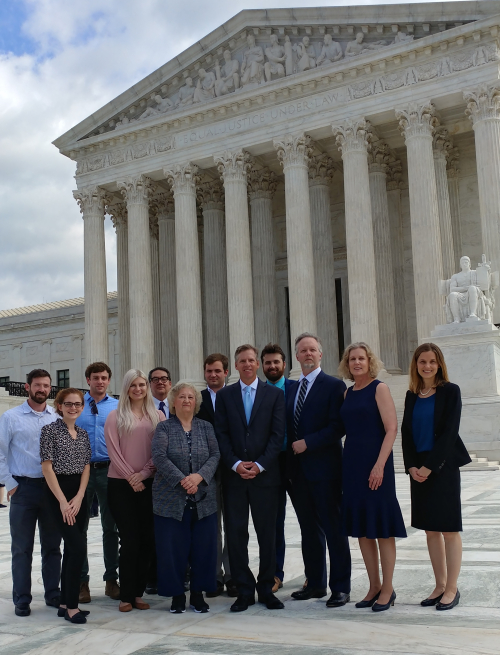
Just out of the Knick arguments. Full report to come later. But for now, these thoughts:

College of Surgeons – D.O.A. I think there’s a consensus to overrule the case to the extent it allows municipalities to remove takings cases to federal court. 

San Remo – On life support. I think also that there may be enough votes to overrule the Catch-22 aspects of that case and the preclusion/full faith and credit trap. 

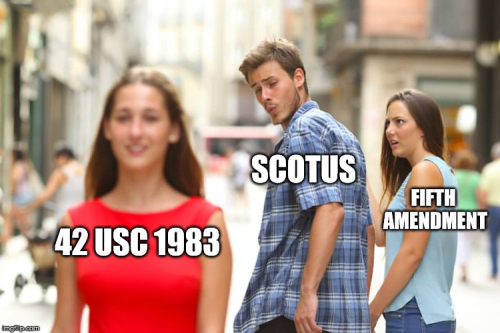
Here’s the federal government’s position, in a nutshell:

2j7vra

Justice Kagan, like us, found that distinction hard to swallow. 

Justice Bryer quote of the day: “why not let sleeping dogs lie?” (Asking about stare decisis.)

As for the “big” issue of whether the Court will overrule Williamson County? Too close to call. We didn’t see an obvious majority forming around anything but overruling Chicago and San Remo. No Justice seemed to like Williamson County too much (except

Continue Reading Meanwhile Back At 1 First Street … Hot Take On The Knick Arguments